
For years, digital marketing relied on creating content, optimizing for keywords, ranking on page one, and collecting the clicks.
But that model is now breaking down.
Driven by the aggressive expansion of AI Overviews and conversational answer engines like ChatGPT, Gemini, and Perplexity, the web is rapidly becoming a walled garden.
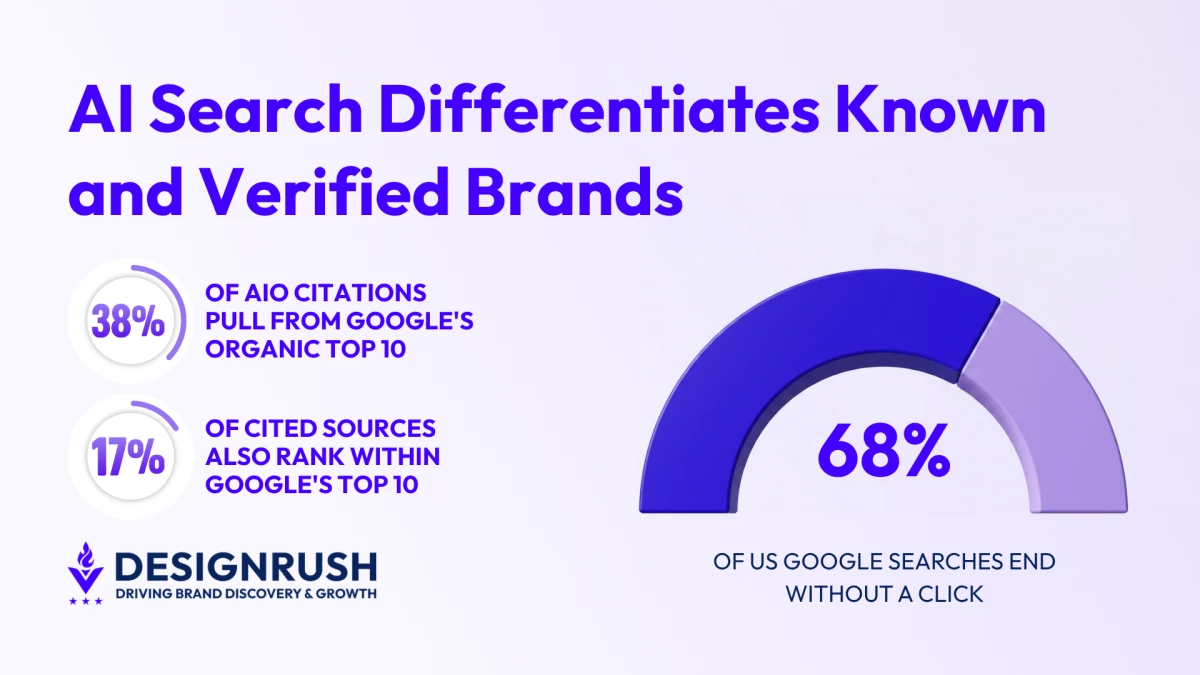
Case in point, a staggering 68% of U.S. Google searches now end without a single click, according to data from Sparktoro.
But this shift reveals an even deeper structural crisis for businesses.
AI search is actively creating a stark divide between brands that are merely known through traditional awareness and brands that are verified by AI models as trusted sources of truth.
If next-generation answer engines don't recognize your brand as a verified authority, you don’t just drop to page two.
You become entirely invisible.
View this post on Instagram
Introducing the "Be Found Framework" Mentality
To survive this shift, organizations must move away from tactical, isolated SEO adjustments and adopt a holistic visibility approach.
This is why we developed our Be Found Framework (BFF).
Visibility is no longer about winning a specific search query. It’s about ensuring next-generation answer engines consistently recognize, validate, and retrieve your brand as the definitive answer.
Instead of treating your website as an isolated island, the BFF mentality views the entire digital ecosystem as an interconnected web of trust.
It focuses on how your brand behaves as an "entity" across multiple platforms, ensuring that when an AI engine searches the web to synthesize a user response, your brand’s perspective is the one it synthesizes.
Keywords Are Out, IR and RAG Are In
Why are traditional SEO tricks failing?
Because legacy strategies like keyword density and superficial blogging are fundamentally obsolete in an environment governed by large language models (LLMs).
AI models rely on advanced Information Retrieval (IR) principles, Knowledge Graphs, and Retrieval-Augmented Generation (RAG).
To be selected as a "source" during this critical RAG cycle, a brand must possess a structured, undeniable, and cross-verified footprint across the internet.
This requires flawless schema markup, consistent digital PR, third-party validation, and highly structured data.
Google’s 2026 algorithm updates shifted heavily to validate this.
View this post on Instagram
The search giant has placed unprecedented pressure on "Entity Depth" within its Quality Rater Guidelines, penalizing thin corporate generic voices and content that lacks an external, verifiable human ecosystem across the broader Knowledge Graph.
If the algorithm cannot cross-verify who you are outside of your own website, you are denied source eligibility.
The New Performance Standard
Because search behavior has shifted from link-clicking to direct answer consumption, traditional traffic metrics no longer paint an accurate picture of success.
Google itself explicitly acknowledged this shift with its recent rollout of official AI Performance Reports within Google Search Console, designed to track impressions and interactions happening exclusively inside AI Overviews and conversational modes.
With the engines themselves shifting the goalposts, the reporting parameters must move beyond traditional clicks to track the two definitive trust validation layers used by next-generation engines:
1. AI Citations (Trust in Your Data)
This occurs when an answer engine references your content as a footnote or inline "Source." An AI citation proves that the engine views your domain as a factual authority, utilizing your data to complete its internal evidence checks.
2. Brand Mentions (Trust in Your Brand)
This occurs when the engine dynamically names your brand directly within the body of its generated response. A brand mention indicates that the model recognizes you as a primary entity and actively recommends your business during its solution check.
Why the Future of Search Must Be Human-Led
Faced with the pressure to build a massive, multi-platform footprint, many marketers make a fatal operational error: they attempt to solve an AI search problem with mass-produced, AI-generated content spam.
At Boostability, we take an uncompromising, proactive stance.
We are fiercely pro-human-led content. While we explicitly optimize for AI search models, we firmly believe that using AI tools to fulfill your content strategy is a catastrophic mistake.
Flooding digital channels with automated, generic messaging does the exact opposite of what answer engines require. It degrades the precise trust signals needed for source eligibility.
The Catastrophic Cost of Automated Scale:
- Erosion of Originality: LLMs prioritize unique data, primary research, and distinct thought leadership.
Mass-produced AI content simply regurgitates existing training data, offering zero retrieval value to a RAG system. If your content sounds like the LLM's own training data, the algorithm has no reason to cite you. - Dilution of Entity Clarity: Automated, unverified content output often introduces logical inconsistencies, factual hallucinations, and weak context.
This blurs your brand’s definition within Knowledge Graphs, tanking your authority.
Building an undeniable web footprint requires deep subject-matter expertise, authentic human insights, proprietary data, and rigorous editorial oversight.
To earn the trust of the algorithms, you must first earn the trust of the audience.
In an era of infinite, low-value automated noise, restraint, human accuracy, and deep authority are the only true competitive advantages left.
If you want next-generation search engines to verify your brand, stop automating your voice and start anchoring your expertise.