-author-avatar_mobile-webp.webp)
Key Takeaways
- Focusing on long-term profitability metrics, new user growth, and ad platform diversity are 2025’s top eCommerce marketing trends brands should adopt.
- As competition grows on traditional platforms, brands are exploring new ones like Reddit, Twitter, and Snapchat to reach untapped audiences.
- To drive growth, brands must target cold audiences, optimize user acquisition campaigns, and leverage tools like AI-powered creative and Marketing Mix Modeling.
Today, brands are under greater pressure than ever to make their marketing budgets work harder and go further, amid market uncertainty that’s largely driven by the political landscape.
With social platforms maturing, privacy updates limiting data, and audience reach becoming more challenging, the old playbook just isn’t enough.
Neon Growth, an award-winning marketing agency, was kind enough to share its insights into the three top trends shaping eCommerce advertising in 2025.
The agency’s strong track record for helping brands across sectors, using a data-driven approach and cutting-edge tools, makes it an expert source on the topic.
3 Top Marketing Trends of 2025
Neon Growth identified three trends that will shape eCommerce marketing in 2025:
- Profitability vs. Vanity Metrics: Brands are focusing on long-term profitability (i.e. Incrementality and Contribution Margins) over vanity metrics, such as return on advertising spend (ROAS).
- New User Growth: Companies are emphasizing the acquisition of new customers by targeting untapped audiences and improving tracking for more effective growth.
- Ad Platform Diversity: Brands are expanding ad strategies to include platforms to reach new, less competitive audiences.
We’ve taken these three broader trends and broken them down even further to give brands actionable insights.
Spending Smarter for Long-Term Profitability
Bottom-line growth is a major focus for brands in 2025. Tighter margins and higher expectations are adding more pressure than ever to make every ad dollar count.
Rather than relying solely on ROAS, brands are taking a broader view of how marketing can contribute to long-term profitability growth.
It’s no longer just about how much a campaign captures but how much lift in revenue it generates — an approach driven by incrementality.
Generating Real User Growth
Brands are concerned with finding new ways to drive authentic user growth.
One key issue is that brands often overspend on warm audiences. These activities are less incremental than advertising to new users.
Instead, they should deliberately push algorithms targeting cold audiences if they truly want new user acquisition.
To achieve this, effective tracking is a must. Pixel data, event triggers, and first-party segmentation are essential for building and scaling new audiences and limiting over spend for repeat customers.
Capturing Fresh Users in New Places
Speaking of tapping into new potential clients, brands are looking for ad platform diversity, moving beyond Google and Meta to discover untapped audiences.
These platforms are still your best bet, so don’t ignore them, but Neon Growth is seeing success on alternative platforms, such as Snapchat, and Reddit.
In particular, Reddit reported its Daily Active Uniques (DAUq) grew by 51% year-over-year, reaching 91.2 million users in 2024, according to the company’s shareholder letter.
This creates opportunities to reach new segments with less competition.
Neon Growth is also closely watching emerging players like AppLovin, a mobile app monetization platform, which shows promise for eCommerce brands ready to scale outside of traditional channels.
Leveraging Emerging Tools and Technologies
For eCommerce companies looking to stay competitive and scale efficiently, Neon Growth highlights the following three technologies and tools:
- MMM Attribution Models: Marketing Mix Modeling (MMM) is essential for measuring the true impact of multi-channel strategies over time. Unlike last-touch attribution, which often over-credits bottom-of-funnel efforts, MMM accounts for upper-funnel and view-through performance, giving a more complete and actionable picture.
- Creative Analysis Tools: Creative performance is a massive growth lever. With the ability to identify what’s working (and what’s not), these tools allow teams to optimize faster and scale winning assets with confidence.
- AI-Powered Creative: From backgrounds and product shots to voiceovers and video b-roll, Neon Growth leverages a robust suite of AI tools to enhance creative output efficiently, improving production quality at scale.
Optimizing Media Strategies to Compete
Companies need to be strategic about how they approach paid media rather than trying to do too many things at once.
This is a common mistake that spreads brands too thin, especially when budgets are limited.
For startups and small businesses, mastering the basics is fundamental. You don’t need to be on every channel, you just need to be really good in one or two.
In fact, many brands can scale up to $100K–$200K per month in spending by focusing solely on Meta and Google before branching out.
To build a strong foundation, Neon Growth recommends:
- Establishing a clear understanding of the target customer, including where they spend time, what they’re doing there, and what they're looking for.
- Defining the brand’s value proposition clearly, with a focus on the specific problem it solves and how it stands apart from competitors.
- Starting with a simple campaign structure supported by creative testing across static, video, and UGC content.
- Concentrating resources on high-impact efforts rather than diluting them across too many channels.
- Expanding into new platforms should only be considered after core channels have been fully optimized and are delivering consistent results.
- Monitoring trends and changes to platforms by subscribing to newsletters, attending webinars, and showing up at industry conferences to stay ahead.
It’s important to consider that expanding and risking into new platforms is possible, but mostly by companies with the budget and the foundations to do so.
Commerce through Meta Shops or TikTok Shops has been lucrative for many brands, yes, but only when those shops are set up correctly and strategically.
Hone in on your target customer: who are they, what channels are they likely to be on, what are they looking for/doing there? What problems do you solve for them? Why should they choose you over competitor solutions?
Answering these questions requires research. For example, here is an infographic from Kantar, a global marketing data and analytics company, showing which platforms users prefer by generation:
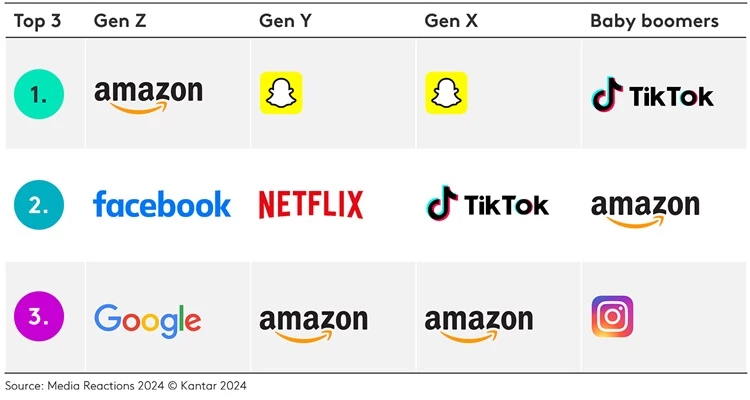
Users of different generations often have different platform preferences, an essential piece of information for marketers targeting specific users.
Leveraging Data to Gain Audience Insights
Success in modern eCommerce advertising hinges on two core pillars:
- Data confidence
- Customer understanding
First, brands need solid data and attribution systems in place. Without reliable insights, brands can't make informed decisions about media planning or performance.
Strong attribution helps identify when campaigns are trending positively and when it’s time to pivot.
Equally important is a deep understanding of the customer. Digital media is about engagement, not one-way communication.
“Digital media is a conversation, and the brands doing well right now understand their customers and their strategies show it.”
In other words, real results stem from tailoring the messaging to resonate with the specific audience.
Ads won’t run in a vacuum. They will be competing with entertainment, social content, and competitor ads.
To stand out, campaigns need to either solve a problem, entertain, or share something new. Ideally, all three.
4 Key Adjustments Brands Should Make in 2025
Brands are rethinking their strategies and making the following adjustments:
- Audience-First Creative: Leading brands are designing ads with their target audience as the primary focus and the product as secondary. By tailoring messaging and visuals to resonate with specific customer segments, they’re seeing stronger engagement and performance.
- Reliable Customer Segmentation: Brands that separate new and returning customers effectively can plan their media strategies around customer lifetime value. This approach enables more efficient budget allocation and drives better long-term results.
From a performance perspective, focusing on segmentation is a no-brainer, as it "makes companies 130% more likely to know their customers’ motivations and 60% more likely to understand their concerns and challenges." - Social Shopping Integration: With social commerce on the rise, top-performing brands are integrating Meta and TikTok Shops into their ad strategies. Allowing users to complete purchases directly within platforms is proving to increase conversion rates across various industries.
- Unified Business Strategy: High-growth brands understand that ad performance is only part of the equation. They align their advertising efforts with broader business operations, optimizing websites, refining offers, and focusing on the full customer experience to maximize results.
The top trends shaping eCommerce advertising in 2025 point to one clear reality: brands need to be more strategic, data-driven, and audience-focused than ever before.
Profitability outweighs vanity metrics, creative strategies need to be built with real users in mind, and platform diversification is essential.
-author-avatar-webp.webp)