
Digital Video Ad Spend: Key Findings
- $72.4 billion in U.S. video ad spend projected, growing up to 3x faster than total media investment, shows why agencies must lead with video in planning cycles.
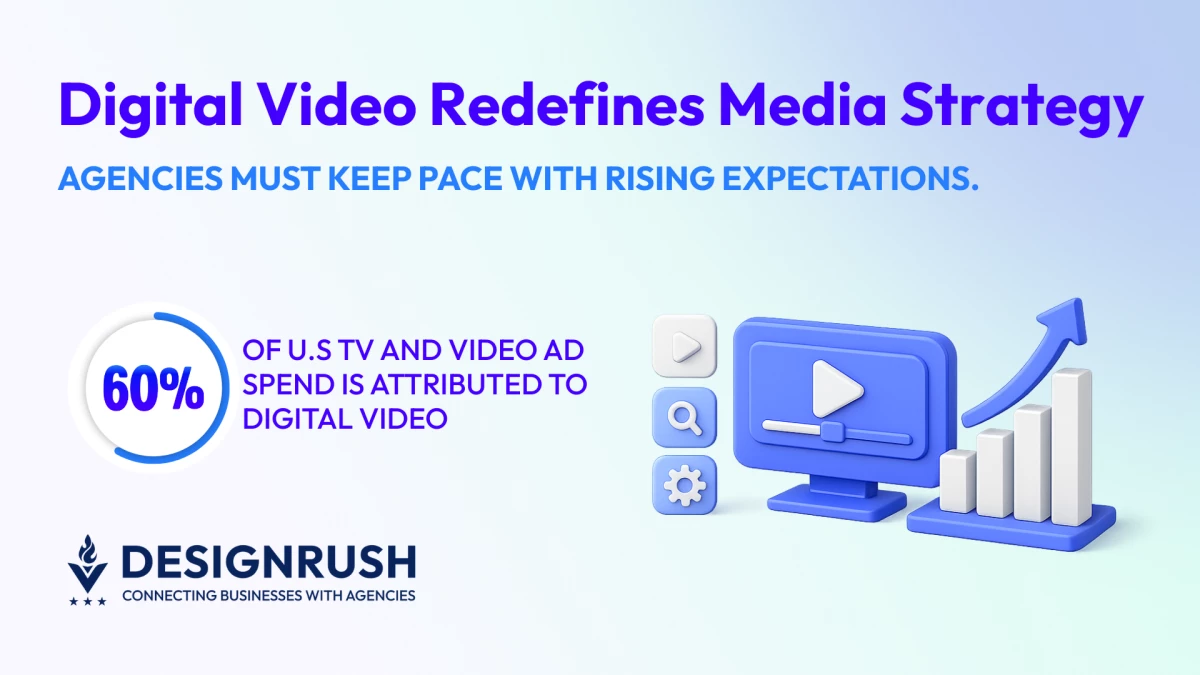
- Nearly 60% of all U.S. TV and video ad spend is shifting to digital, confirming that streaming, social, and CTV are now the foundation of modern media strategy.
- Streaming viewership has jumped 71% since 2021, now 44.8% of TV usage, proving that brand discovery is happening on digital-first platforms where results are easier to measure.
Digital video ad spend is projected to hit a record high.
According to the Interactive Advertising Bureau’s (IAB) Digital Video Ad Spend & Strategy Report, U.S. digital video investment was expected to reach $72 billion by the end of 2025.
This follows an 18% surge in 2024 that pushed spend to roughly $64 billion.
The exponential growth rate is two to three times faster than overall media investment, indicating more than just the market gathering momentum. It signals a reprioritization.
The rise of digital video isn’t just a sign of how it is outperforming traditional platforms, but proof of how brands are prioritizing channels that offer optimal reach, engagement, and return.
Editor's Note: This is a sponsored article created in partnership with Colormatics.
The industry’s pivot toward digital video as the core of media strategy is already reshaping the creative brief.
At agencies like Colormatics, a video-led agency where strategy and execution are closely intertwined, client demands have become increasingly complex.
Why?
Clients today aren’t asking for one-off videos. They want content that works together, travels across platforms, and still feels right for each audience.
For many, video isn’t just a supporting asset anymore. It’s where the entire media strategy begins.
Video Is Now the Center of the Media Plan
Digital video is expected to account for nearly 60% of total U.S. TV and video ad spend, according to the same IAB report.
And while linear TV hasn’t disappeared, it’s clearly lost its monopoly on attention and budgets.
The rise of streaming is evidence of this, reaching a historic high of 44.8% of total TV usage, with viewership up more than 70% since 2021.
Social video follows close behind.
As the gateway to discovery, consideration, and conversion, social media accounts for as much as 48% of store visits, 42% of sales, and 39% of lead generation.
Why the Digital Video Boom Matters
This shift isn’t driven by novelty but by control.
Digital video provides advertisers with measured visibility, and allows campaigns to be targeted with greater precision.
This is achieved through real-time measurements and the ability to optimize quickly when results fall short.
According to Chris Marcus, CEO and Co-Founder at Colormatics, a leading video-led creative agency, this has drastically altered client expectations.
“Streaming and social video have become the primary discovery channels for brands,” Marcus says.
That means that agencies can no longer think about video as a single asset anymore, with creative works required to perform across platforms, placements, and audiences, often at the same time.”
For brands, the appeal of digital video goes beyond scale.
It’s cemented in accountability, providing insights into what’s working and what isn't.
This has resulted in budgets being redirected from legacy channels and into formats that offer clearer signals of return.
What This Means for Agencies
“While some may assume that the rise in spending means less pressure for agencies, it's quite the opposite,” Marcus says.
From delivering creative works that function across multiple screens to driving tangible results that exceed ROI, agencies need to do more to ensure optimal results and return on investment.
As such, these three trends are steering the industry forward:
1. GenAI Is Moving From Experiment to Expectation
Thanks to its speed and adaptability, generative AI is growing in popularity, with nearly 90% of digital video buyers already using or planning to use GenAI to support video ad creation.
GenAI is being used to accelerate editing, localize creative, generate multiple variations for testing, and support rapid iteration across CTV, mobile, and social formats.
When applied thoughtfully, it allows teams to scale production without sacrificing consistency or creative intent.
2. Precision Targeting Is Critical
Digital video rewards relevance and punishes generic thinking.
By utilizing richer audience data and contextual signals, agencies can design campaigns that align creative with intent, not just demographics.
“A CTV campaign aimed at high-intent buyers, for example, demands a different approach than that of a six-second social video designed to stop the scroll,” Marcus says.
Precision targeting helps agencies improve performance while making media investment easier to justify. And in an environment where clients expect clarity, that alignment matters.
3. Performance Has Become Part of the Creative Brief
Video is no longer judged purely on craft, with advertisers expecting video creative to contribute directly to KPIs such as engagement, conversion, and revenue.
Here’s what you can expect when you use Colormatics to craft your media strategy 👇 https://t.co/9KrqNE2dP6
— Colormatics (@Colormatics) October 17, 2022
This is particularly relevant for channels such as CTV and social, where outcomes are measured against business results and not just reach.
And while strong narratives still matter, they now need to be supported by testing, insight, and iteration.
Agencies that can connect storytelling to performance, and refine creative using live data, will rise above the competition.
How Can Agencies Prepare For the Future?
While digital video continues to influence the share of TV and media budgets, agencies must invest in smarter workflow, adaptable talent, and performance-driven thinking.
This is essential to scaling without losing creative integrity.
“Digital video isn’t just growing; it’s redefining expectations,” says Marcus.
“Those that adapt how they build, deploy, and prioritize measurement will be the ones positioned to lead as video becomes the backbone of modern advertising.”