
Key Takeaways:
- Sensory marketing turns physical stores into emotional experiences by engaging sight, sound, scent, and touch and boosting dwell time, satisfaction, and return visits.
- Gen Z and Gen Alpha expect immersive, tech-enabled retail, and brands that stay static risk losing relevance.
- AI and data are enabling dynamic, hyper-localized experiences, from adaptive music to real-time visual content and scent strategy.
Physical retail will still drive around 72% of total U.S. retail sales by 2028, according to Forrester.
What many businesses overlook, however, is that these stores aren’t just sales channels; they’re experience platforms.
That means winning customer attention isn’t just about convenience or layout. It’s about what people hear, see, smell, and feel when they walk through your doors.
That’s where sensory marketing comes in, and few know more about it than Jaime Bettencourt, SVP at Mood Media.
With decades of experience in retail CX strategy, she’s helped brands like The North Face, H&M, and Macy’s turn in-store atmospheres into brand-building, revenue-driving machines.
We spoke with Jaime about what modern sensory marketing really means and how retailers can use it to drive deeper engagement and achieve measurable ROI.

Who is Jaime Bettencourt?
Jaime Bettencourt is the senior vice president of brand strategy at Mood Media, a global leader in in-store media experiences. With over two decades of experience in branding, strategy, and experiential marketing, she’s worked with Fortune 500 retailers to elevate customer moments through audio, visual, scent, and interactive solutions. Her approach blends strategy with storytelling, helping brands connect emotionally across physical and digital spaces.
Sensory Marketing Is the Next Layer of CX Strategy
Customer experience doesn’t end at digital. For physical retail to compete — and win — it must engage the senses in a coordinated, meaningful way.
Sensory marketing taps into this opportunity by creating environments that stimulate sight, sound, scent, and touch in harmony.
As Jaime explains, “Sensory marketing leverages physical retail's unique advantage: engaging all five senses simultaneously.”
The result is increased engagement, dwell time, and emotional connection.
Mood Media’s research shows that 67% of shoppers don’t enter stores for specific items. Instead, they’re looking for inspiration.
Music Is More Than Background Noise
Sound is one of the most powerful, yet underutilized, tools in a retail brand’s arsenal.
In-store music sets the tone for customer behavior and supports both brand consistency and regional relevance.
“For some clients, this means reimagining their audio approach with region-specific playlists that reflect local character,” Jaime explains.
This flexibility enhances brand identity while aligning with community tastes. It’s also a critical tool for maintaining energy and staff morale.
Post-implementation support includes regular content updates, ensuring stores never go stale.
As Jaime emphasizes, “The relationship continues well beyond installation, creating a partnership focused on continuously enhancing the sensory experience to drive meaningful business results.”
Scent Drives Emotion and Memory
The sense of smell is closely linked to emotion and memory.
In retail, a signature scent can quietly but powerfully define how a brand is remembered.
Mood Media partners with global fragrance houses to develop custom olfactory signatures for clients.
More broadly, scent strategy is being used to uplift mood in healthcare settings and energize guests in fitness centers.
As Jaime notes, signature scents create instant brand recognition. It’s subtle but incredibly powerful in forming emotional bonds.
“By crafting environments that engage multiple senses — from curated music and marketing scent to dynamic visuals — we create spaces where customers naturally want to linger and explore,” she says.
Visuals Must Be Contextual and Curated
Retail screens shouldn’t be treated as passive billboards.
Digital signage and in-store content need to reflect changing conditions — season, time of day, demographics — and feel connected to the space.
Mood Media builds systems that support dynamic content adaptation.
“Our solutions enable centralized control while allowing location-specific customization through scheduling systems that can target content by region, demographic or even time of day,” Jaime explains.
This balance between brand consistency and local flavor helps global retailers feel relevant in every community they serve.
Visual content must stay purposeful, dynamic, and brand-aligned.
Interactive Media Creates Two-Way Engagement
Touchscreens, mobile tie-ins, and gesture-based displays can elevate a store from transactional to experiential, but only when deployed with intent.
Tech for tech’s sake doesn’t work. Every interactive element should serve the brand and simplify the experience.
Without a strategic foundation, interactive media risks adding friction rather than removing it.
Retailers are increasingly adopting heat mapping and digital engagement tracking to understand how customers move through a space and where technology can meaningfully enhance discovery or conversion.
“They're thinking deeply about how sound, visuals and layout work together to create intuitive shopping journeys,” Jaime notes.
Case Study: A Multisensory Strategy That Delivered
When The North Face expanded its Regent Street flagship by 33%, it didn’t fill the new space with racks and shelves.
Instead, it created a multisensory centerpiece: a 360-degree projection dome built inside a branded tent.
“Five synchronized projectors display AI-generated content showing stunning landscapes transitioning from day to night across different seasons,” Jaime explains.
“We also added nature soundscapes and even developed a signature scent called ‘White Pepperwood’ with notes of cedarwood and bergamot.”
The result?
“Shoppers now spend significantly more time in the store and return more frequently,” Jaime reports.
“What I love most about this project is how boldly The North Face committed to the experience. Most brands would have used that prime center-of-store real estate for additional product displays.
Instead, they dedicated it entirely to creating an immersive escape that truly transports visitors from urban London to the wilderness.”
The Future of Retail Is Multisensory
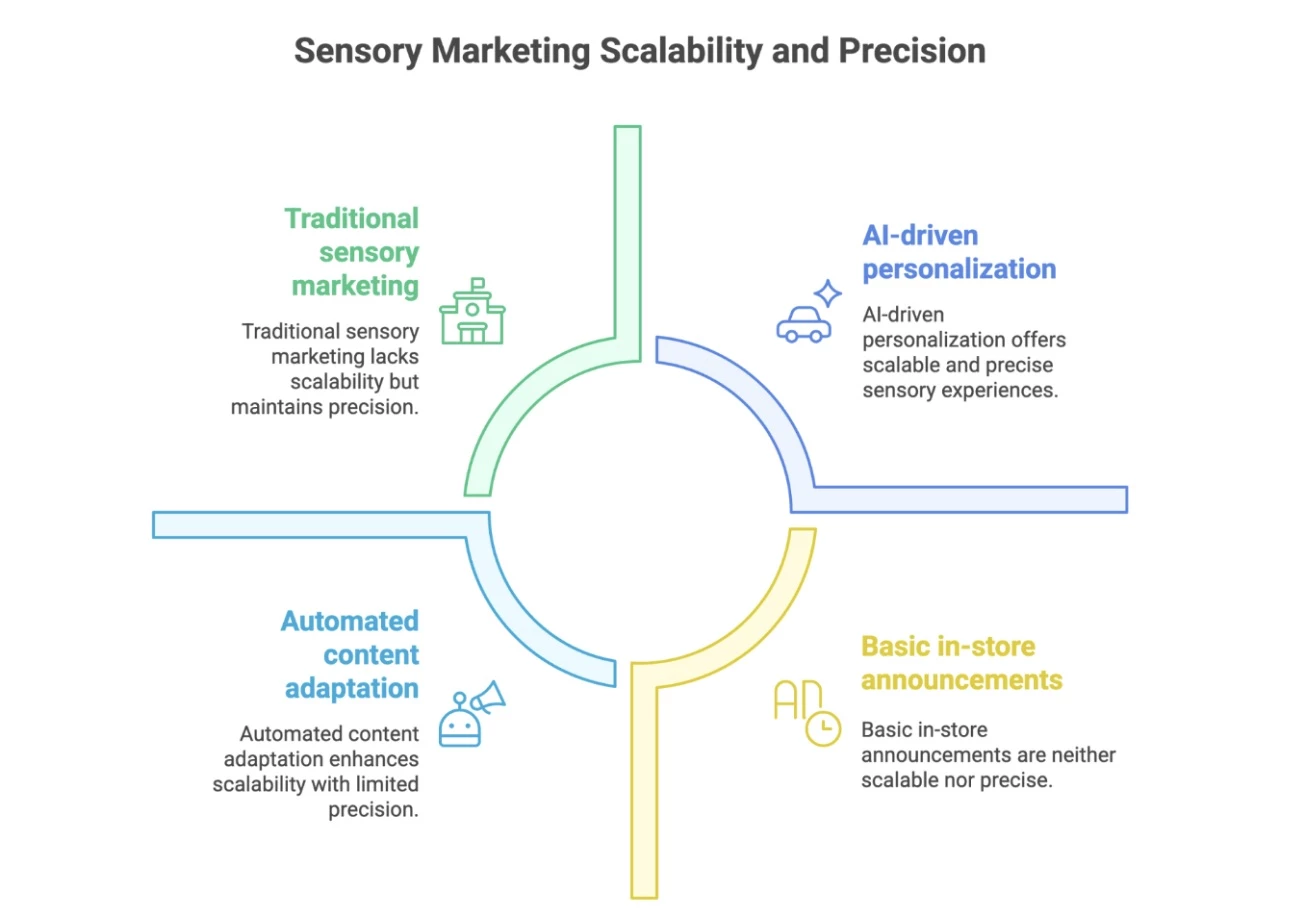
With AI and data analytics powering real-time personalization, sensory marketing is becoming more scalable and precise. Mood Media is at the forefront of this shift.
“AI is becoming incredibly useful in personalizing sensory experiences,” Jaime says.
“We’re implementing systems that adapt content based on who’s in the store, changing visuals and soundscapes that match the demographic mix or time of day.”
Tools like Mood Media’s Messaging Copilot are also streamlining in-store communications.
It helps store managers create professional audio announcements in minutes rather than days, highlighting the operational upside of sensory-led tech.
Retailers are also rethinking stores as social and cultural spaces.
“Major retailers like Foot Locker are creating dedicated ‘Drop Zones’ for trending releases, while others are investing heavily in store redesigns informed by heat mapping and customer movement patterns,” Jaime shares.
The most successful sensory strategies don’t overwhelm — they remove friction.
“Brands should be removing friction and enhancing natural customer behavior. That’s where sensory marketing is having its biggest impact,” Jaime says.
Final Takeaway for Retail Leaders
For CEOs, CMOs, and brand leaders, the mandate is clear: treat physical space as a living expression of your brand, not just a channel for sales.
“Look beyond your own industry for inspiration,” Jaime recommends.
Retailers are finding their best ideas outside their own industry, borrowing from hospitality, entertainment, and design thinking to build more immersive, human-centered spaces.
And always remember — your next customer could be Gen Z or Gen Alpha.
These consumers expect physical stores to be as dynamic and interactive as their digital lives.
Brands stuck in static, product-first environments risk losing their attention.