
WhatsApp's U.S. Campaign: Key Findings
- Adam Scott and Adam Brody headline a new WhatsApp ad on group chat fails and fixes.
- The campaign spotlights polls, reminders, and encryption as key messaging upgrades.
- It spans TV, digital, social, and live events tied to sports, college, and awards season.
Quick listen: WhatsApp taps Adam Scott and Adam Brody to spoof group chat fails, proving polls, reminders, and encryption outsmart SMS.
Group chats shouldn’t fall apart over a missing address or one bad reply.
That’s the premise behind WhatsApp’s new U.S. campaign, “It’s Time for WhatsApp.”
It highlights the platform’s group chat features and draws a clear line between WhatsApp and standard SMS.
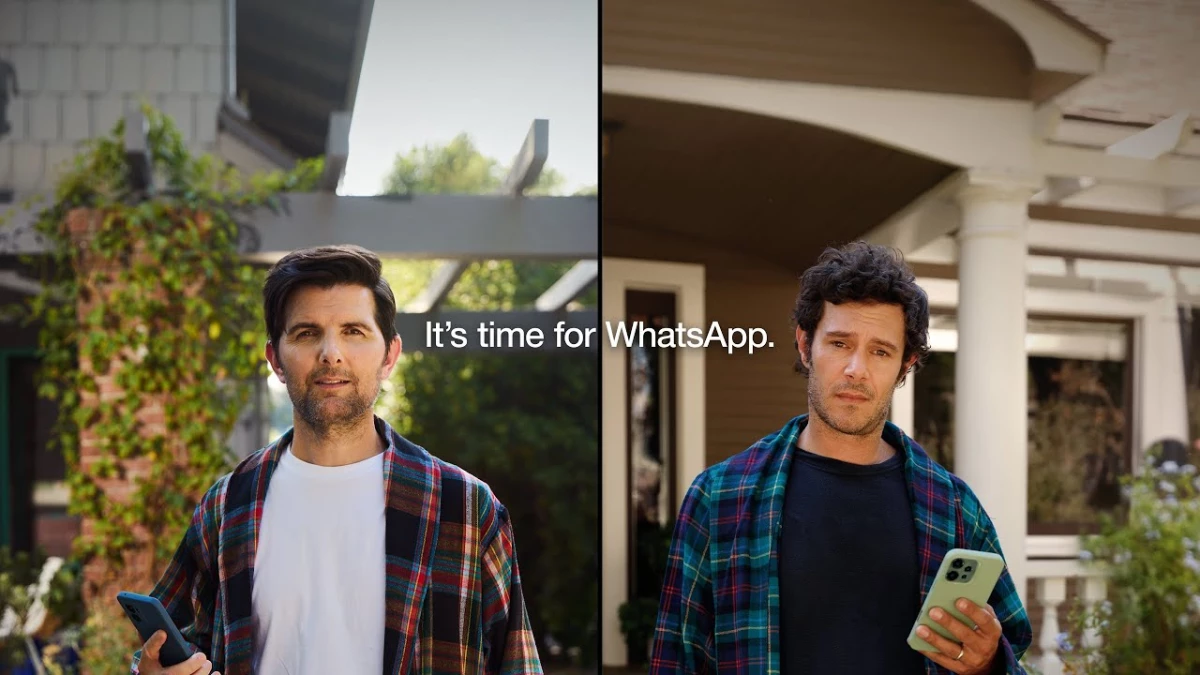
The campaign features Emmy-nominated actors Adam Scott and Adam Brody in a dual-storyline ad where each plays a party planner using different messaging tools.
Brody’s event runs smoothly using WhatsApp’s built-in polls and event reminders, while Scott’s falls apart due to missed updates in a basic group chat.
Created by BBDO New York and directed by Tom Kuntz, the campaign premiered on September 3.
It will run through November across TV, digital, social, and out-of-home channels.
Additional activations are scheduled for college campuses, football events, and the Emmy Awards on September 14, where both actors are nominees.

Vivian Odior, WhatsApp’s global head of marketing, told AdWeek the initiative targets everyday coordination challenges in the U.S., where many users still rely on default SMS tools.
“The role of a group chat in organizing real-world networks is also growing and is much more important,” she added.
The campaign aims to position WhatsApp as a more reliable solution for secure, multi-user communication.
The spot uses real-time chat visuals to reflect how users interact with the platform in daily life, emphasizing clarity, notifications, and privacy in group settings.
Built on Utility, Framed Through Familiar Faces
Meta has reason to make this move now.
WhatsApp has more than 3 billion global users, but American adoption still trails other markets.
While it surpassed 100 million users in the U.S. last year, many still rely on default SMS threads that miss the mark when things get busy.
That’s the habit this campaign is trying to change.
Instead of overexplaining features, WhatsApp lets Brody and Scott act them out.
To celebrate #adamscott and #adambrody finally talking to each other on camera, I made this. Happy Scott x Brody Day! pic.twitter.com/VK8UgASNZy
— Jamie Lee Kurtis Conner (@_bella_baxter) September 4, 2025
When Brody’s party works, it’s because the tools made coordination simple.
When Scott’s fails, it feels honest, not staged.
There’s no product demo or lifestyle sell.
Just a split screen that makes its point and moves on.
Online response has been strong, especially among younger users who praised the dry humor and real-world accuracy.
TikTok will host more clips, including a Brody-Scott interview.
🎥 New video! Adam Scott and Adam Brody for WhatsApp (via TikTok) pic.twitter.com/agYSvrG4Xx
— Adamazingscott (@adamazingscott) September 3, 2025
The campaign has already earned millions of views, with some comparing it to Apple’s “Get a Mac” series.
More content is on the way, including activations around college football and real-time event tie-ins this fall.
WhatsApp is not positioning itself as something new.
It’s positioning itself as the tool that should have been used in the first place.
Our Take: Can Familiar Faces Fix Messaging Fatigue?
I watched the “Adam vs. Adam” spot twice, not out of obligation but because it captured something real.
The pacing works, the split-screen concept is clear, and both actors deliver without overplaying the roles.
It sidesteps the usual tech jargon and focuses instead on everyday miscommunication: missed details, bad timing, and the kind of confusion most people recognize.
WhatsApp makes its case without overexplaining, showing how simple tools can fix familiar problems.
For another campaign using a familiar face to spotlight everyday tech frustrations, see how Kevin Bacon brings it home for T-Mobile.
Want users to switch? These app firms solve real problems and show the difference clearly.