

Wezom, a leading software development company, has just introduced a nine-step framework designed to fast-track eCommerce success, positioning businesses to thrive in the final quarter of 2024.
Having a solid eCommerce strategy is crucial in growing every online business, regardless of their objective.
Whether it’s a fully functioning eCommerce platform or software development, companies need to lay out a step-by-step process to understand how they can get from point A to point B and effectively achieve their goals.
Wezom’s Business Partners’ Journey
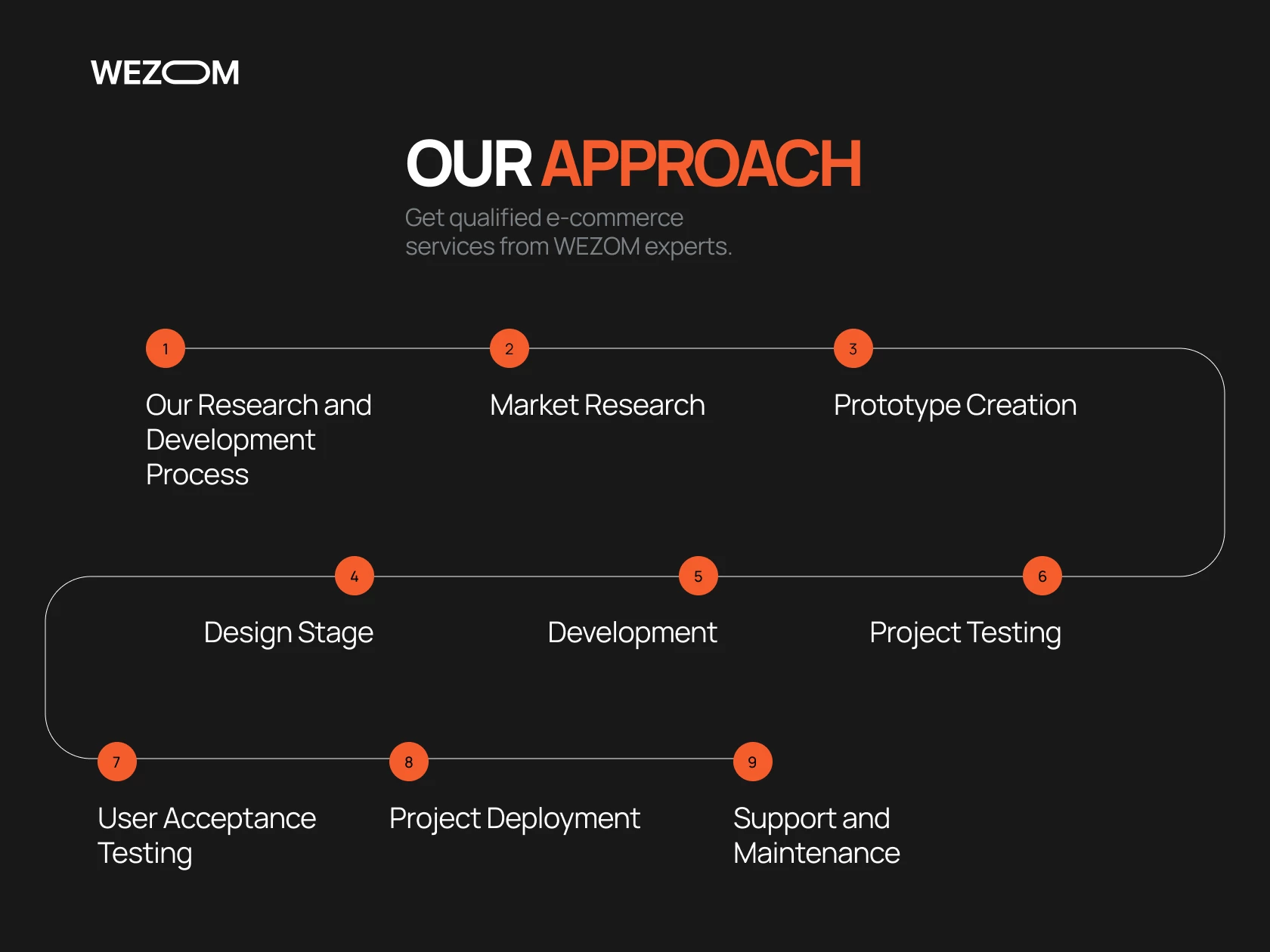
According to Wezom, its strategy can be divided into nine stages, ensuring business needs are met from start to finish.
- Research & Development
- Market Research
- Prototype Creation
- Design Stage
- Development
- Project Testing
- User Acceptance Testing
- Project Deployment
- Support & Maintenance
“Our priority is aligning with your business goals, and we take pride in the work we do and the clients we serve,” Serge Guzenko, CEO and founder of Wezom, said in a statement.
Step 1: Research and Development (R&D)
During this stage, the company carefully discusses with clients their specific requirements and preferences.
Once the project’s goals are laid out, the company outlines the development stages with its team before it presents a commercial proposal to the client.
From here, the company and client finalize the terms of their contract before beginning the actual work.
Step 2: Market Research
As soon as the go signal is given to Wezom, the market research stage commences.
Here, it conducts market analysis on its client’s specific niche by conducting surveys and interviews with potential users of online stores, as well as analyzing data using Google Analytics, Trends, and other tools.
From its gathered information, Wezom then forms hypotheses on how best to tackle the eCommerce platform, including its functionality, appearance, and more.
Another aspect of this stage includes conducting a comparative analysis based on other eCommerce solutions within the client’s niche.
Step 3: Prototype Creation
Taking into account all its findings from the previous stage, Wezom begins its construction of a website prototype for the client, including key interface elements, navigation, content placement, and page connections.
By building a prototype, the company can visualize its concept, test hypotheses on specific user needs and behavior, and receive feedback from the client to make necessary adjustments.
Step 4: Design Stage
After guaranteeing the project’s functional aspects and with approval from its client, Wezom moves on to the design stage, where it creates the overall look of the eCommerce store.
Based on the client’s branding and corporate style, the company will work on crafting the company’s visual appearance, color scheme, fonts, icons, and images to make its marketplace memorable.
Throughout this stage, Wezom conveys the brand’s values and emotional tone while ensuring the visual elements capture the interest of users and stand out among competitors.
Step 5: Development Stage
Developing the actual ecosystem comes next, where Wezom will use a variety of tools, frameworks, and software to program language, including:
- PHP, known for its performance and compatibility with different platforms
- Laravel 8, a web application framework to ensure flexible development and customization
- HTML, CSS, and JavaScript language to style and structure the website
- A bootstrap framework to guarantee functionality across different devices and resolutions
- MySQL database management system to score and process information on products, users, and more website data
- Elasticsearch to get fast and dependable search capabilities
- Git version control system to keep track of code changes
By utilizing this arsenal of tools and technologies, Wezom stays well-equipped to build robust and scalable ecosystems, meeting a client’s specific needs while working in sprints. The team approaches business needs flexibly while taking into account new features as necessary.
Step 6: Project Testing
Following what’s considered to be the most tedious and time-consuming phase, the company will commence its testing stage to ensure that operations run smoothly for the eCommerce project.
The main purpose of this stage is to guarantee the security and reliability of the client’s store while assessing its performance under heavy user traffic.
Step 7: User Acceptance Testing
In this stage, Wezom launches the project to a limited group of users to evaluate it based on certain metrics.
Here, A/B testing, surveys, analytics, and other user acceptance testing software will also be used to guarantee ease of use and convenience. Once they’re all set, Wezom moves on to the next stage.
Step 8: Project Deployment
First, the company guides the client in selecting a server or host for your eCommerce platform. Then, Wezom transfers the marketplace from the test server to the chosen domain and host.
After the transfer, the company conducts a final functionality check before the site is officially launched and made live.
Step 9: Support & Maintenance
In the final stage, the company provides ongoing support and maintenance to make sure everything runs smoothly, the site remains secure, and the software stays up to date.
Additionally, Wezom will help in monitoring the performance of the eCommerce store to optimize its effectiveness.
Through its comprehensive nine-stage approach to eCommerce development, Wezom ensures that every client receives a tailored solution that meets their unique needs and objectives.
By carefully guiding clients from initial research to final deployment and beyond, Wezom delivers not just a website, but a strategic tool designed to drive sales in the highly competitive eCommerce market.
And it has since done wonders for a wide variety of clients.
Wezom recently built an entire digital ecosystem from scratch for leading air conditioner manufacturing company Cooper&Hunter.
“In just 10 months, we went through the entire cycle of developing a large digital ecosystem — from the stage of searching for ideas to the release of the finished product,” Guzenko told DesignRush at the time.
Editing by Katherine 'Makkie' Maclang