

Trustpilot vs. Google Reviews: Key Findings
- Trustpilot beats Google by 57% in CTR: Even with the same stars and review count, consumers clicked more when the badge came from Trustpilot.
- Recognition drives results: Ads with Trustpilot earned 6x more clicks than Yotpo and 5x more than Bazaarvoice, highlighting the value of consumer familiarity.
- Trust signals perform like pricing levers: In one test, a stronger Trustpilot badge was able to offset a 20% price premium.
- Consistency multiplies impact: Displaying the same review source across ads and landing pages deepens trust and action.
Quick listen: Trustpilot’s reviews outperform Google by 57%. Here’s how smart CMOs are turning stars into sales, in under 3 minutes.
Just because it’s five stars doesn’t mean consumers trust the stars. Brand still matters.
New research confirms that the review platform behind the rating isn’t just a design detail. It can actually make or break performance.
In a July 2025 study from Trustpilot and London Research, 1,200 U.S. consumers were shown identical ads for a fictional brand, Velocity Home.
The only difference was the review provider, and results showed a clear favorite.
Ads featuring Trustpilot stars and logo drew considerably more clicks than those with high Google ratings.
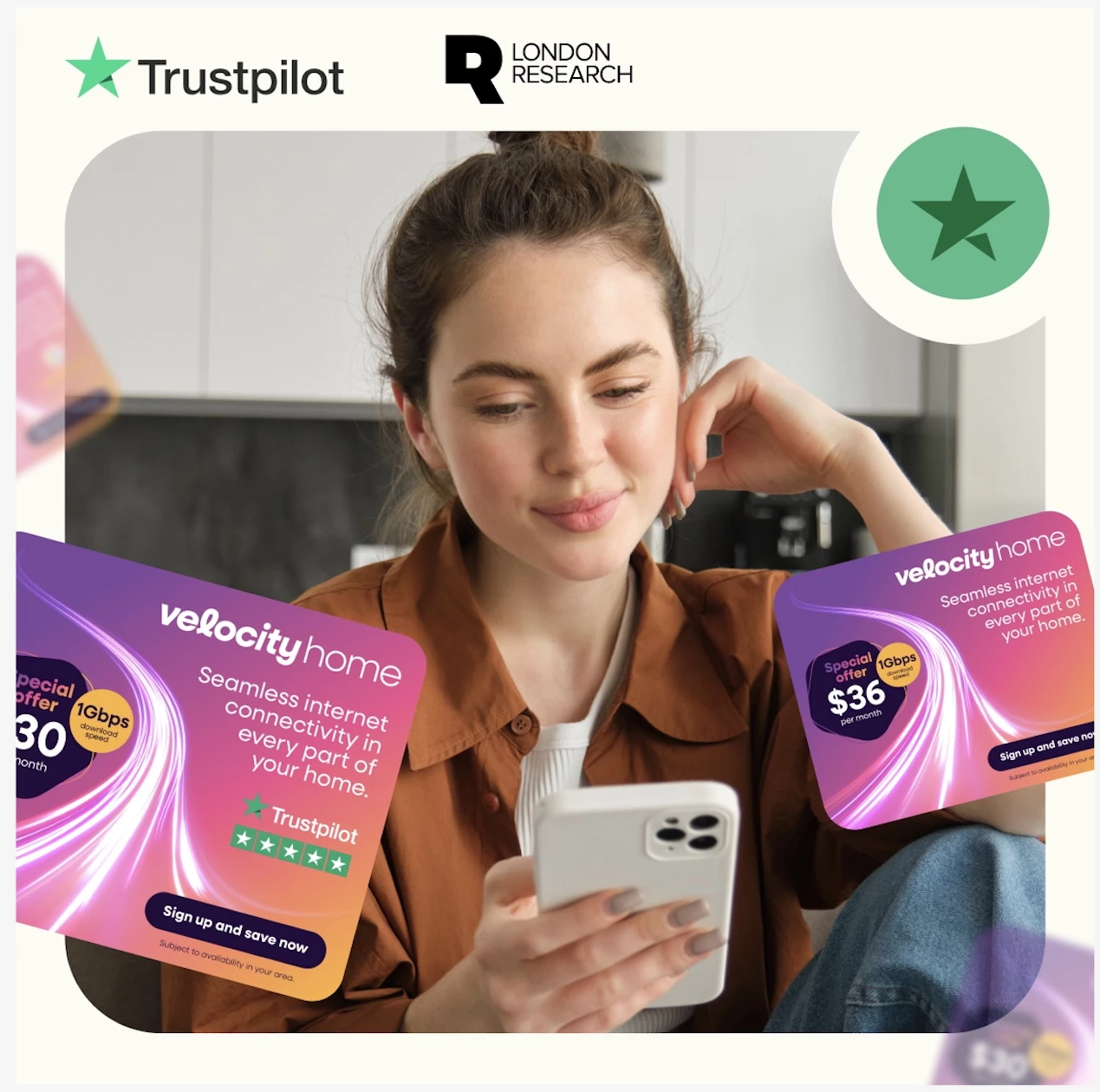
Against other direct competitors, Trustpilot also delivered several times more clicks, respectively.
“We set out to uncover how trust shows up as people are making decisions, and what we found is it’s not just important, it’s decisive.
In today’s economy, trust has become the tie-breaker. When everything else is equal, it’s what moves someone from ‘maybe’ to ‘yes,'” Trustpilot U.S. VP of Marketing Dana Bodine told DesignRush.
As someone who’s familiar with running performance campaigns where every 0.1% CTR shift matters, I find these numbers hard to ignore.
When a simple logo swap can create this kind of difference in numbers, it should be worth it for advertisers to pay attention.
It’s not just about visibility. It’s about brand recognition and credibility that consumers instantly perceive.
Not All Stars Are Trusted Equally
It’s tempting to think that a five-star rating speaks for itself. In reality, the platform behind these stars matters just as much.
Consumers don’t just read the review. They look at where it came from.
The study compared five-star ads for made-up internet company Velocity Home using Trustpilot, Google, Yotpo, and Bazaarvoice across a range of test formats.
Each ad used the same brand name, image, star rating (5.0), and number of reviews (3,000+).
The only variable was the review badge.
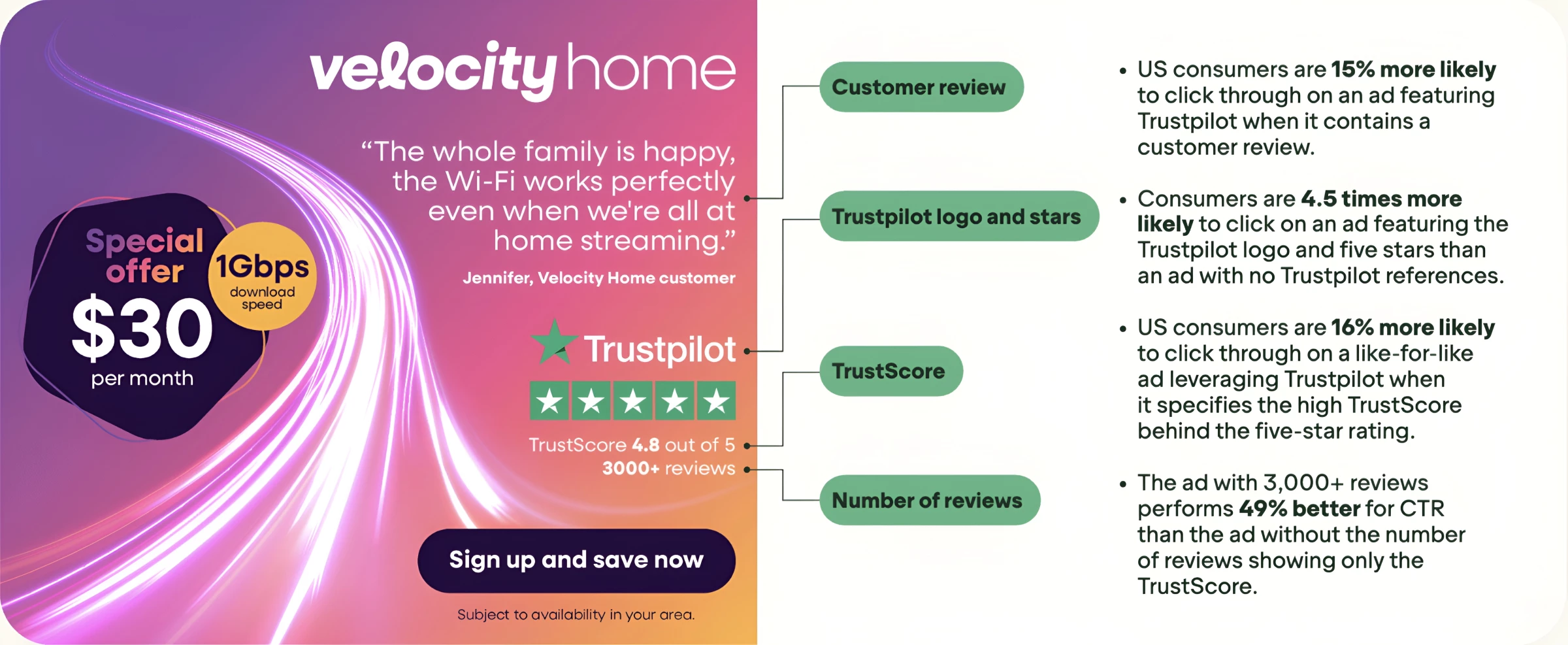
The results speak volumes:
- 57% CTR for Trustpilot vs. Google
- 6× more clicks than Yotpo
- 5× more clicks than Bazaarvoice
- 5× more conversions than no-review ads
- 10× CTR lift vs. ads with no review content at all
Another particularly compelling stat: a Trustpilot ad drew the same 5× higher CTR as a non-Trustpilot version, even though it listed a price 20% higher.
This shows that if the trust signal is strong enough, people are willing to pay more, or at least click to learn more.
Trustpilot has built its brand around transparency and independence. Its logo, five-star badge, and review count function as signals people recognize.
In contrast, Google reviews are everywhere but not always trusted.
Most users know that anyone can post one, and moderation varies. This affects the tech giant's credibility.
Yotpo and Bazaarvoice, while respected inside the industry, don’t carry the same weight with everyday consumers.
In a cluttered feed, unfamiliar logos feel generic. This limits their impact, even when the review content is solid.
Trust That Sticks After the Click
This research wasn’t limited to clicks. It also explored how review branding shapes brand perception.
What stood out to me was the consistency across the funnel:
- +8.5% increase in brand trust when consumers saw the Trustpilot badge
- +4.9% in favorability, even though the star rating itself didn’t change
- +2% in brand recall, both prompted and unprompted
What’s more, the study showed a cumulative effect.
When people saw a Trustpilot-branded ad and then landed on a site with the same review widget, their trust and conversion intent rose again.
This aligns with what many marketers suspect: trust signals work best when they’re repeated across touchpoints, not siloed.
For instance, TurboDebt saw a 14% conversion lift after adding Trustpilot to its landing pages.
ThriftBooks also reported 125% more organic traffic and a jump in revenue growth from 80% to 180% in the year after prominently using Trustpilot sitewide.
I see this as a missed opportunity hiding in plain sight. Here are what CMOs should act on now:
- Test review platforms in ad creative: Run controlled A/B tests where the only variable is the review source to see which drives stronger engagement.
- Use the same review brand across ads and landing pages: Reinforce trust by making the review signal consistent throughout the customer journey.
- Make review branding part of strategy: Treat the review platform as a core performance element, not just a design detail.
- Re-evaluate default review providers: Choose review platforms your audience actually recognizes and trusts, not just what's built into your tools.
Most of us treat reviews in ads as filler or visual polish.
This study reframes them as a key performance indicator (KPI) that can be tested, measured, and optimized, just like copy, images, and CTAs.
For CMOs looking to unlock marginal gains, I think this is a smart place to start.
It’s a chance to improve performance and drive more revenue, one that too many brands and agencies might be overlooking.
If your review placement is an afterthought, you're leaving conversions on the table. These teams make trust part of your ad system: