
Miro AI Builds 'Rome in a Day:' Key Findings
- Miro used its own AI tools to produce its first global brand campaign, aligning product claims with real production workflows.
- The six-week timeline compresses a traditional creative cycle, offering a concrete proof point for enterprise teams under delivery pressure.
- Tool of North America applied generative AI across characters, environments, and sound, showing how automation and craft can operate together inside brand storytelling.

Campaign Snapshot
Miro decided to demonstrate its product promise rather than explain it.
After years of talking about faster creative collaboration, the AI workspace platform launched its first global brand campaign and built it using Miro tools from start to finish.
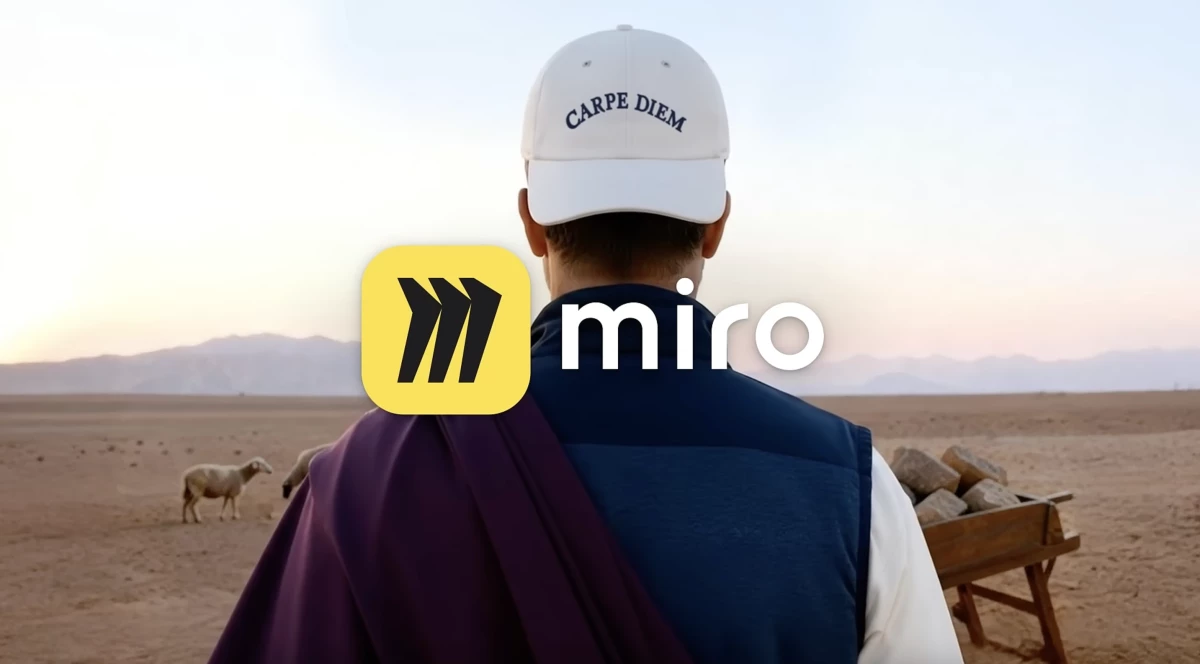
Titled "Build Rome in a Day," the campaign that takes a deliberately meta approach was developed with creative production partner Tool of North America.
It demonstrates ambitious work getting done faster by building it the same way the brand claims modern teams should work.
With the Miro AI Innovation Workspace, teams can get practically anything done, faster than ever before. #GetGreatDonepic.twitter.com/rjrhQTQU4T
— Miro (@MiroHQ) January 6, 2026
The tongue-in-cheek film imagines ancient Rome colliding with modern startup culture, with senators looking like founders and gladiators dressed like product managers.
“Now we’re taking that message global with Miro’s first-ever AI brand campaign," Drew Jaz, head of creative at Miro, shared in a statement.
"And yes, we made it exactly the way you’d hope: by using Miro AI to get it all done.”
The ad posted on YouTube has since accumulated over 5.7 million views.
Rather than starting with a traditional brief, the campaign began with a prompt inside Miro AI.
The creative hook is playful, but the strategy underneath is serious, as Miro wants its first brand statement to feel earned.
Instead of positioning speed as an abstract benefit, the campaign actually shows it in practice.
This choice gives the brand a practical advantage, turning its own workflow into evidence that reduces skepticism and makes the benefits feel tangible.
The Production Method Becomes the Message
One early sticky note idea, “historical achievements reimagined with Miro AI,” became the creative backbone.
From there, the team leaned into the tension between ancient ambition and modern speed, asking whether AI-powered workflows could help legendary builders move faster.
This framing shaped every creative decision, with the film’s universe deliberately blurring eras, pairing marble columns with whiteboards and togas with hoodies.
The goal was relatability for modern teams expected to ship faster without sacrificing quality.
AI Workflows is now available for Miro Enterprise customers.
— Miro (@MiroHQ) January 12, 2026
Collaborative AI workflows that automate end-to-end processes visually — turning your teamwork into finished deliverables in minutes instead of hours.
Build unlimited custom collaborative AI workflows. #GetGreatDonepic.twitter.com/qrqHyxRLg4
The entire project lived inside a single Miro canvas, where internal teams and production groups mapped everything from casting and wardrobe to locations in real time.
“Seeing the entire project play out at every stage on one board made it especially easy to answer questions and pull people in when we needed their expertise,” Antoine Levi, production lead at Miro, said.
The campaign embedded creative collaboration directly into how the work got done.
The full film was delivered in six weeks, from first prompt to final cut, with no handoffs between disconnected systems.
AI As a Craft Accelerator
Once the concept was locked, Tool of North America pushed deeper into AI-driven production and tested whether the spot should be in live action or fully generated.
The team committed to AI as the primary engine, and specialized tools were used to develop characters, define movement and speech, generate environments, and create the soundtrack.
AI also allowed the team to solve problems mid-edit, as shots could be regenerated instantly and scenes could be adjusted without resetting a production sequence.
What might have slowed or stalled a traditional shoot stayed fluid and responsive.
“We’re big believers in the power of AI, not just for saving time and money, but its creative potential,” Tool of North America President and Managing Partner Dustin Calli explained.
“When AI is put in the hands of our talented team, we can deliver on the craft and storytelling that a brand campaign like this requires.”
Meanwhile, brand teams used Miro Flows to map product demos, timelines, diagrams, and visual logic for the film.
Each scene evolved directly from these boards, keeping strategy and execution tightly linked.
For CMOs and brand leaders, “Build Rome in a Day” functions like an operational case study:
- Product credibility increases when marketing mirrors real workflows, especially for AI platforms selling efficiency and collaboration.
- Generative AI shortens production cycles when teams commit early, rather than treating it as a post-production add-on.
- Shared workspaces reduce friction across agencies and internal teams, keeping strategy, creative, and execution aligned.
The broader implication is simple. AI-led branding lands harder when the work itself shows restraint, clarity, and execution discipline.
Our Take: Does Miro AI Actually Walk the Talk?
For what I see, yes, it does, because Miro didn’t market AI as a shiny layer on top of existing workflows.
AI is the operating system behind the work itself.
This choice matters in a moment when CES 2026 is flooded with AI claims that sound impressive but rarely show evidence
Letting execution carry the message enables Miro to avoid the usual abstraction that plagues AI storytelling.
As AI moves into categories where trust carries real consequences, visible processes have become part of the product.
This same emphasis also shows up in OpenAI’s launch of ChatGPT Health, where the product is defined as much by how it is built and separately from regular chats as by what it can do.
Credibility grows when products show their work. These top companies build AI platforms where execution proves the promise.