
Mercedes-Benz x The Sphere: Key Findings
- Mercedes-Benz turns a massive Las Vegas landmark into a moving canvas, showing how large-format illusions can drive hype.
- The AMG lineup becomes a visual centerpiece, proving that product storytelling scales when motion design reinforces real-world performance cues.
- The automaker demonstrates how consistent experimentation with architectural canvases can shape long-term brand awareness.
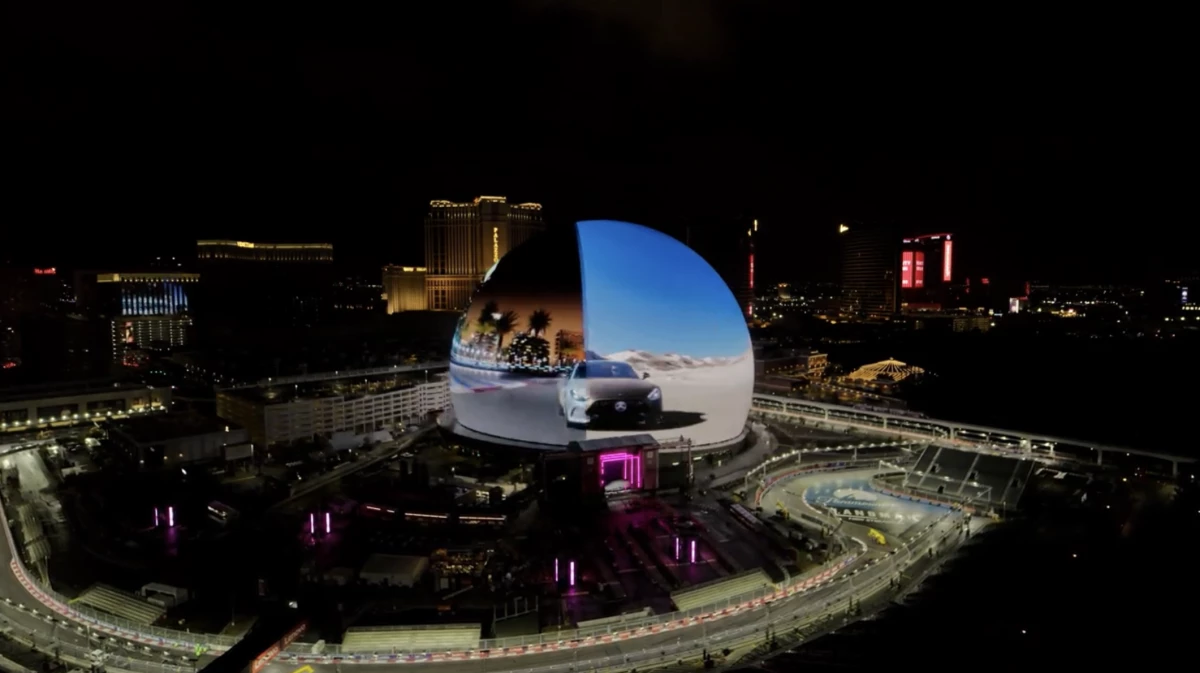
The Sphere has seen countless eye-patching visuals since opening, but Mercedes-Benz turned it into something closer to a moving racetrack in the sky.
The execution uses a new production workflow and a split-screen technique developed with Merkley + Partners and NEXUS.
Mercedes-Benz then created a 360-degree illusion that wrapped its AMG GT lineup across 580,000 square feet of LED panels.
The system was designed to make the cars appear to drive toward viewers on one side of the Sphere and away on the other.
This gives audiences a seamless, panoramic read no matter where they're standing.
It’s a high-visibility moment that shows how far brands will go to grab attention, especially with how crowded the sports and entertainment corridor is.
It also shows how immersive surfaces are quickly becoming a core part of modern brand marketing strategy.
Inside the Visual Experience
The campaign centered on three AMG GT 63 models, including the APXGP Edition, which mirrors design details featured in "F1: The Movie."
The car’s 577-hp V8 biturbo engine and 2+2 interior layout were highlighted through a rotating visual sequence that emphasized performance and practicality.
Mercedes-Benz also spotlighted the Concept AMG GT XX, its record-breaking prototype.
It's built on the new AMG Electric Architecture, which delivers more than 1,341 hp and ultra-fast charging capabilities.
While the work leans heavily on spectacle, it also shows how automakers are using event-driven experiences to expand reach.
This comes at a time when cultural attention is already peaking in Las Vegas.
Just take a look at LEGO.
Earlier this week, it brought in "White Chicks" actor Terry Crews to hop on a real-life 418,000-brick Cadillac together with the world's biggest F1 racers.
In the case of Mercedes-Benz, a brand with decades of performance storytelling, the Sphere offered a dramatic stage to showcase what its future hardware looks like.
Not only that, it showed why its core audience should care.
While the activation functioned primarily as a visual spectacle, it also demonstrated how luxury branding translates engineering stories into outdoor media experiences.
And in the EV race, spectacle matters, especially when competitors like Tesla and BMW have staged their own large-scale reveals in similar high-traffic hotspots.
What Marketers Can Learn From This Showcase
Mercedes-Benz is a textbook example of turning new technology into an ambition-setting public moment. Here, we learn:
- One way to make large-format outdoor media more immersive is to align motion design directly with a product’s physical capabilities.
- Futuristic concepts gain credibility when supported by activations that feel grounded in real-world cars and the audience's perspective.
- Automakers have shown similar interest in grand-scale marketing, proving that this kind of storytelling has consistently shaped long-term audience perception.
Now, it's up to Mercedes-Benz to extend this momentum into future launches, all while it balances combustion heritage with its electric ambitions.
Our Take: Can Spectacle Still Sell Cars?
Mercedes-Benz knows that people don’t just fall in love with spec sheets. They also fall in love with moments.
Watching a car appear to glide across a building the size of a small planet taps into this childhood instinct of seeing machines as something larger than life.
I also think The Sphere gave Mercedes-Benz a chance to tell audiences that performance is an emotion first and an engineering claim second.
If I were running a campaign like this, I’d bet heavily on immersive formats, too.
Because it's clear to me that the battle for attention is moving upward at a pace faster than sports cars on the raceway.
In other news, Lexus took a different approach to its automotive marketing, enlisting NBA star Russell Westbrook, known for his "tunnel fits."
Discover the top ad agencies creating campaigns that make waves in our agency directory.