
McDonald's 'First Job Confessional' Tour: Key Findings
- McDonald's launched the campaign on March 6, with booths touring New York, Austin, Pittsburgh, and Chicago through July.
- Statistics show that 1 in 8 Americans has worked at McDonald’s, representing about 40 million past and present crew members.
- "Love Island" star Olandria Carthen fronts the campaign, drawing on her own family's history with McDonald's to anchor the launch video.
McDonald's is making the case that first jobs deserve more credit.
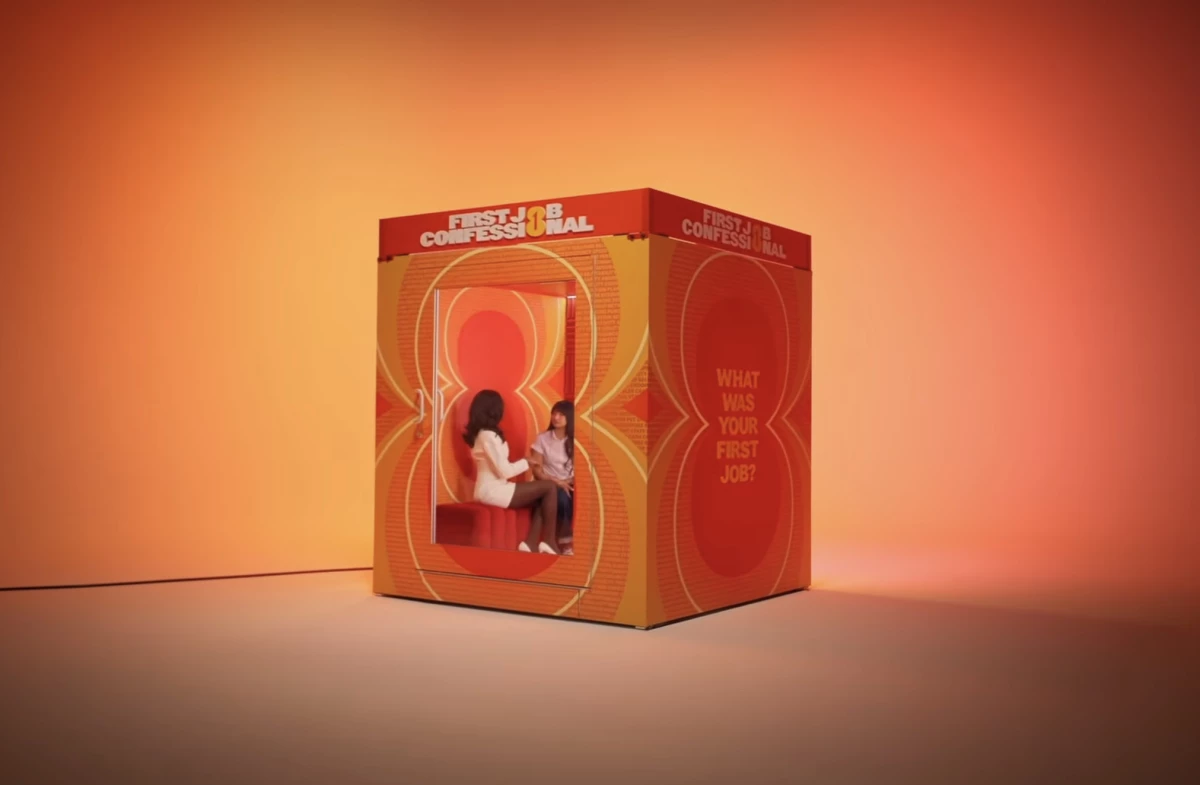
"The First Job Confessional" launched on National Employee Appreciation Day and invites people to record their first job stories in exchange for a $15 gift card.
The campaign was developed by global agency Golin on creative and PR, Bully Pulpit International on paid media, and We Are Social on experiential.
TV personality and "Love Island" star Olandria Carthen fronts the launch.
She appears in a 90-second video alongside an actual McDonald's crew member about the skills their early jobs gave them.
People can also post their first job story on Instagram or LinkedIn using #FirstJobConfessional for a chance to appear on McDonald's official YouTube channel.
The four-city tour and social submission mechanic give McDonald's a brand marketing strategy that runs through July, well past the news cycle around the launch.
A Kiosk Repurposed as a Camera
The confessional booth takes the physical form of a McDonald's ordering kiosk, but replaces the menu with a camera and soundproof seating.
The design uses a piece of familiar brand infrastructure to stage something personal and unscripted.
Carthen's involvement adds a specific cultural frame. She grew up in Alabama, and both her mother and sister worked at McDonald's.
"Before I was on TV, I was just a small-town girl from Bama, raised by a family that believes in clocking in, working hard and doing things the right way," the actress said in a statement.
"My mom and sister worked at McDonald's and showed me that our first jobs teach us skills we carry for life."
The activation kicks off in New York at Gansevoort Plaza before traveling to Austin in March, Pittsburgh in April, and Chicago in July.
The social media component also extends the campaign well past the four tour stops.
User-generated content on Instagram and LinkedIn will feed directly into McDonald's YouTube channel, giving the brand a pipeline of real, authentic stories.
The 1 in 8 Statistic Does the Heavy Lifting
McDonald's operates roughly 13,500 U.S. restaurants, 95% of which are owned and operated by independent franchisees.
The campaign's strategic foundation is the claim that 1 in 8 Americans has worked at McDonald's.
The brand has been building this fact into its communications under its "1 in 8" platform.
This figure represents approximately 40 million past and present crew members across the country.
Owner/Operator Joy Silmon adds her own take on her own path from crew member to franchisee:
"Working at McDonald's was more than just my first paycheck," she said in a statement.
"It was one of my first classrooms, where I learned to solve problems, adapt quickly and find my confidence as a professional."
The longer play here is building the 1 in 8 platform into something with enough cultural recognition that it functions as a standalone brand asset over time.
The initiative offers a few angles worth noting for brands thinking about experiential and social-first work:
- Repurpose existing brand assets for creative use. Familiar elements keep activations visually tied to the brand.
- Design campaigns to generate user content. Built-in submissions extend engagement across multiple locations and timelines.
- Ground influencer participation in personal stories. Authentic connections strengthen credibility with audiences.
This structure ties the campaign directly to American working life, showing people how many careers, routines, and life stories began behind a McDonald’s counter.
Our Take: Does the Confessional Format Hold Up?
We think the 1 in 8 statistic is a truly powerful figure.
It gives McDonald’s a claim that few brands can match in how deeply it intersects with American culture.
The confessional booth is a smart physical execution because it uses something people already associate with its visual identity, all while giving it a fresh purpose.
Carthen's casting is also a great idea, because her family's real history with McDonald's gives the video something real to stand on.
It looks like the fast-food giant is capitalizing lately on the reality that it's a huge part of people's lives and habits.
McDonald's UK recently launched a campaign using real fan camera rolls to celebrate the brand's role as a late-night ritual.
Brands building experiential campaigns around workforce or cultural storytelling need agencies that understand how to connect physical activations to sustained social content.
Take a look at the top experiential marketing agencies in our directory.