
KitKat's F1 Chocolate Car: Key Findings
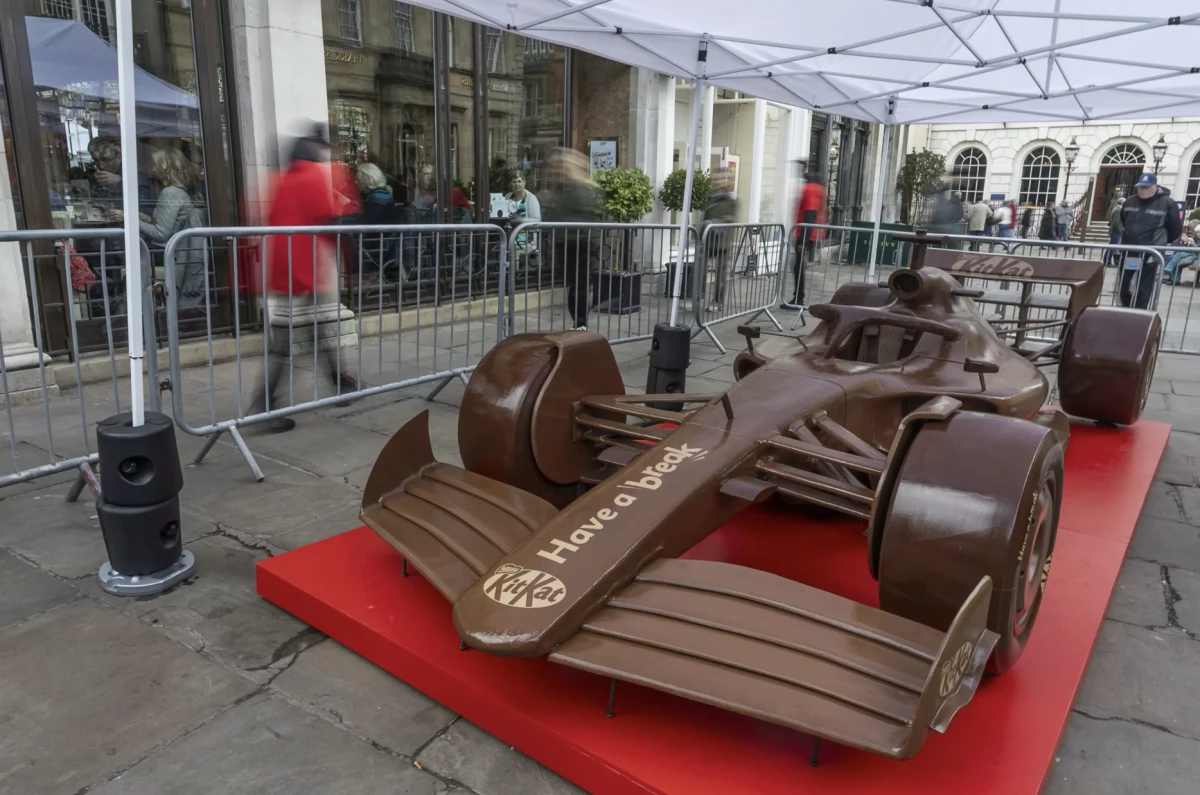
- KitKat built a five-meter chocolate Formula 1 car in York to celebrate its new role as the official F1 chocolate bar.
- The 350-kilogram sculpture took 1,254 hours to create and equals more than 16,900 two-finger KitKat bars.
- The campaign includes limited-edition products, race weekend visibility, merchandise, and fan activations.
KitKat just parked a 350-kilogram chocolate Formula 1 car in the middle of York.
The five-meter creation arrived in the historic English city to celebrate the confectionery brand’s growing relationship with F1, drawing crowds and media attention.
The giant chocolate car first debuted at the legendary Silverstone racetrack, where former racing driver and F1 commentator Billy Monger unveiled the piece.
From there, it made its way to York, widely known as the birthplace of KitKat, where visitors gathered at St Helen’s Square to see the edible replica up close.
Built entirely from chocolate and weighing about 350 kilograms, the sculpture took more than 1,254 hours to complete.
The project was led by master chocolatier Jen Lindsey-Clark and required the equivalent of more than 16,900 two-finger KitKat bars.
The installation highlights a deeper partnership strategy between the confectionery giant and the global racing league.
KitKat recently became the official chocolate bar of Formula 1, a move that connects the brand’s “Have a Break” positioning with the high-pressure world of pit stops and race weekends.
Scott Coles, managing director at Nestlé Confectionery in the U.K. and Ireland, saw the stunt as both a celebration of heritage and a marketing moment boosting the brand's relationship with F1.
"We’re incredibly proud to bring this spectacular F1-inspired chocolate car home to York, the birthplace of KitKat," Coles said in a press release.
"This city has been at the heart of our brand for generations, and sharing such a unique celebration of creativity and craftsmanship with the community means a great deal to us, as does our partnership with F1."
A Giant Sculpture Made Out of Chocolate
The giant chocolate car wasn’t just for photos.
Alongside the installation, visitors could sample a new limited-edition KitKat miniature replica chocolate car, now rolling out nationwide in the U.K.
The product features a milk chocolate shell filled with creamy chocolate and crispy cereal pieces, echoing the design of the larger sculpture.
The smaller collectible version turns the stunt into something consumers can actually buy, creating a bridge between experiential marketing and retail sales.
The campaign also connects to York’s role as a major innovation hub for the company.
The city is home to Nestlé’s global confectionery research and development centre, where teams experiment with new product formats and manufacturing techniques.
Across the season, the Formula 1 collaboration will extend far beyond this single display.
Planned brand activations include trackside visibility during race weekends, exclusive merch, social media campaigns, prize promos, and in-store experiences across major markets.
In short, the chocolate car acts as a physical centerpiece for a much wider marketing push built around the booming racing scene.
KitKat’s Take on Experiential Marketing
KitKat’s campaign shows how physical spectacle can turn a sponsorship into a shareable moment beyond sports fans:
- Experiential stunts can turn a brand sponsorship into a public event that attracts media coverage and organic social sharing.
- Limited-edition products tied to campaigns help convert curiosity from marketing spectacles into measurable retail demand.
- Locating campaigns in meaningful brand locations strengthens storytelling while reinforcing heritage and authenticity for long-time consumers.
As of 2012, about 20.5 billion KitKat bars every year, or 650 bars every second, are consumed across over 80 countries worldwide.
Our Take: Can a Chocolate Car Drive Real Marketing Value?
A five-meter chocolate race car is the kind of absurdly ambitious idea that gets people pulling out their phones and talking about the brand.
But we believe that the real trick here isn’t the sculpture. It’s the follow-through.
KitKat wisely turned the extravagant display into a product you can actually buy in mini form, which means the excitement doesn’t stop at the photo op.
In our view, that’s where the campaign earns its keep.
If a giant chocolate car gets someone curious enough to pick up a KitKat at the store, the stunt did exactly what it was meant to do.
Check out our top experiential marketing agencies that design campaigns to spark joy among audiences.