
Key SMB Takeaways on AI Adoption
75% of small and growing businesses are already experimenting with AI and seeing real results.
Clear messaging and transparency build SMB trust, helping overcome skepticism around AI.
Agencies that offer onboarding and hands-on support can turn AI tools into valuable growth drivers for SMBs.
75% of small and growing businesses are at least experimenting with AI — and seeing results, according to a Salesforce report.
But despite growing adoption, hesitation remains.
Many small and mid-sized businesses (SMBs) are drawn to the outcomes AI enables, such as time savings and automation.
However, they remain skeptical of the term “AI” itself due to concerns around accuracy, overhype, and trust.
This disconnect is at the heart of a new study from Duda and Localogy, the SMB Perceptions of AI and Automation Report.
The study surveyed 754 SMB owners to uncover how they perceive AI versus automation, and how agencies and SaaS vendors can drive adoption more effectively.
Editor’s Note: This is a sponsored article created in partnership with Duda.
The insight? In many cases, how you talk about AI matters just as much as what it does.
Here’s how to position AI tools for SMBs in a way that earns trust, drives results, and removes the buzzword barrier.
- Sell the Outcome, Skip the Jargon
- Earn AI Trust with Transparency and Help
- Close the AI Gap with Real-World Support
- Make AI the Next Everyday Essential
1. Lead With Benefits, Not Buzzwords
If you want SMBs to adopt AI tools, start by talking about what those tools actually do — not that they’re powered by AI.
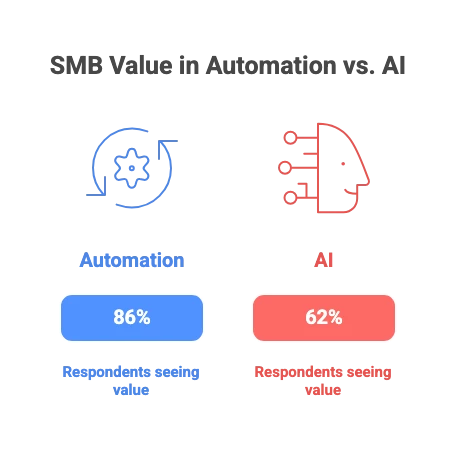
In the survey, 86% of respondents saw value in automation, while only 62% said the same about AI, even when describing the same capabilities.
Why the disconnect?
For many SMBs, “automation” signals something practical and proven. “AI,” by contrast, still carries baggage: hype, uncertainty, and a lack of transparency.
“We found that simply replacing the word ‘AI’ with ‘automation’ led to a clear rise in positive sentiment. It shows the gap isn’t just about tech literacy; it’s about trust,” a Duda representative said.
This reinforces the importance of proper framing when it comes to selling AI tools to SMBs.
You’re not selling AI. You’re selling clarity, control, and business results.
A great way to do this would be to emphasize benefits like faster workflows and reduced manual effort resonates more than leading with tech terms.
2. Build AI Trust Through Clarity and Support
The same Duda-Localogy report shows 30% of SMBs say AI features influence their software purchasing decisions.
But that doesn’t mean they fully trust the tech.
Many remain cautious, unsure about AI’s accuracy, reliability, and relevance to their everyday operations.
In fact, 15% of SMBs say they’re still unclear about what AI even does, compared to just 2% when asked about automation.
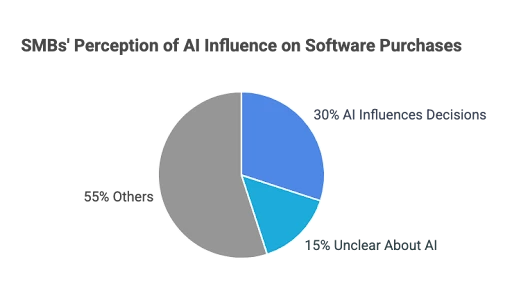
This trust gap is one of the biggest obstacles to AI adoption, but also one of the biggest opportunities.
“SMBs are eager for innovation, but they also exercise caution. That’s why it’s critical for agencies and software providers to not just offer AI tools, but provide guidance and training around how to use them,” a Duda representative explained.
To close the trust gap, software providers and agencies need to go beyond just offering AI-powered features:
- Explain where AI is used in your product, and what it actually does
- Use plain, relatable language
- Share practical examples that reflect real SMB workflows
- Include onboarding and guided walkthroughs to ease the learning curve
- Offer ongoing support so users feel confident and in control
3. Bridge the AI Gap With Hands-On Support
The Duda-Localogy report also shows that 70% of SMBs believe agencies should offer AI-powered services, but they don’t want features alone.
They want support, onboarding, and training that help them put those features to use.
This is a chance for agencies to go beyond implementation and become educators and strategic partners.
“What SMBs want isn’t just a new tool. They want help understanding it, applying it, and getting ROI from it,” a Duda representative said.
Agencies that invest in enablement, whether through onboarding sessions, AI-powered content workflows, or co-piloted campaign execution, can increase confidence, build retention, and become indispensable.
4. Position AI as the Next Phase of Everyday Tools
With 92% of SMBs already using digital platforms for tasks like HR, payroll, and finance, the infrastructure for AI adoption is already in place.
The challenge is perception: many SMBs don’t realize that AI is often just a smarter, faster version of the tools they already use.
To shift that mindset, frame AI as the natural evolution of automation.
Show how it improves things they already trust:
- Faster scheduling and form responses
- Smarter website content generation
- Streamlined reporting and analysis
Grounding AI in real use cases helps SMBs see it not as a risk but as an upgrade.
When they understand how AI enhances tools they already use, it becomes a natural next step rather than a disruptive shift.
Sell the Results, Not the Buzzwords
The data is clear: SMBs want the benefits of AI, but not the hype.
Companies like Duda understand the importance of focusing messaging on practical results rather than technical jargon.
When marketing AI tools to this audience:
- Talk less about the tech itself
- Talk more about time saved, tasks simplified, and outcomes improved
- If the term “automation” builds more trust, use it
In the end, SMBs don’t care if it’s AI, ML, or GPT behind the curtain. What they really care about is that it works.