
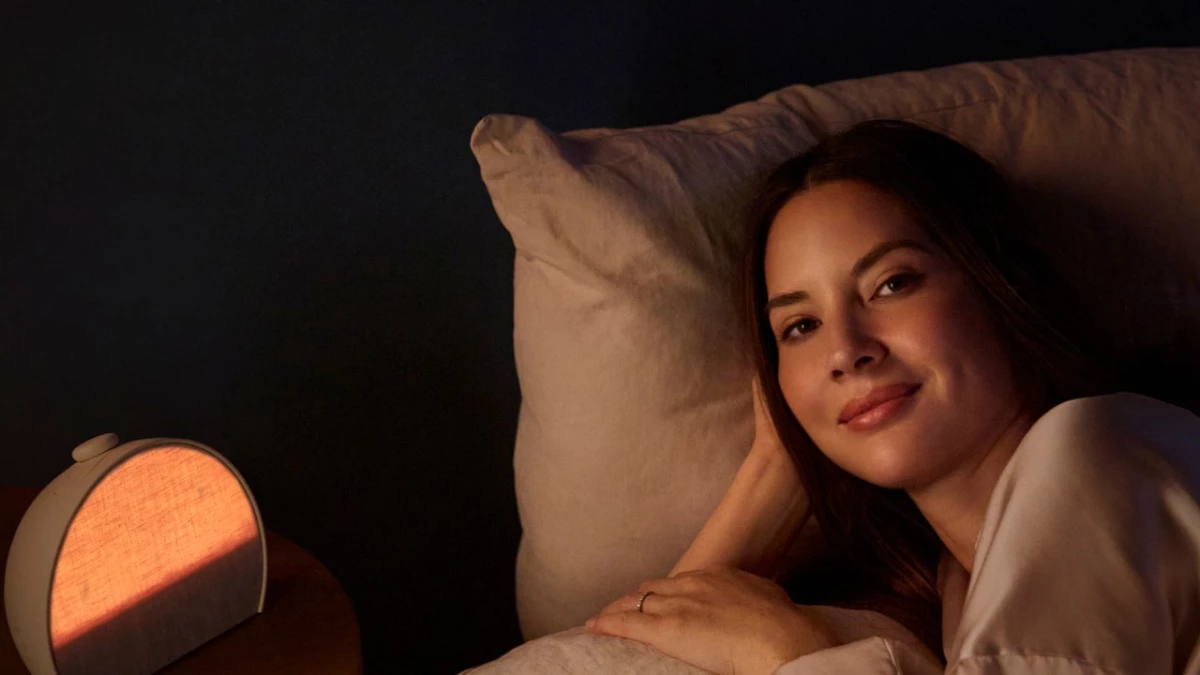

Hatch just asked Olivia Munn to tell shoppers they can stop grading their sleep.
The company has launched "Life of Scores," a brand new campaign starring Munn for the "Hatch Sleep Clock," its new bedside sleep tracker.
Nearly every habit in wellness comes with a number now, and Hatch wants sleep to stay off that list.
Munn said in a press release that her days are already full of decisions by the time bedtime arrives.
"I don’t want more data or another metric to think about. I just want to wind down," she added.
"That's what I like about Hatch. It turns bedtime into something I look forward to instead of something I keep pushing off."
Creative studio Ways & Means developed the campaign in collaboration with Hatch.
Hatch is selling into a non-wearable sleep tracker market worth $1.72 billion, and it wants people focused on the routines that get them to sleep.
Peloton ran the same anti-metrics pitch three weeks ago with Miley Cyrus, and Hatch is now making it for sleep.
Wellness brands keep reaching for celebrity marketing to give a product a human voice.
The "Attack of the Show!" host gives Hatch a voice for the irritation sleep scores cause, which is harder to show than a number on a screen.
A Day Full of Metrics, A Night With No Score
The 30-second spot opens with Munn in bed, counting hours of sleep, steps, screen time, and a forgotten field trip form.
And then comes bedtime, the one part of the day where Hatch argues the scorekeeping should stop.
This sets up the Hatch Sleep Clock, which uses contactless tracking to learn a person's sleep patterns.
Hatch says the sensor detects sleep with 97% accuracy and sends personalized insights to the app.
"Hatch Sleep Clock learns how I sleep, so my bedtime routine actually works for me," she says, as she closes her eyes and the spot ends.
Guided routines, original sleep audio, and circadian-backed lights give users ways to wind down each night.
Hatch also lets owners see their sleep data without a Hatch+ membership, so the pitch holds up at the point of purchase.
At 249.99, Tom's Guide notes that the Sleep Clock costs $80 more than the $169.99 Restore 3, Hatch's sunrise alarm clock.
The added tracking has to justify this gap, and Hatch is using Munn to do it instead of a feature list.
"Life of Scores" debuted on October 12 across YouTube, CTV, social, and digital platforms, which reaches viewers at home and on their phones.
Product positioning holds up when the hardware already does what the ad promises.
Hatch wrote the no-score rule into the device itself, so Munn is describing a real setting.
Non-Wearable Sleep Trackers Hit $1.72B in 2025
Spherical Insights estimated the global non-wearable sleep tracker market at $1.72 billion in 2025 and expects it to reach $5.25 billion by 2035.
Hatch sells into this category at $249.99, and a price like this needs a reason bigger than a data readout.
A product launch priced above the brand's own lower-priced model needs the story to explain the gap, since a spec sheet rarely does.
Peloton ran a similar play with Miley Cyrus for the Tread Flex, its first foldable treadmill.
"Let Yourself Run" debuted on September 22, about three weeks before Hatch went live with Munn.
Peloton CMO Megan Imbres pitched it as a change in the conversation about fitness, describing it as an "era of optimism that celebrates what the body can do."
Hatch makes a comparable case for sleep, with Munn in Cyrus' role.
Brands planning a celebrity-fronted wellness launch can borrow these three moves:
- Pick one claim and repeat it: A single product promise gives the celebrity one line to deliver, which keeps every cut of the spot saying the same thing.
- Match the star to a daily routine: Casting someone whose schedule mirrors the viewer's makes the product read as part of an ordinary evening.
- Debut everywhere on one date: A single launch date across channels puts the same idea in front of a shopper several times in one week.
A familiar face pushing the no-score agenda gives a $249.99 device a stance that shoppers can repeat.
Celebrity endorsements do the most when the star is selling an opinion that the audience can take a side on.
Our Take: Can a Tracker Win Trust by Skipping the Grade?
A bedside device that watches you breathe all night asks for a lot of trust, and Hatch is asking for it with a pitch about lowering the stakes.
We think the pitch holds up because a sleep score hands people a verdict before breakfast, and those numbers are a lousy way to start a day.
Hatch still sends personalized "Night Notes" after about seven nights, so the app's tone is what gets tested here.
Oura and Whoop built real businesses on a daily score, and plenty of people like opening the app to see it.
So the no-score pitch is not a universal truth; it is a segment play.
Hatch is selling to people who never wanted a wearable and those who the metric-heavy apps burned out.
Munn is here for the second group, since the first one needs no convincing.
We see the first seven Night Notes deciding whether the actress' line about winding down survives the product launch.
Find the teams continuously driving growth and engagement across every platform.
Check out these top digital marketing agencies in our directory.