
Gopuff x Tom Brady & Druski: Key Findings
- Gopuff backs a federal holiday push with The Super Monday Off Coalition, addressing $3 billion in lost productivity with Tom Brady and Druski.
- The "HARD PASS" campaign combines CTV ads, in-app donations, and congressional lobbying, turning consumer participation into real action.
- Celebrity advocacy addresses a real frustration, aligning the delivery service with a cultural movement.
Gopuff just handed Tom Brady and Druski footballs and told them to start throwing.
The target? Anyone stuck at work on the Monday after the Big Game.
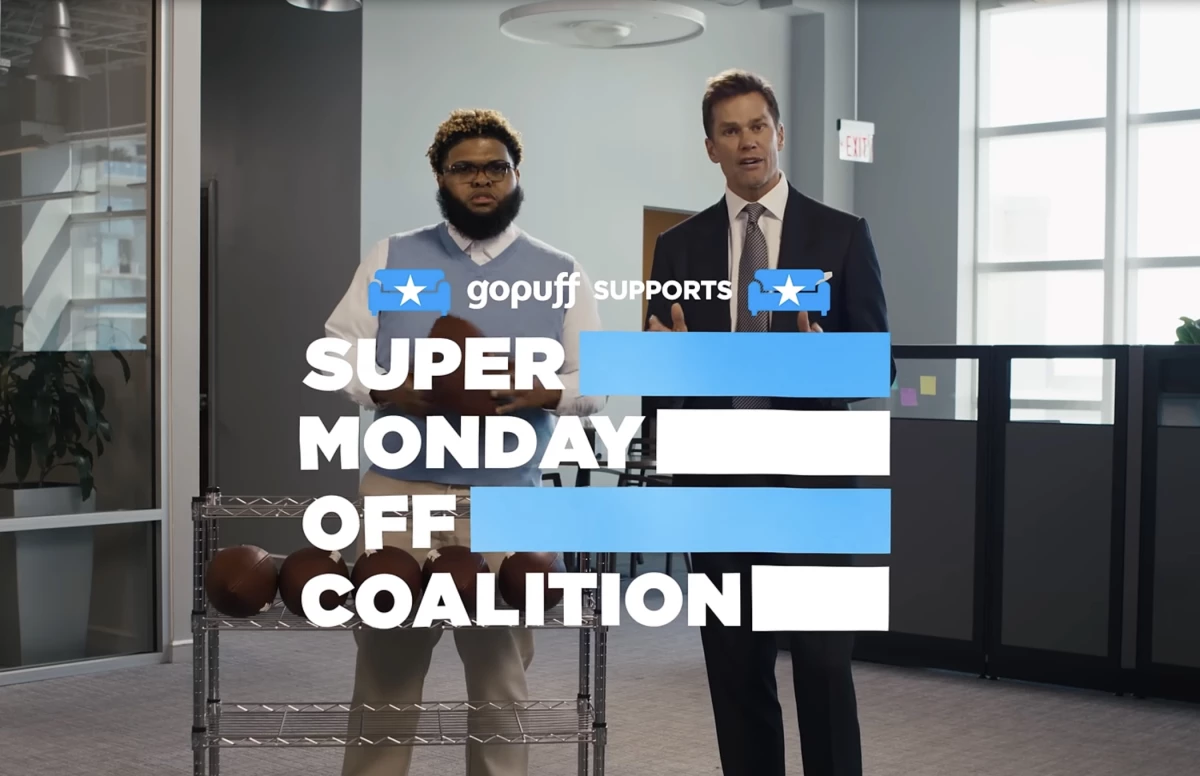
The delivery platform launched its "HARD PASS" campaign today, November 26, to support The Super Monday Off Coalition.
It's a 501(c)(4) nonprofit lobbying Congress to make the day after the Big Game a federally recognized holiday.
#SuperMonday is a real thing, alright? Don’t believe me? Too bad, cause it’s a thing. pic.twitter.com/PkSblI2URJ
— FOX (@FOXTV) February 1, 2020
Directed by Pete Marquis through creative studio Shadow Lion, the campaign will premiere during the Green Bay vs. Detroit Thanksgiving Day game on FOX.
It shows the NFL star and comedian pelting office workers with footballs while they struggle through post-game exhaustion.
"The Big Game brings every single American together," Gopuff Co-CEO Yakir Gola said in a press release.
"That's why the Monday after the Big Game must become Super Monday – an official federal holiday that honors our love for competition, victory, and the greatest country on Earth."
Gopuff positions itself as the first major corporation backing the federal holiday push, making the campaign more than just a marketing stunt.
Post-Game Absenteeism as a Path to Advocacy
Showcasing the dreaded in-office Super Monday experience, the campaign acknowledges what everyone already knows.
People often call in sick on the Monday following the Super Bowl.
Harris Poll data shows 43% of employed Americans believe the day should be a national holiday, with 56% wishing their employer would grant them the day off.
Experts also estimate that American businesses lose about $3 billion annually from unexpected absences and low productivity.
Gopuff argues that making it an official holiday replaces disruption with predictability, letting employers plan ahead instead of scrambling to cover shifts.
Brady also explains how he's deepened his partnership with Gopuff to address what he sees as a major economic drain.
"A massive number of employees unexpectedly call out of work the day after the Big Game, creating a huge headache for businesses across the country and a drag on our economy."
The campaign will run across linear TV, CTV, and IRL activations throughout the remainder of the football season.
Gopuff has also built direct participation into the campaign structure.
From today through February 8, 2026, the platform will donate 1% of profits from its Super Monday Off collection to the coalition, capped at $25,000 per week.
Customers can add donation cards directly to their carts through the app.
The official website also lets visitors sign petitions and contact legislators, converting brand engagement into political action.
Why Advocacy-Driven Marketing Works Now
Gopuff is tapping into a broader shift toward brands taking public stances on cultural issues.
Studies show 87% of consumers will purchase from a company that advocates for an issue they care about.
This makes advocacy a strategic tool for brands looking to differentiate beyond product features.
Super Bowl marketing also continues to dominate cultural conversations, with 30-second ad spots reaching up to $8 million this year.
Gopuff uses this moment by positioning itself as a brand that understands how the Big Game actually affects Americans' daily lives.
The campaign also reflects how brands can use celebrity partnerships to drive movements in addition to sales.
Brady and Druski also give the coalition visibility that would be harder for a traditional lobbying effort to achieve, converting cultural frustration into action.
Here's what brands and agencies can learn from Gopuff's advocacy strategy:
- Start with real problems: Gopuff didn't invent the issue of post-game absenteeism, and instead acknowledged what everyone already knows happens.
- Make participation easy: The campaign gives people multiple ways in, such as buying products, donating directly, signing a petition, and contacting legislators.
- Use celebrities as actual advocates: Brady and Druski are driving a movement that links to Gopuff's values and creates cultural conversation.
This is a repeatable model that other brands can use when they want advocacy to do more than just generate buzz.
Our Take: Can Lobbying Actually Work as Marketing?
I think Gopuff nailed the execution here.
The campaign feels genuine, building multiple participation layers that give consumers real urgency.
I also like how Brady's legacy adds workplace credibility to its case, while Druski keeps it relatable with humor.
Even if Congress doesn't act fast, Gopuff has shown us how important cultural touchpoints can be in shaping daily life.
This is the kind of brand equity that lasts longer than any single campaign.
RITZ is also returning to the Super Bowl in 2026 with football-shaped crackers and a third-quarter spot.
Sports marketing succeeds when brands partner with agencies that understand cultural moments and advocacy-driven storytelling.
Explore our top sports marketing agencies that specialize in turning live events into lasting brand impact.