
Generative Engine Attribution: Key Findings
- Zero-click searches now dominate as 69% of Google searches end without a website visit after AI Overviews, which makes visibility inside AI-generated answers a core performance metric rather than traditional traffic reporting.
- AI is reshaping product discovery with nearly 47% lower click-through rates when summaries appear, requiring executives to measure demand creation earlier in the journey instead of relying on click-based signals.
- Attribution is becoming probabilistic as buyers are influenced by repeated AI exposure that never shows up in GA4 or UTMs, pushing companies to track AI share of voice and strengthen structured sales feedback loops to capture real influence.
Your prospect just booked a demo. You ask how they found you. “I’m not sure,” they say. “I just kept seeing your name come up.”
No UTM parameter. No referral source. No session in GA4. Just a deal in the pipeline and zero idea how it got there.
Welcome to the attribution crisis that generative AI is quietly building inside your funnel.
As AI-powered answer engines synthesize responses from multiple sources without surfacing clickable URLs, the tracking infrastructure that performance marketers have relied on for decades is becoming obsolete.
For revenue-focused executives, this is far more than a search trend to monitor.
View this post on Instagram
The crisis is already underway, and it’s eroding the data models that budgets are built on.
Zero-Click Search and Declining Referral Traffic
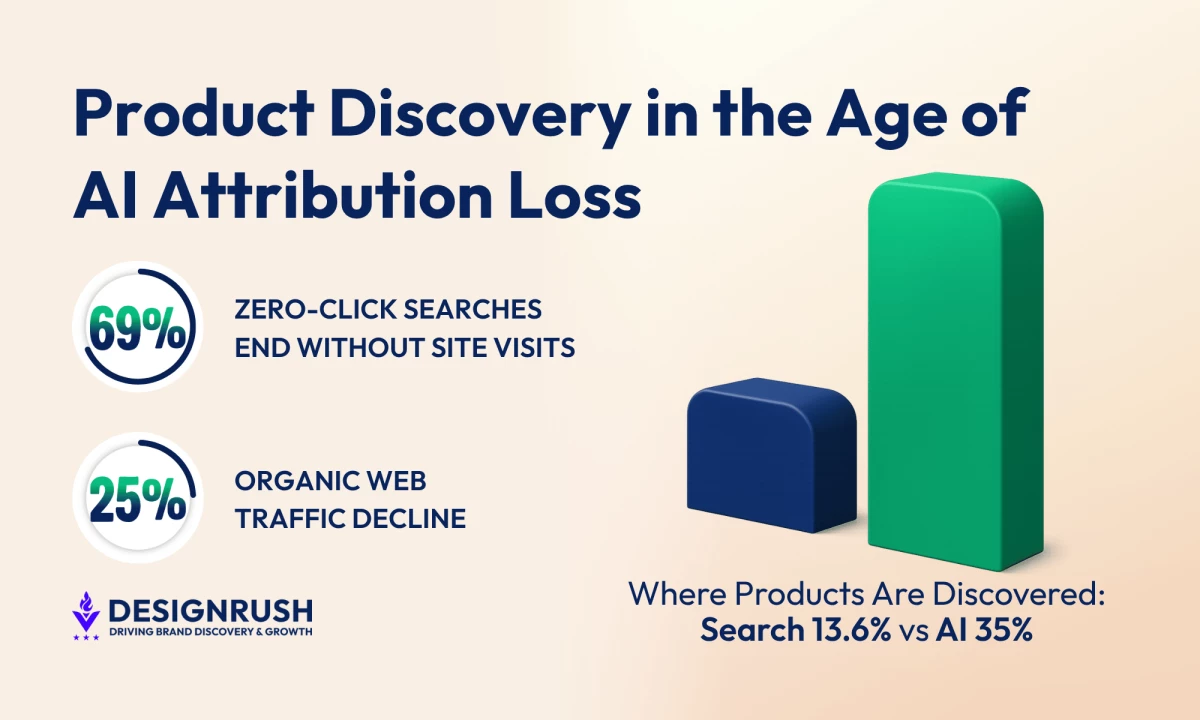
After Google’s AI Overviews launched in May 2024, the share of zero-click searches on Google climbed from 56% to 69% in just one year (a 13-point jump), SimilarWeb found.
That means nearly 7 in 10 searches now end before a user ever reaches a brand’s website.
The problem extends beyond Google.
About 80% of consumers now rely on zero-click results in at least 40% of their searches, according to Bain & Company, which is reducing organic web traffic by an estimated 15% to 25%.
Meanwhile, DigiDay reported that general search referral traffic to 1,000 web domains dipped from 12 billion global visits in June 2024 to 11.2 billion in June 2025, roughly a 6.7% decline year over year.
The referral traffic arriving from AI platforms like ChatGPT and Perplexity is real, but it doesn’t offset these losses.
At least not yet.
Where Attribution Breaks
Traditional web analytics operate on a clear premise: A user clicks a link, a session begins, and a conversion gets assigned to a source.
Last-click attribution, even in its most criticized form, produced a number. Something was measured.
Generative engine optimization (GEO) disrupts this at the source.
When Google AI Overviews, Perplexity, or ChatGPT synthesizes an answer, it may draw on a brand’s published expertise without ever sending the user anywhere.
A Pew Research study of 68,000 real search queries found that users clicked on results just 8% of the time when AI summaries were present, compared to 15% when they were absent, showing a clear drop in click-through behaviour when generative summaries appear.
That’s a 46.7% relative reduction in click-throughs.
The brand whose content informed the response receives no referral signal, the session never starts, the funnel never opens, and critically, GA4 has no mechanism to record what never arrived.
According to Similarweb, 35% of U.S. consumers use AI during product discovery, compared to 13.6% who use traditional search.
Purchase decisions are increasingly forming before a user ever lands on a website. Instead, the shortlist is being set inside the AI response itself.
When a prospect eventually enters a sales conversation and says they “kept seeing the brand come up,” that is generative engine influence operating entirely outside any trackable channel.
The brand shaped a decision without producing a session, a lead form submission, or a UTM parameter.
This is what probabilistic attribution looks like in practice.
Instead of a clean referral path, there’s a pattern of brand exposure across AI-synthesized responses that compounds over time until a buyer enters the funnel with existing preferences.
The problem for most organizations is structural. Performance teams are staffed, incentivized, and evaluated on click-based metrics.
Brand-level measurement is treated as a softer, secondary concern. But that division no longer reflects how buyers actually make decisions.
What Executives Need to Rethink
The immediate risk is misallocation.
If last-click attribution continues to be the primary performance signal, channels that generate AI-mediated brand authority will appear to underperform compared to paid channels capturing demand at the bottom of the funnel.
Budget shifts accordingly, undermining the exact asset, authoritative content, that earns presence inside AI responses.
Three adjustments are worth prioritizing now:
1. AI share of voice should be treated as a measurable output.
GEO practitioners now measure how often a brand is mentioned in AI-generated answers, which URLs or domains are cited, and a brand’s share of voice relative to competitors using tools like BrightEdge, Semrush, Google Analytics, etc.
Establishing a baseline today creates the data foundation needed to demonstrate influence over time.
2. Self-reported attribution from sales conversations deserves more systematic collection.
Every lead generation form should include an open-ended field asking, “How did you hear about us?” Just don’t include a dropdown, as it can introduce bias.
Open-ended fields allow prospects to report things like “I asked ChatGPT for the best tool, and it recommended you,” the kind of specificity no analytics dashboard can surface.
3. Content strategy must align with how generative engines evaluate credibility.
Content with verifiable statistics and named citations achieves 30% to 40% higher AI visibility than unoptimized content, as per SimilarWeb.
Specificity, sourced data, named authorship, and clear topical focus are the signals that determine which brands get cited and which are invisible.
How Misattribution Impacts Revenue
Attribution matters because budgets follow it.
When AI-mediated influence can’t be traced to a revenue outcome, it’s systematically underfunded.
As such, brands that fail to adapt their measurement frameworks will keep pulling investment away from the very content that’s shaping purchase decisions upstream.
The organizations that are best positioned for this aren’t necessarily those with the largest content libraries. Instead, they’re the ones that recognize zero-click doesn’t mean zero impact and that influence without a click still requires an instrument to detect it.
Building that instrument now, before the gap between actual influence and reported influence widens further, is the more urgent strategic priority.