
"The Domino" has arrived, and Domino's wants you to buy from its competitor before you try it.
The pizza chain is running a promotion called "Is the Domino Worthy?" that asks customers to buy an item from a rival fast-food chain first.
They can then trade the receipt for a free Domino, the Detroit-style personal pizza that hit stores nationwide on Aug. 31.
And the chain put up to $1 million worth of pizza behind the offer, and the pitch is blunt.
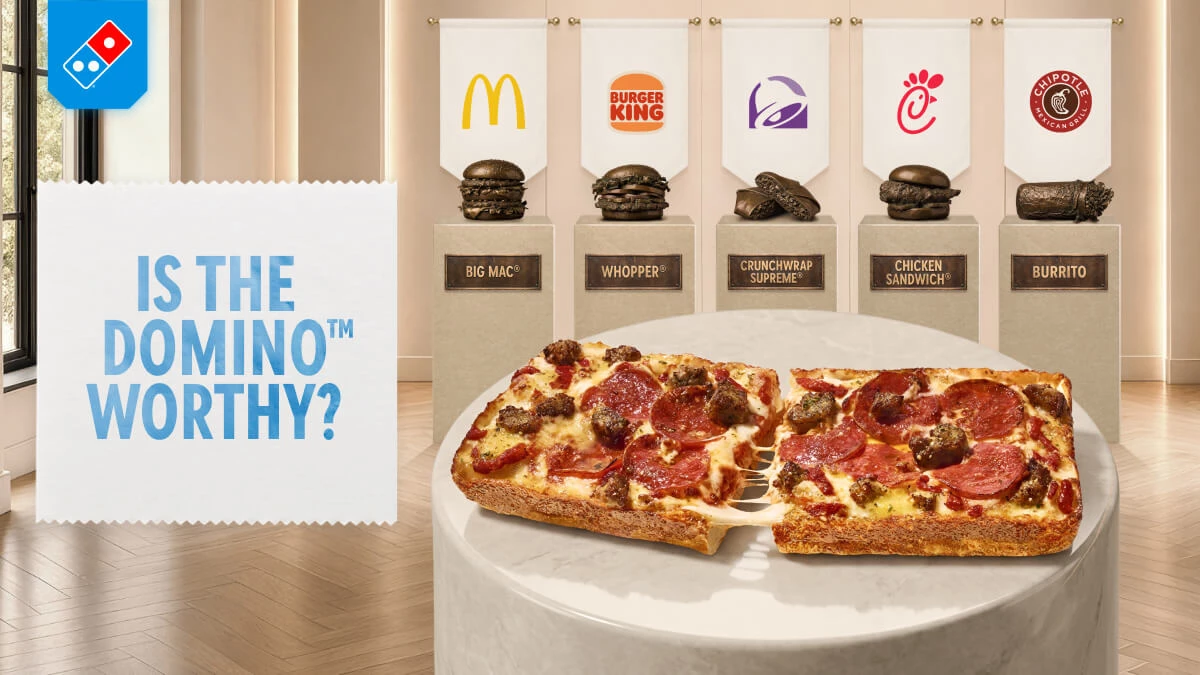
Does a pizza shaped like the brand's own logo deserve a spot next to the Big Mac, the Whopper, and the Crunchwrap Supreme?
With bold confidence, Domino's is putting the answer in customers' hands.
The offer runs through Sept. 30 or until 105,375 codes are gone, whichever comes first.
Each code covers one three-topping Domino valued at $9.49, which is how Domino's arrives at a headline figure of $1 million.
The terms also include a free entry route, and customers can request a code without uploading a competitor receipt at all.
Both routes end at the same place, which is a single-serving pizza in front of one person.
Domino's EVP and CMO Kate Trumbull sees the pizza as a response to how people eat now, "where a meal doesn't always mean sharing the same pizza."
"It solves a problem traditional pizza never could: everyone gets the toppings they love, without having to compromise," Trumbull said.
She added that the product performed well in independent testing.
"We saw an opportunity to reinvent pizza from the crust up, and the result is the Domino," she added.
The Domino is made with buttery pan dough and a Parmesan-crusted edge, two layers of cheese, a choice of sauce, and up to three toppings.
A drizzle of garlic seasoning finishes it, and the pie comes cut into two slices.
What makes it special is how it follows the shape of Domino's own logo, and rated among the best-tasting products the chain has tested.
This effort builds on the pizza's late-August debut.
Domino's introduced the item as its first namesake product in more than 65 years.
And the launch was timed to flat U.S. same-store sales and a stated goal of pulling in late-night diners.
The current giveaway pushes the introduction into a public comparison test, with a dollar figure attached to it.
The Domino in Action
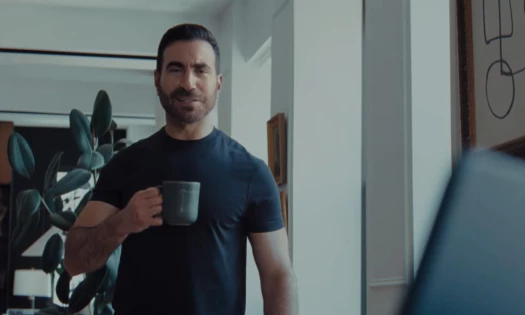
The campaign is called "Pizza Can't. The Domino Can," and it opens on a 60-second hero spot from agency of record WorkInProgress.
It starts with a family visually disappointed with their pizza, with one child expressing his dislike for pineapples.
The scene cuts to a climber with a box of Domino's on his back, struggling to enjoy it as he makes his ascent.
We then see a gamer accidentally knock her water bottle on her keyboard as she holds a big box of pizza, causing the keyboard to short-circuit.
Each situation then blows out of proportion.
The pineapple kid lashes out at his dad, a car of friends careens off a cliff, the gamer's desk catches fire, and the climber falls.
The solution? The new Domino.
Three 30-second cuts expand on individual scenes, and a 15-second product ad runs alongside them.
The buy spans linear, Netflix live spots, connected TV, paid digital, and social.
The rollout also includes placements during the NFL international opener on Netflix on September 10 and the Emmys on September 14.
To claim a free Domino, customers must first purchase any of the following:
- A Big Mac from McDonald's
- A Whopper from Burger King
- A Crunchwrap Supreme from Taco Bell
- A Chicken Sandwich from Chick-fil-A
- A Burrito from Chipotle
They then upload the receipt to IsTheDominoWorthy.com, and Domino's emails back a code on a first-come, first-served basis.
Codes expire on October 14, with one claim per person.
The mechanic asks most entrants to spend money at a competitor before the chain gives them a free taste of the Domino.
The entry ticket is a receipt from one of five chains.
This promotional strategy gives Domino's a rough read on which fast-food orders its target customer already has in rotation.
Naming the Competition Is the Campaign
A meta-analysis of comparative advertising published in the Journal of Marketing found that naming a rival lifts attention, recall, and message awareness.
The same work found that these ads score lower on source believability.
Meanwhile, challenger brands comparing themselves to established ones gain the most.
Domino's is the challenger here, since pizza has never held a spot in the single-serving fast-food set.
Domino's is trading some of that believability risk for a mechanic that produces real transaction data across five different chains.
- Require proof, not just attention: A receipt closes the gap between a claim and a completed purchase, which builds trust differently than a headline comparison would.
- Name the exact rival: Listing McDonald's, Burger King, Taco Bell, Chick-fil-A, and Chipotle by name turns a vague fast-food claim into five specific, checkable ones.
- Fund the comparison with product: Paying out in pizza instead of ad placements keeps the cost tied directly to how many people complete the loop.
Remember that a giveaway that starts at a competitor's counter only holds up if the free item at the end justifies the detour.
The Big Mac has 60 years of muscle memory working for it, and the Domino gets one chance to answer that.
Our Take: Does the Receipt Requirement Do Any Work?
Domino's wrote a free entry route into its own terms, so nobody actually has to buy a Big Mac to get a Domino.
We'd like to think that the receipt was never the mechanism that mattered.
The five logos on the microsite do the work because a customer reading the offer has already filed the Domino next to the Whopper.
The receipts Domino's does collect still hold value, since they show which chains its trial customers already visit.
Emergency Pizza drew over 5 billion earned media impressions on a similar setup, where the mechanic was the story, and the giveaway was the excuse to tell it.
We'll find out in the coming weeks whether the pizza for one isn't just talked about, but also good enough to garner repeat purchases.
Find the teams driving growth and engagement across every platform. Check out these top digital marketing agencies in our directory.