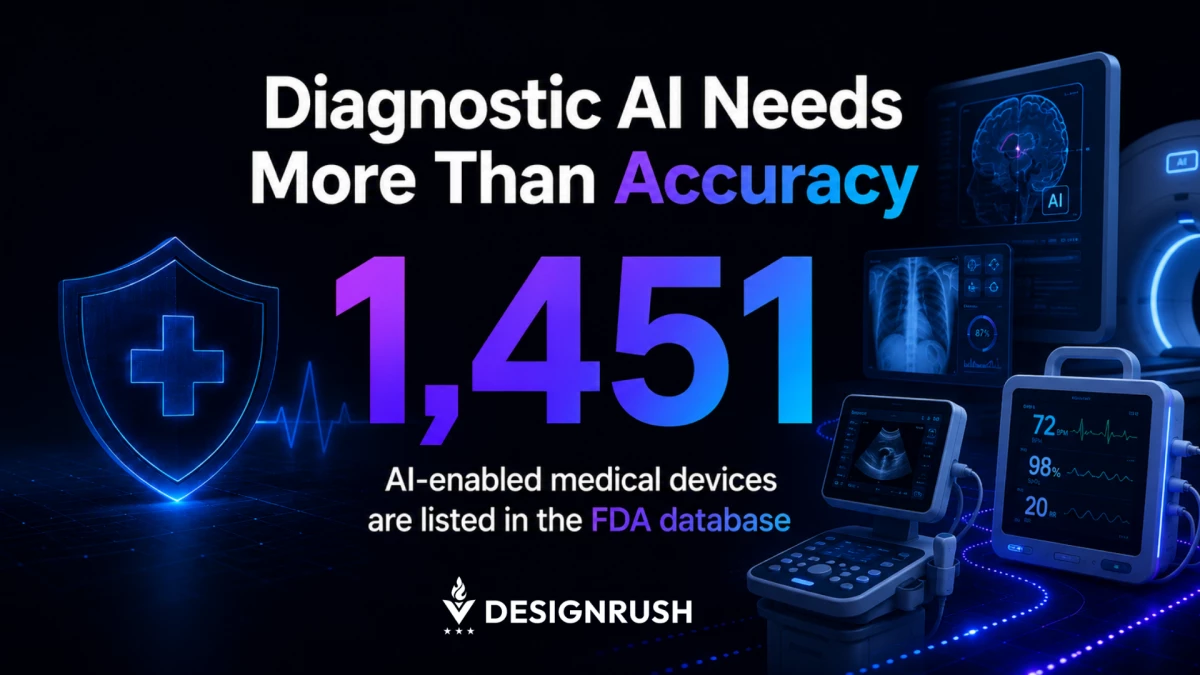

More AI-driven medical devices keep entering the U.S. market, with the FDA's existing database containing 1,451 AI-enabled medical devices.
Of those, radiology takes first place among all types of devices.
In 2025 alone, 331 devices were added to the FDA list, becoming the largest annual increment in the agency's history.
However, having the right regulation for an AI product does not guarantee its safe operation in any clinical setting.
The performance of diagnostic AI could be dependent on a variety of factors such as patient demographics, data quality, machine capability, procedures, and many others that exist in the clinic.
Validation and governance, therefore, play an equal role in the performance of the AI models.
It is necessary that the diagnostic or predictive AI should undergo a certain research procedure that includes data selection, bias check, transparency, human involvement, and monitoring, among many others, before it becomes part of patient care.
YouTube channel, Medicalfuturist, breaks down the rapid growth of FDA-authorized, AI-based medical devices over the years:
What Diagnostic AI Validation Actually Means
Validation goes beyond showing that the AI model works effectively on the test dataset.
It aims at proving the reliability of the AI model under its specific purpose, target population, environment, and process.
That means validation should consider:
- Whether the study population represents intended patients
- Whether the test data reflects real clinical conditions
- Whether performance remains consistent across sites and equipment
- Whether clinically meaningful outcomes are being measured
- Whether limitations and failure conditions are understood
The FDA's approach to AI-enabled medical devices emphasizes evaluating safety and effectiveness in relation to a device's intended use and technological characteristics.
The Key Layers of Diagnostic AI Validation
Validation of an AI diagnostic tool involves more than verifying that the tool makes accurate predictions.
The performance of the tool must be tested to verify that it consistently works under various patient populations and clinical scenarios.
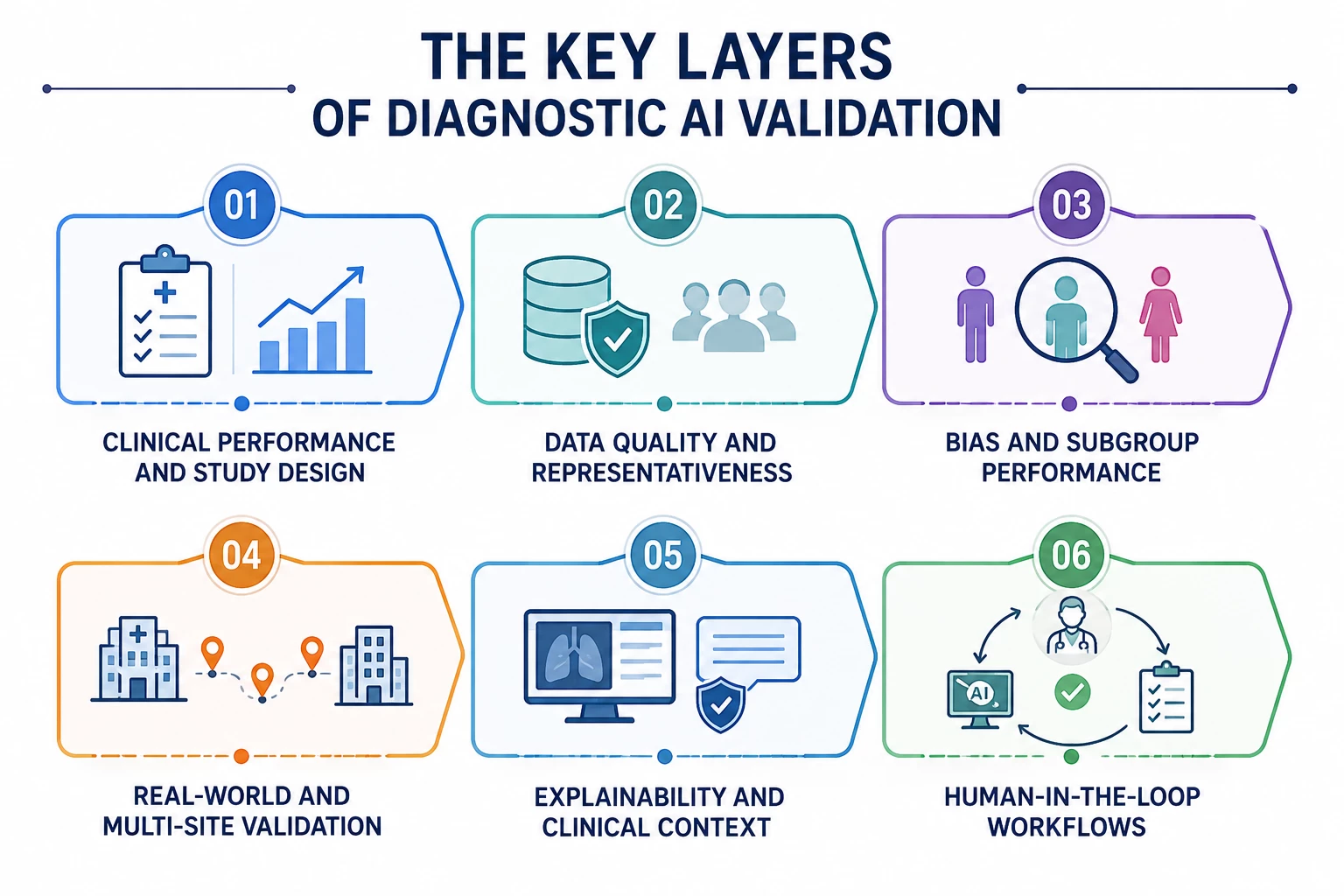
Clinical Performance and Study Design
An AI diagnostic system requires proof of clinical utility of its outputs, rather than merely its prediction accuracy in correlation with a validation dataset.
Depending on the intended application, the performance evaluation may involve sensitivity, specificity, false-positive rate, false-negative rate, predictive value, and many other clinical endpoints.
Before the evaluation, the study design should also determine the target population, reference standard, sample size, endpoints, and statistical analysis method.
Data Quality and Representativeness
An AI system may have good performance with regard to a training data set but behave differently when tested with data obtained from a different hospital, different device, different population, or different clinical setting.
Validation should therefore examine differences in:
- Patient demographics
- Disease prevalence
- Imaging or diagnostic equipment
- Data quality
- Clinical settings
- Acquisition and preprocessing methods
The more similar the validation data to the operating environment of the system, the more relevant the performance evidence is.
Bias and Subgroup Performance
Overall accuracy can hide performance differences between patient groups.
Validation should test for consistency of performance among relevant demographic and clinical subpopulations and determine where there might be drops in performance.
This is especially the case if the diagnostic system affects decisions in ways that impact patients' lives.
Real-World and Multi-Site Validation
A model that works well on a restricted dataset might experience other circumstances when used in a clinical setting.
By validating across multiple sites, instruments, processes, and patient groups, one can uncover problems that would have remained hidden during development.
Real-world performance should thus be seen as an evidence component, rather than something considered only after deployment.
The FDA has specifically sought input on approaches for measuring AI-enabled medical-device performance in real-world settings, including detecting performance drift.
Explainability and Clinical Context
Clinicians need to have sufficient information to interpret an AI output in the clinical workflow setting.
It is not advisable that the output of an AI system is just an absolute conclusion. The output must give context, confidence information, limitations, or supporting evidence where applicable.
The aim is not to remove clinical judgment but to improve informed decision-making.
Human-in-the-Loop Workflows
Diagnostic AI should be designed around clinical workflows rather than operate independently from them.
The system should define:
- When clinicians review AI outputs?
- When can results be accepted or overridden?
- How are uncertain cases escalated?
- Who is responsible for the final clinical decision?
- How are AI errors or disagreements recorded?
This keeps the clinician involved where professional judgment is required.
Governance Continues After Regulatory Authorization
Validation does not end when a model receives regulatory authorization or enters production.
AI integration into app workflows works in environments where patient populations, clinical practices, data sources, and software dependencies can change over time. Governance therefore needs to continue throughout the product lifecycle.
A practical governance cycle can be:
- Validate
- Approve
- Deploy
- Monitor
- Review
- Update
This requires clear ownership across developers, clinical teams, compliance teams, and the healthcare organization using the system.
Key governance practices include:
- Performance monitoring: Monitor accuracy, errors, drifts, and surprises.
- Auditability: Keep track of the version of the model, validation, changes, and incidents.
- Clinical oversight: Identify people who assess system performance and determine when intervention is needed.
- Periodic revalidation: Re-evaluate performance in the event of major changes.
- Change management: Assess changes to models, data, software, and clinical processes before implementing them.
Predetermined Change Control Can Help Manage AI Updates
AI systems can evolve after their initial development, which creates an important regulatory and engineering challenge.
The FDA's guidance on Predetermined Change Control Plans (PCCPs) provides a framework for describing planned modifications to certain AI-enabled device software functions and how those changes will be managed.
For development teams, this means changes should not simply be pushed into production because a new model performs better in development.
A controlled approach should define:
- What types of changes are anticipated?
- How will those changes be evaluated?
- What validation is required?
- What performance thresholds apply?
- When may regulatory review be necessary?
- How are changes documented and monitored?
This creates a more predictable path for maintaining AI systems as they evolve.
What Safe Deployment Looks Like in Clinical Practice
A safe diagnostic AI workflow keeps the technology within a controlled clinical process:
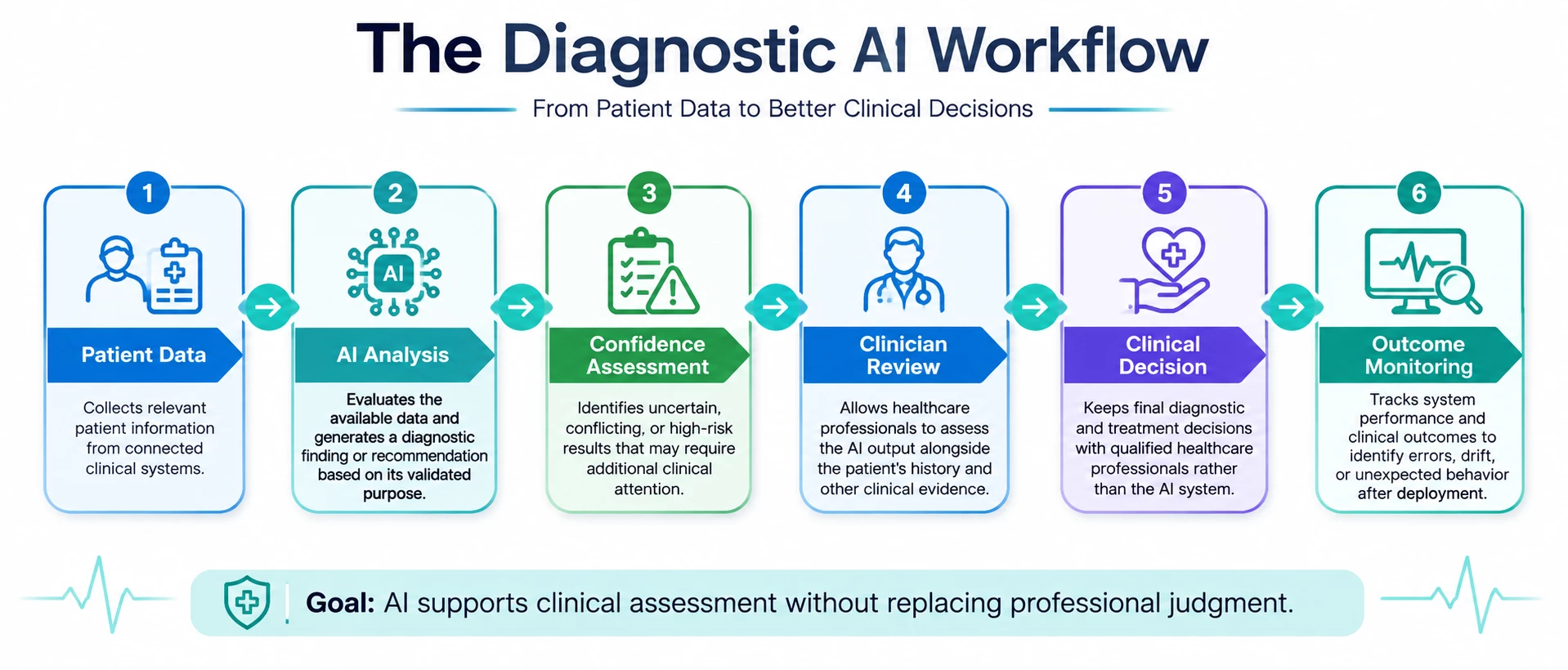
- Patient information: Accesses patient data from connected clinical applications and processes it for further analysis.
- AI analysis: Evaluates the available data and generates a diagnostic finding or recommendation based on its validated purpose.
- Confidence assessment: Pinpoints any uncertain, contradictory, or high-risk outputs that may warrant additional clinical review.
- Clinical review: Gives the possibility for healthcare professionals to evaluate AI results together with patient history and other clinical data.
- Clinical decision making: Preserves decision-making on the part of trained healthcare professionals without transferring all the control to AI.
- Outcomes tracking: Monitors the performance and outcomes of the system to detect any mistakes or unforeseen effects.
In such a way, a human-in-the-loop approach is realized, which allows for using AI support during clinical assessment but does not substitute professional judgment.
The Goal Is Reliable AI, Not Just Accurate AI
An AI system for diagnostics may be excellent at development and unable to bring the same benefit in real clinical practice.
The difference between the deployable and demo versions of a system is determined by the context and governance of the model.
This includes proper research design, appropriate dataset, subgroup analysis, explainability, human supervision, control of changes, and constant monitoring.
For organizations seeking to develop healthcare software solutions, a continuous life cycle of validation and governance may be helpful for identifying problems, maintaining the reliability of the system, and controlling the use of AI for clinicians.