
Under Armour's Brand Fail: Key Findings
- Stock plunge: The brand, once worth nearly $19 billion, shed over $17 billion in value.
- Marketing went missing: Operational cleanups took priority while consumer connection eroded.
- Promotional cuts backfired: Under Armour pulled back on deals and lost 27% of its e-commerce sales.
- Recovery efforts are underway: The brand is now investing in storytelling, design, and a return to premium.
- Lessons for brand leaders: Cutting noise without replacing it with narrative leads to irrelevance.
Quick listen: Under Armour’s $17B brand collapse shows what happens when marketing goes silent, in under 3 minutes.
Under Armour had the market, the momentum, and a message. Then it lost all three.
I still remember the stretch where it seemed like they might actually run past Nike.
They had momentum, swagger, and a brand that made performance feel personal.
This version of Under Armour peaked around 2016, with sales climbing and Wall Street valuing the company at nearly $19 billion.
In 2014, Under Armour’s star was rising fast.
By 2016, it had posted 26 consecutive quarters of 20%+ growth, reflecting its relentless momentum.
It even dethroned Adidas in the U.S., making UA the #2 sportswear brand by sales. The annual net revenue that year was on track for nearly $5 billion.
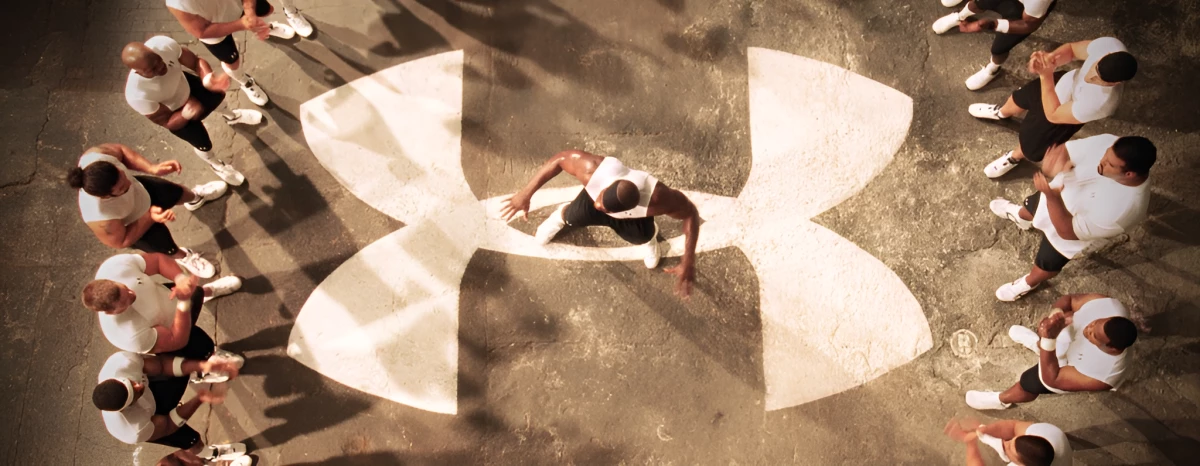
Under Armour had built its name on high-performance gear and aggressive marketing, from outfitting college teams to signing superstar athletes.
It was the scrappy Baltimore underdog “protecting its house” and taking the fight to Nike.
But today’s Under Armour is a shadow of its former self.
The brand's golden era ended around 2017, when a combination of market shifts and strategic blunders caught up to it.
The athleisure boom soared, but UA missed the trend, sticking to traditional performance wear as consumers flocked to sport-fashion hybrids.
Even as demand for women’s athletic wear surged across the industry, Under Armour struggled to move past its male-first identity.
Only a quarter of its sales came from women, a gap former Under Armour President and CEO Stephanie Linnartz admitted had held the brand back.
"Protect this house can expand to mean more than just sweaty men playing football. It can expand. It’s all about how we bring it to life. I deeply believe that.
So we’re going to market to women in a different way, too. You don’t market to women the same way you market to men. We’ve got to figure that out," Linnartz said in a 2023 interview.
Meanwhile, rivals like Lululemon surged from yoga niche to a $27.4 billion athleticwear force, now second only to Nike in market cap for North America.
Upstart shoe brands On Running, Hoka, and Brooks also sprinted ahead with double-digit growth.
In short, while Under Armour stood still, the competition ate its lunch.
After peaking at $53.78 on September 17, 2015, its stock went into freefall, eventually cratering nearly 90% from its high.
This effectively wiped out roughly $17 billion in market value.
The company that once could do no wrong was suddenly synonymous with stalled innovation and slipping relevance.
“There are two ways to look at Under Armour’s negative sales numbers. The first is that they are a function of the deliberate reengineering the company is undertaking to strengthen its brand.
The second is that they result from a brand that has become out of tune with consumers and is not punching through in a competitive market.
In our view, the truth lies somewhere between these two positions," GlobalData Managing Director Neil Saunders told Retail Dive last February.
In plainer terms, the brand lost its mojo, some of it due to intentional belt-tightening and some due to consumers simply falling out of love with the brand.
Behind the scenes, the company dealt with internal instability and headlines that distracted from its core message.
A 2017 earnings miss and surprise CFO resignation sent shares plunging 26% in one day.
Soon after, investors accused the company of accounting tricks to hide slowing demand, leading to SEC investigations, lawsuits, and settlements for pulling forward sales.
UA Founder Kevin Plank, once seen as the brand’s driving force, also drew scrutiny for public stances and scandals that didn’t always align with the values of its customer base.
By 2020, Plank stepped down as CEO amid these missteps, and Under Armour cycled through two chief executives in three years before bringing its founder back.
I love our country & company. I am stepping down from the council to focus on inspiring & uniting through power of sport. - CEO Kevin Plank pic.twitter.com/8YvndJMjj1
— Under Armour (@UnderArmour) August 15, 2017
The brand that once could count on teens and athletes to flock to its gear now saw many of them drift to trendier labels.
All told, Under Armour’s decline has been a slow bleed, one that cost the company billions and hard-earned brand equity.
Its fall wasn’t sudden; it was the slow kind, where bad calls, missed signals, and a quieting brand voice chipped away at consumer attention.
One decision, though, seemed to sum up everything: Under Armour went quiet on promotions to fix its margins, and never filled the silence with a better reason to care.
The Price of Pulling Back
In theory, pulling back on discounts can restore brand value.
In reality, Under Armour saw a 25% drop in e-commerce revenue for fiscal Q1 2025 and an 11% decline in direct-to-consumer sales for its fiscal Q4 2025.
This was a steep cost for a strategy meant to signal control.
The logic was understandable. The company had grown too promotional, too reliant on clearance bins and coupon codes.
But instead of replacing discounts with energy, story, or product heat, the brand said less and sold less.
When I look at the past few years of Under Armour marketing, what’s striking isn’t what they said, it’s what they didn’t.
The brand had no strong narrative to guide consumers through the transition.
While competitors ran bold campaigns and launched hero products, Under Armour pulled inward.
The actual problem wasn’t the cost-saving, it was the absence of anything compelling to carry the brand through it. And it seems Plank also knew this.
"Engage Under Armour's underdog positioning infused with resilience and grit through our Sports House positioning in all aspects of storytelling," is one of the strategies outlined under "Story," one of the four pillars stated in its 2025 Outlook.
Now, the brand is finally trying to say something again. But it has to make sure people are still listening.
Marketing Can’t Be an Afterthought
Under Armour’s focus on structure over storytelling is one of the biggest takeaways here.
The company did what many in its position might do: it trimmed inventories, cut products by 20 to 25%, and closed a major distribution center.
These moves helped clean up the balance sheet, but without a corresponding brand narrative, they left consumers disengaged.
As someone who watches brand leadership closely, I found the CEO shuffle particularly telling.
Morningstar’s David Swartz isn’t surprised that Kevin Plank is returning to $UAA as CEO:
— Yahoo Finance (@YahooFinance) March 14, 2024
“He never really wanted to leave. He was basically forced to resign as CEO because there were a number of kind of embarrassing press scandals involving his personal life.” pic.twitter.com/sQXasfBNdg
After hiring an outsider from the hotel industry to broaden its customer focus, especially with women, Under Armour quickly reverted back to Plank.
Linnartz, who had promised stronger retail and digital experiences, lasted just over a year.
Her ideas, many of which revolved around brand experience and product relevance, were replaced by another round of internal control.
It was only after Plank’s return that the company began hiring the right creative minds:
- Adidas veteran Eric Liedtke for brand strategy
- Designer John Varvatos for product vision.
Varvatos will join the US-based performancewear brand as its new chief design officer on 11 September. Read more here.#fashion#fashionnews#retail#retailnews
— Drapers (@Drapers) September 6, 2023
https://t.co/66izcbue5Wpic.twitter.com/n75mDSlyNx
These are definitely strong moves.
But they came late, after years of under-marketing a product that was trying to go premium without the halo.
If anything, this stretch proved how expensive it can be to run a brand through a financial lens alone.
Signs of a Slow Comeback
Under Armour is now embarking on a steady recovery, and it’s backed by changes across product, marketing, and global strategy.
While the results are still mixed, there’s movement in the right direction:
- Under Armour is narrowing its focus to fewer, higher-priced products, including a $140 performance backpack and updated footwear lines.
- Marketing is shifting to athlete-led digital content, with campaigns like the “Let Them Talk” series during March Madness prioritizing attitude over ad spend.
- Its loyalty program has surpassed 17 million members and is being redesigned around community and product value instead of discounts.
While U.S. sales declined 11%, European revenue stayed flat, suggesting global markets may offer a stronger path forward.
What Brand Leaders Can Take Away
Under Armour’s reset isn’t complete, but it’s already a case study in what not to overlook.
If you’re leading a brand right now, especially in retail or consumer categories, here’s what I’d pull from this:
- Silence doesn’t solve perception problems. Pulling back promotions is fine, but only if you replace them with a story that helps consumers see the value.
- Operational clarity isn’t enough. Clean inventories and higher margins don’t matter if the brand feels cold or disconnected.
- Marketing must have a seat at the table. Without a CMO perspective, product improvements go unnoticed, and positioning drifts.
- Relevance requires momentum. If you're not staying visible, someone else is filling the gap.
Rebuilding takes time, but brand storytelling has to start now.
Under Armour can still bounce back and even surpass its heyday, but only if it continues speaking to consumers with more than spreadsheets.
This case is a reminder that in today’s market, silence doesn’t just lose sales, it can cost your entire narrative.
When product improves but perception doesn’t, these teams help connect the dots with smart, consistent storytelling: