
Coca-Cola's 'You Must Love Coke' Campaign: Key Findings
- The brand uses optical illusionsthatcontainzerored, with fans' brains generating the brand's iconic color themselves.
- The OOH campaign launches in Argentina before a planned global rollout, targeting football stadiums where red isn't welcome.
- WPP Open X led the work, with VML and Grey at the helm, supported by Ogilvy and WPP Media.
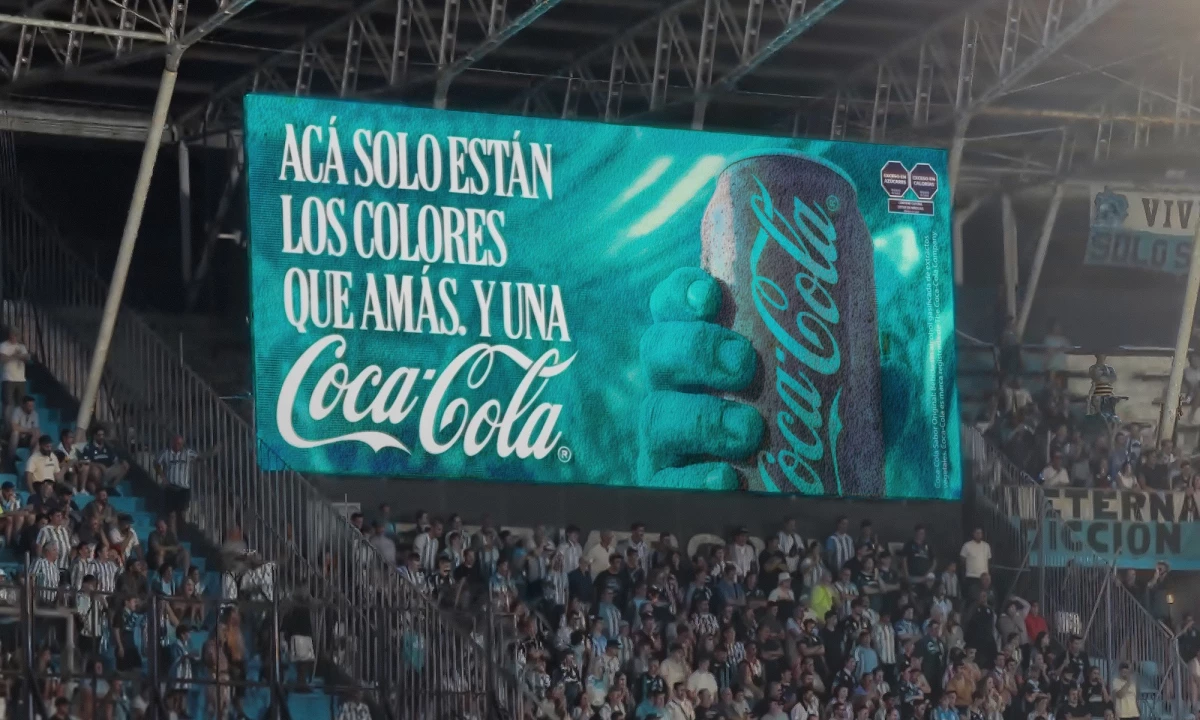
Coca-Cola's latest football activation uses optical illusions to place its signature red inside rival football stadiums where the color has long been unwelcome.
"You Must Love Coke" was developed by WPP Open X, WPP's dedicated AI platform, led by VML and Grey and supported by Ogilvy and WPP Media.
The work avoids using red entirely, relying instead on visual tricks that prompt fans to perceive the color themselves.
The illusions work by triggering a perceptual response in viewers, with fans' brains filling in the Coca-Cola red.
The OOH campaign rolls out first in Argentina before a wider global expansion.
In football's most tribal environments, where wearing the wrong color can draw real hostility, the campaign finds a way to creatively show up without provoking a fight.
An Optical Illusion as Creative Strategy
The work runs along supporter routes, stadium perimeters, and fan gathering points, designed to sit inside the matchday journey as a natural fixture.
Creative placements use perception-bending color techniques to embed Coca-Cola's signature red inside blue-only designs.
This, in turn, makes the brand visible only through the viewer's own visual processing.
The concept is rooted in color perception science.
Certain visual patterns trigger afterimage effects where the brain perceives a complementary color that isn't physically present in the image.
Red sitting at the opposite end of the color wheel from blue makes the effect particularly pronounced in stadium environments dominated by rival team colors.
The visual trick prompts viewers to perceive red, and it works because that color is already tied to Coca-Cola in people's memories.
This connection allows the soda giant to show up through its brand color, where recognition comes from what people already associate with it.
If it's Coca-Cola, then it must be red.
Football Culture as the Brief
The campaign is built around a specific tension in football.
Some supporter cultures treat the color red as something to be completely avoided on matchdays, with certain clubs going so far as to ban it from stands.
"You Must Love Coke" addresses this by finding a format that respects the intensity of these supporter traditions.
At the same time, it gives Coca-Cola's visual branding a place in spaces where it would typically stand out for the wrong reasons.
Argentina was selected as the campaign's launch market, given how deep football rivalry runs in the country.
Here, strong club allegiances have lasted for generations, and as such, color associations carry significant social weight.
The campaign's social extension also mirrors its OOH strategy.
In this case, the content was designed to travel across fan communities and provoke the same perceptual reaction on mobile screens as they will on stadium walls.
OOH advertising reached a record $9.1 billion in U.S. revenue in 2024.
Transit formats led category growth at 10.6%, the segment most relevant to stadium placements like this one.
The "You Must Love Coke" campaign offers a few mechanics worth noting for brands dealing with culturally specific environments:
- Use the audience's perception as the medium: When the viewer generates the brand experience themselves, the engagement carries a different quality.
- Acknowledge cultural codes first: The campaign earned its place in rival stadiums by working with supporter traditions, giving it credibility in environments that can have hostile reception.
- Let the science do the creative work: Color perception theory gives this campaign a replicable mechanic that holds up across stadium walls and social feeds.
Campaigns that operate inside a community's existing rituals tend to generate more sustained attention than those that interrupt them.
Our Take: Does the Trick Work?
We think so. The optical illusion only works on fans who already know what Coca-Cola red looks like, making the audience a co-author of the ad.
Stadium advertising is one of the most cluttered environments a brand can buy into, and getting fans to stop and stare takes more than a logo.
It'll be interesting to see what happens when the campaign rolls out globally.
Football tribalism runs differently depending on where you are, and a concept so culturally specific will need some adaptation to travel.
Brands building culturally specific activations need agencies that understand how to work inside a community's existing rituals.
Explore these top out-of-home advertising companies in our directory.