
ClickUp Super Agent: Key Findings
- ClickUp acquired Codegen.Inc to embed AI coding agents directly into its platform, signaling a move from task orchestration toward execution-level software creation.
- The integration reframes tasks, docs, and chats as live inputs for code generation, reducing delays between planning and production for non-technical teams.
- Codegen’s standalone service will sunset in January 2026, while its core technology becomes foundational to ClickUp’s broader AI strategy.
ClickUp is making a clear bet on where modern work platforms are headed.
The company has acquired Codegen.Inc., bringing AI-powered coding agents directly into the ClickUp ecosystem.
The move pushes ClickUp beyond work management and deeper into execution, positioning tasks and documentation as actionable inputs rather than static artifacts.
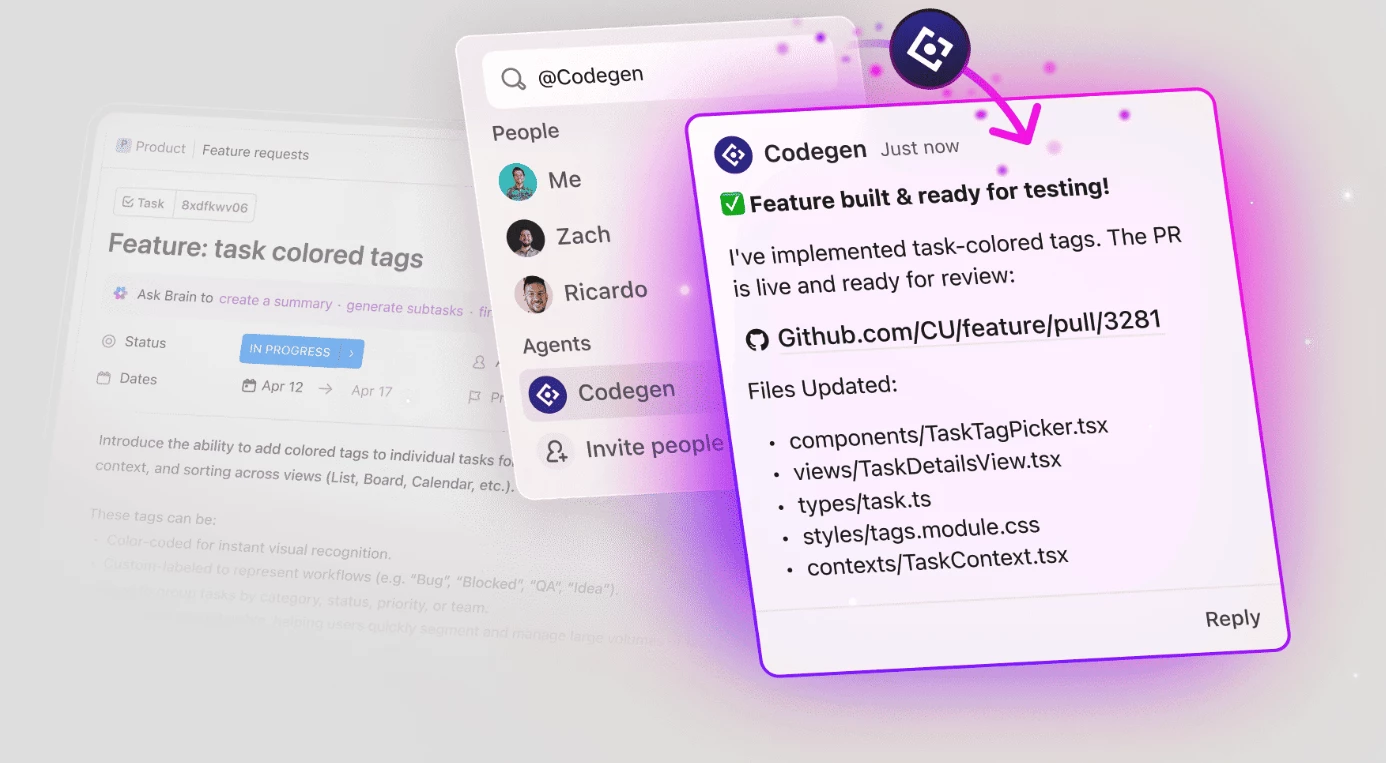
For teams used to long handoffs between planning and shipping, the acquisition aims to compress that cycle.
According to ClickUp, Codegen’s agents will operate inside the workspace, using existing context from projects, docs, and conversations.
The deal was announced on December 23, 2025, and the financial terms were not disclosed.
When Planning Tools Start Doing the Work
The problem ClickUp is targeting is painfully familiar to fast-moving teams. Work is planned in one place, then passed to a small group of technical specialists somewhere else.
That separation slows everything down. Ideas lose momentum, iteration takes longer, and only a few people can act on what the team wants to build.
With Codegen’s agents built in, ClickUp is trying to remove that gap entirely and turn the workspace into a place where execution begins the moment an idea appears.
How Can High-Paced Marketers Benefit?
The combined offering is designed to support a range of use cases:
- Customer support teamscan translate recurring tickets into code-level fixes.
- Product managers can move from PRDs to functional prototypes without waiting for engineering availability.
- Marketing and agency teams can update landing pages and microsites without routing every change through developers.
Moreover, engineering teams can generate test suites directly from requirements, as the strategic shift is less about teaching everyone to code and more about letting more people shape the software.
That approach fits ClickUp’s long standing promise of bringing all work into one system, and it now stretches that idea into build and deployment workflows as well.
The acquisition fits a wider shift in the industry as AI agents and context-rich environments become more powerful.
Coding tools have advanced quickly, but most still sit outside the places where real work decisions happen.
ClickUp’s advantage is that the context already lives inside the platform.
Tasks, documents, and conversations are all in one place, which gives these agents something meaningful to act on.
Context is becoming the real AI advantage
Industry research consistently shows that context and integration drive the adoption of AI tools more than raw capability.
Platforms that reduce friction between planning and execution tend to see faster experimentation cycles and higher internal usage.
From a market perspective, the move also tightens competition with platforms positioning themselves as operating systems for work rather than point solutions.
The implication is clear: productivity platforms that stop at coordination may struggle to keep pace as execution becomes automated.
For brands and agencies watching this space, the ClickUp-Codegen deal offers several takeaways:
- Execution is moving upstream, with planning artifacts increasingly expected to trigger real output.
- AI differentiation is shifting toward proprietary context, not just model performance.
- Non-technical teams are gaining more control, which will reshape internal workflows and approval cycles.
ClickUp also confirmed that Codegen’s CEO, Jay Hack, will join the company as Head of AI, reinforcing the acquisition’s strategic weight.
Existing Codegen customers can access the service until January 16, 2026, when the standalone product will be retired.
Our Take: What Should a Modern Work Platform Actually Do Now?
If you are anything like us, you bounce between tools and tabs while trying to keep projects moving.
That is why ClickUp’s move stands out. It suggests that simply tracking work no longer meets the needs of modern teams.
ClickUp is trying to close the gap between intent and output, and that shift matters.
A platform that can plan the work and help produce it gives teams real leverage, especially in fast-moving SaaS and agency settings.
If ClickUp delivers, it could reset expectations for productivity software. We already see early signs in bug-tracking platforms, where the focus is shifting from recording issues to resolving them inside the tool.
For us, the direction is clear. Coordination is no longer enough. Execution is becoming part of the platform.
Looking for a Top Digital Agency that can execute at speed? Explore top digital agencies vetted for strategy, build, and iteration.