
Clash Royale's 'Cracked Royale': Key Findings
- Clash Royale’s new campaign rewards Brazilian players who win matches on broken screens with exclusive in-game items.
- The campaign uses hashtag-driven user-generated content and influencer participation to grow visibility and encourage community-led storytelling online.
- A launch film and in-game rewards connect social engagement and gameplay, strengthening long-term player retention and activity.
Clash Royale is turning cracked screens into a symbol of pride and proof of player dedication.
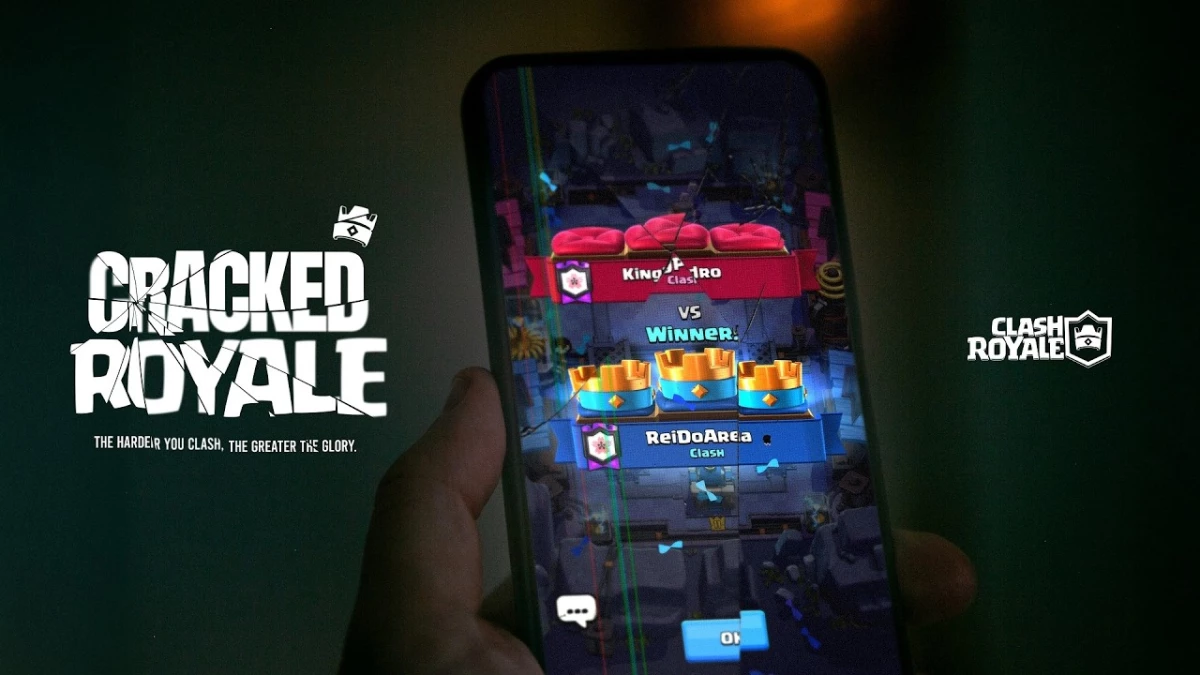
The Supercell-owned mobile game has launched “Cracked Royale,” a campaign built around players who continue to win matches despite using damaged phones.
Created with DAVID New York, the effort focuses on a specific kind of player behavior that often goes unnoticed but says a lot about how deeply people engage with the game.
It invites players in Brazil, one of Clash Royale’s most active communities, to post videos of themselves winning battles on cracked or barely functional screens using the hashtag #ClashModoHard.
In return, selected participants receive in-game rewards such as a Legendary Wild Card and a limited-edition Cracked Royale banner.
"Clash Royale players don’t just play the game. They live it," Clash Royale Marketing Lead Gabriel Caramelo said in a press release.
And despite broken phones and missing pixels, players still manage to win.
"'Cracked Royale' is our way of celebrating those players who go one level harder and showing them the love they deserve," he added.
Overall, this campaign hits two birds with one stone.
It builds authenticity by highlighting a hyper-specific gamer behavior, and it also makes players themselves become the storytellers through user-generated content.
This makes it a win-win situation for the mobile gaming platform.
"Clash Royale players are some of the most competitive and passionate in mobile gaming," said DAVID New York CCO André Toledo in a press release.
"But seeing them dominate the arena with cracked screens is next-level dedication and proof that nothing can break a true Clash Royale fan."
Broken Screens Power UGC in ‘Cracked Royale’
The campaign launches with a film that visually mirrors the idea of playing through damage.
"In Clash Royale, you battle hog riders, golems, and skeletons. But some players have to battle the cracks in their own screen, too," the narrator tells the viewers.
We then see a screen that is split and fractured, showing gameplay unfolding across cracked surfaces while still capturing the fast-paced action that Clash Royale is known for.
Players are then invited to prove they can win on a cracked screen to get more rewards by posting a video using the hashtag #ClashModoHard, ending the spot with a call-to-action.
Influencers and creators within the game’s ecosystem are also participating, sharing their own attempts at playing on damaged screens and encouraging followers to join the challenge.
This creates a loop where content feeds more content, growing the campaign beyond the initial film.
Instead of relying only on updates or features, campaigns like this focus on amplifying how players already interact with the game.
And in turn, boosting brand loyalty.
Cracked screens are more common than we think, so Supercell caved in and finally decided to do something about it.
Clash Royale’s Player-Led Campaign
For marketers, Clash Royale offers a clear example of how small, real user behaviors can be turned into scalable campaign ideas:
- When your campaign spotlights everyday user struggles, you can turn these problems into moments of recognition and reward.
- With 90% of consumers influenced by UGC, simple participation mechanics like hashtags make it easier for audiences to join without friction.
- Connecting social engagement with in-game incentives helps grow brand awareness and encourage active participation.
Launched in 2016, Clash Royale remains one of Supercell’s flagship titles and continues to draw strong engagement from global audiences.
According to Supercell, the company generated $3 billion in revenue in 2025, with Clash Royale contributing to its long-running portfolio.
Our Take: Can Imperfection Be a Strategy?
The reality is, people would tap away on cracked glass and try to win for the love of the game.
This is what makes "Crash Royale" a genius marketing move, because it finally gives the most loyal players a run for their money despite their gaming inconveniences.
It feels a lot closer to how games are actually played, not how they’re usually advertised.
When a brand stops pretending everything is perfect, it earns a different kind of trust.
You’re not selling a product anymore; you’re acknowledging the player’s experience as it is.
The lesson here is to keep it real, keep it close to the player, and you're almost certain it'll become something people want to be part of.
In other news, the mobile game recently marked its 10th anniversary with a campaign built entirely on fan-created content and community moments.
Find the teams driving growth and engagement across every platform. Check out the top digital marketing agencies in our directory.