
Digital Marketing Agency for 2026: Key Findings
- CMOs are moving away from channel-level execution and toward connected growth systems grounded in first-party data and trustworthy AI.
- The most capable agencies blend brand, performance, analytics, and testing into one shared workflow.
- In 2026, the best partners are flexible, transparent, and deeply measurement-driven, and able to operate confidently through AI shifts, privacy changes, and the growing number of discovery channels.
On the surface, the world of digital marketing agencies doesn’t look dramatically different than it did a few years ago.
But the expectations have changed completely.
Delivering assets on time or sending a monthly recap might keep things moving, but it doesn’t drive growth.
Brands want partners who take responsibility for the strategy, can explain their reasoning, adapt quickly, and tie their work to business outcomes.
Data shows the internal pressure is real.
Only 52% of senior marketing leaders feel confident proving marketing’s value internally.
This is why so many brands end up working with vendors instead of true partners.
This guide outlines how top-tier digital marketing agencies operate in 2026, the questions CMOs should ask, and the signs that show whether an agency can keep up with what’s coming next.
The 7 Qualities that Separate Strong Agencies from the Rest
Most agencies talk about growth, but only a smaller number can deliver it in a durable way.
The difference usually shows up long before the first creative concept, in how they plan, test, measure, and run their day-to-day operations.
These are the qualities that matter most in 2026.
Need a new website to improve your results? Request a quote from Digital Silk.
1. AI You Can Trust
65% of companies now use generative AI in at least one business function, up from 33% the year before.
Yet 57% of marketing leaders say their companies lack the talent or expertise to use gen AI responsibly, and almost half say they don’t have a clear strategy for it.
Nearly every agency today talks about AI, but the question is how they manage it behind the scenes.
A responsible digital marketing agency can show:
- When and how humans step in
- Notes or logs explaining why something needed an override
- How they check for bias and brand-safety issues
- Where they separate testing from real spend
If a team spends the entire conversation showing you AI screenshots without explaining who supervises what, that’s usually a sign that things aren’t as organized as they appear.
A quick test: You can ask the agency you’re working with to walk you through a real example where its team overruled an AI recommendation and why.
2. Measurement that Holds Up
The biggest shift in measurement is the simple fact that brands can no longer rely on third-party signals.
Serious agencies start with the fundamentals, including tracking, consent, event validation, and data that can survive an audit.
Once that’s solid, they move to methods that still work when platforms change the rules, such as controlled experiments, holdout tests, geographic lift tests, or mixed models built around revenue and margins instead of impression-based metrics.
And they translate everything into terms finance teams actually care about, like payback periods, profitability, and contribution to revenue.
A good way to test measurement maturity: Ask how they would evaluate performance if ad platforms removed most of their reporting overnight.
Their answer will tell you everything.
3. Brand & Performance in One System
Brand teams and performance teams used to sit on opposite sides of the strategy table.
The former shaped perception, while the other chased conversions.
That divide made sense when pathways were linear. Now, it slows everything down.
87% of CMOs say brand building is critical for growth, but only 41% feel confident in their performance-measurement maturity.
When messaging, creative, and media share the same strategy, performance almost always improves. When they don’t, campaigns often fail.
Research supports this.
The MMA/TransUnion Brand as Performance report shows that campaigns built for brand impact delivered 4-5 times higher conversion lifts and 1.8-6 times greater long-term sales results than campaigns focused purely on performance.
Gartner’s Genius Brands study shows a similar pattern, with top performers generating 16.5 times more site traffic than average companies.
In practice, integrated agencies don’t rely on magic.
Instead, they rely on:
- A weekly touchpoint across creative, media, and analytics
- Testing that strengthens both visibility and conversion
- Shared scorecards that everyone understands
- Insights from one channel pushing improvements in another
If an agency can clearly explain how their brand and performance work together, they’re operating in the modern model, not the outdated two-lane one.
4. Outcomes Over Outputs
The days of agencies saying “we’ll deliver five ads, three landing pages, and monthly dashboards” are fading fast.
With budgets flat and finance teams asking harder questions, CMOs need partners who talk about business outcomes first, e.g., “We’ll enable $X in revenue, reduce customer acquisition cost by Y%, or shorten pay-back period to Z weeks.”
A 2024 Forbes Business Council analysis noted that more service providers are moving toward outcome-based contracts, where compensation is tied to the results.
Agencies built for 2026 naturally operate this way: they define success before work begins and measure progress against it.
You’ll know you’re speaking with a serious agency when it can explain what its work is expected to change and how they’ll prove it.
Looking to improve your online presence and leads? Speak with Digital Silk’s experts.
5. Visibility Beyond Google
Search is changing quickly.
Around 50% of consumers already use AI-powered search today, and brands unprepared for the shift risk losing 20-50% of their traditional search traffic.
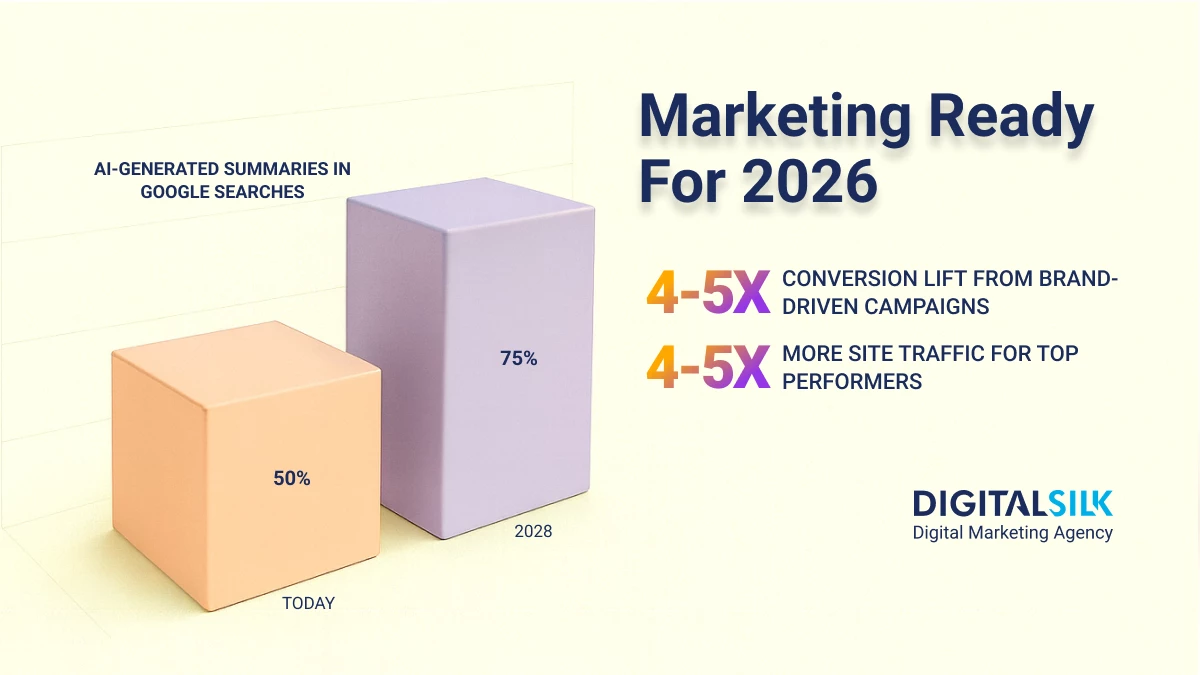
On top of that, about 50% of Google searches already include AI-generated summaries, and this number is expected to rise to over 75% by 2028, according to trend analysis.
Ranking on Google still matters, but it’s no longer enough.
Strong agencies think in terms of being found wherever questions are asked, which means:
- Appearing in AI-generated answers
- Earning visibility in knowledge panels and entity-based results
- Structuring content so machines can understand it
- Preparing assets for voice, chat, AR/VR, and specialized platforms
If an agency can’t tell you where your brand appears outside traditional search results, they’re building for yesterday’s internet.
6. Tech Choices that Stay Flexible
Tech decisions determine what you can measure, how quickly you can react, and how confident you can be in your reporting.
But not every platform fits every business.
Mature agencies don’t push clients toward the tools they prefer.
They study your current setup, look at how data moves across systems, check whether consent and tracking are handled properly, and then recommend what genuinely fits, even if it means not migrating.
Just as importantly, they design systems you can walk away with.
If you decide to change agencies or shift parts of the work in-house, your data, your assets, and your operational setup remain fully portable.
Your data, assets, and workflows should remain yours, not locked behind a vendor.
7. Governance Without the Guesswork
A strong agency is defined by what it can build, but also by how safely, transparently and sustainably it operates.
The agency you want to work with understands that governance is part of the value.
Strong agencies can speak clearly about how they manage data, structure access and retention, ensure their work withstands legal review, and prepare assets for global use.
They also make it easy for you to leave if you need to.
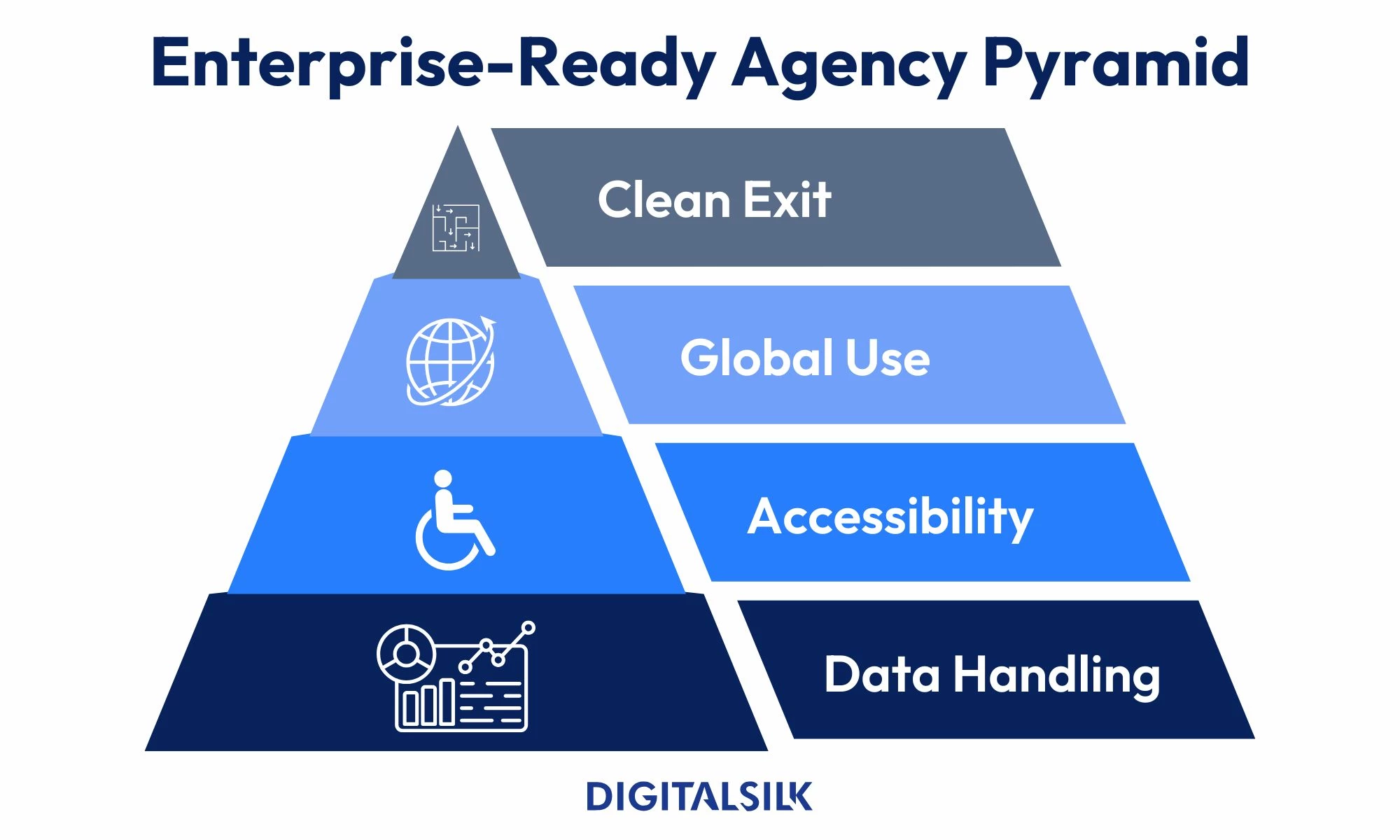
When an agency is truly ready for enterprise-level work, you’ll hear it in the way they talk about:
- Clear data handling: They can explain, in normal language, where your data lives, who has access to it, and how it’s protected.
- Accessible work for all users: Their design and content process naturally includes making websites and digital products easy for everyone to use, including people with disabilities.
- Ready for global use: If your brand operates in different regions, they can show how they adapt content, creative, and digital assets so nothing breaks when you expand into new markets.
- A clean exit: If your partnership ends, you get all your files, content, designs, code, and data in usable formats, without friction or delays. There are no surprises, no hold-ups, no missing pieces.
Strong governance is one of the clearest signs an agency knows what it’s doing.
If they can walk you through how they protect your data and support you over the long run in normal, straightforward language, you’re dealing with a real partner.
It’s also a strong sign they can grow with your brand, protect your reputation internally, and withstand the scrutiny of legal, IT, and procurement.
Improve your website performance. Request a quote from Digital Silk.
What Credible Results Actually Look Like
When you ask an agency for proof, the explanation should feel straightforward.
You should hear what changed, how they measured it, and why it mattered for the business.
A good partner walks you through:
- The metric, i.e., the actual shift in leads, revenue, engagement, or efficiency.
- The method, i.e., how they verified it instead of assuming it.
- The materiality, i.e., what that improvement unlocked for the business.
Here’s what that looks like in practice.
Urbanna Landscaping came to Digital Silk with a problem most service-based businesses know well: their marketing was active, but it wasn’t bringing in enough qualified leads.
Their strongest, high-value services weren’t getting the attention they deserved, and their local visibility wasn’t strong enough to keep revenue steady throughout the year.
What improved:
Within a few months, Urbanna saw a meaningful shift.
They generated more than 300 qualified leads, total sales rose by 66%, and the average client value doubled, showing that they were finally reaching homeowners looking for larger, premium projects.
How it was achieved:
Digital Silk tightened Urbanna’s targeting, refreshed their creative, and aligned campaigns to local demand, helping qualified leads reach the sales team quickly.
Why it mattered:
Instead of depending on inconsistent channels or seasonal momentum, Urbanna gained a steady, predictable stream of high-intent leads.
The lift came from clearer positioning, smarter targeting, and a strategy grounded in how their customers actually search.
View this post on Instagram
That’s what real improvement looks like. It’s a real shift in how the business earns attention.
Benchmark Expectations for Growth Teams in 2026
Teams that perform reliably in 2026 don’t usually rely on one big tactic or a clever trick.
It’s the opposite.
They follow a handful of steady habits that compound over time and possess the kind of discipline that makes results predictable.
Here’s what strong performance usually looks like today:
1. Stronger Acquisition Efficiency
They start by cleaning up the basics: the data, the messaging, the flow of the journey.
Once those are aligned, acquisition costs naturally settle down.
The improvement sticks because it comes from fixing the foundation, not from squeezing more out of a channel.
2. Faster Creative Cycles
High-performing teams move quickly without turning the process into chaos.
They lean on templates, set simple approval paths, and keep conversations open between creative, media, and analytics.
AI helps with the repetitive bits, but the direction is still set by people.
3. Higher Conversion Performance
When brand, UX, and performance sit at the same table, everything becomes easier.
Pages feel more consistent, friction falls away, and people understand the offer faster.
Conversions rise because the entire experience is pointing in the same direction.
Get a quote on your digital presence. Request a quote from Digital Silk.
4. Visibility Beyond Traditional Search
These teams don’t think of visibility as a Google-only metric.
They look at how often the brand appears in AI answers, in voice results, in structured panels, and in the smaller surfaces where people now get information.
5. Smarter, Supervised Automation
Automation can help, but humans still need to keep an eye on it.
High-performing teams know when to let platforms run and when to step in.
6. Improved Content Clarity & Recall
Clear structure, clean metadata, thoughtful linking, and helpful page layouts make a brand easier to understand and easier for machines to surface.
What’s Coming Next in 2026-27
The pace of change isn’t slowing down.
If anything, the next two years will accelerate the gap between agencies that can adapt and those that can’t.
These are the shifts CMOs should expect and the signs an agency is prepared for what’s coming:
- More platform changes and less data to work with: Privacy updates and shrinking signal availability will continue.
Agencies that rely on platform-reported data will feel the impact first, while teams built around clean first-party data and experimentation will stay steady. - Higher creative output and more personalization: Brands will need more creative variations, more often.
The teams that win will have efficient production systems rather than scrambling to create content at the last minute. - Discovery moving beyond search: AI assistants, voice tools, and niche platforms are taking up more of the search journey.
Visibility won’t stop at Google, so content needs to work across a wider set of discovery surfaces. - In-house teams taking on more work: Internal teams will keep expanding, and they’ll expect agencies to plug in smoothly and not compete with them.
Collaboration, shared workflows, and clear handoffs will matter more than ever.
These aren’t predictions for the distant future, but the conditions brands are already stepping into.
Want to generate more leads? Talk to Digital Silk’s experts.
2026 Agency Readiness Check
Before choosing an agency, CMOs need a quick way to understand whether a partner is truly built for 2026.
This scorecard offers a simple way to assess those systems in under ten minutes.
It highlights the areas where modern growth partners excel and where traditional vendors tend to fall short.
Use it during early conversations or reviews to see whether an agency’s capabilities hold up beyond general claims.
Choose an Agency Built for What’s Next
The right agency in 2026 should feel like an extension of your team.
Not a channel vendor. Not a task executor. A true partner.
You’ll see it in the questions they ask, the way they measure results, how they plan for change, and the clarity of their systems.
If the ideas in this guide resonated, such as disciplined measurement, integrated creative-performance teams, and strong governance, you’re already thinking the right way.
If a potential partner can't show this level of maturity, keep exploring your options.
And if you want to shorten the search, consider speaking with Digital Silk.
They’ve built custom solutions for brands across industries and their approach emphasizes transparent governance, flexible architecture, and measurable outcomes.
As a full-service digital marketing agency, Digital Silk’s services include:
- Digital marketing
- Social media marketing
- SEO Services
- PPC Campaigns
- Branding and web design for law firms
Contact the Digital Silk team or call them at (800) 206-9413 to schedule a consultation.
When you meet your next agency candidate, ask the tough questions and expect clear answers.
Because in 2026, how they move is as important as what they do.