
The New Best Buy Marketplace: Key Findings
- Marketplace launch: Best Buy opened its doors to 500+ new sellers, giving Best Buy Ads more inventory and shoppers more variety.
- Scale comparison: Amazon pulled in $56.2B from ads last year, while Walmart Connect made $4.4B. Best Buy can’t match that scale, but it’s aiming for a more curated edge.
- Market growth: U.S. retail media spend is expected to climb to nearly $100B by 2028, which means agencies can’t afford to treat it as a side channel.
- Programmatic shift: Nearly all marketers (96%) say they’re ready to buy retail media through DSPs, signaling a fast move toward automated buying.
Quick listen: Best Buy’s marketplace adds a premium twist to retail media. Here’s how agencies can turn it into ROI.
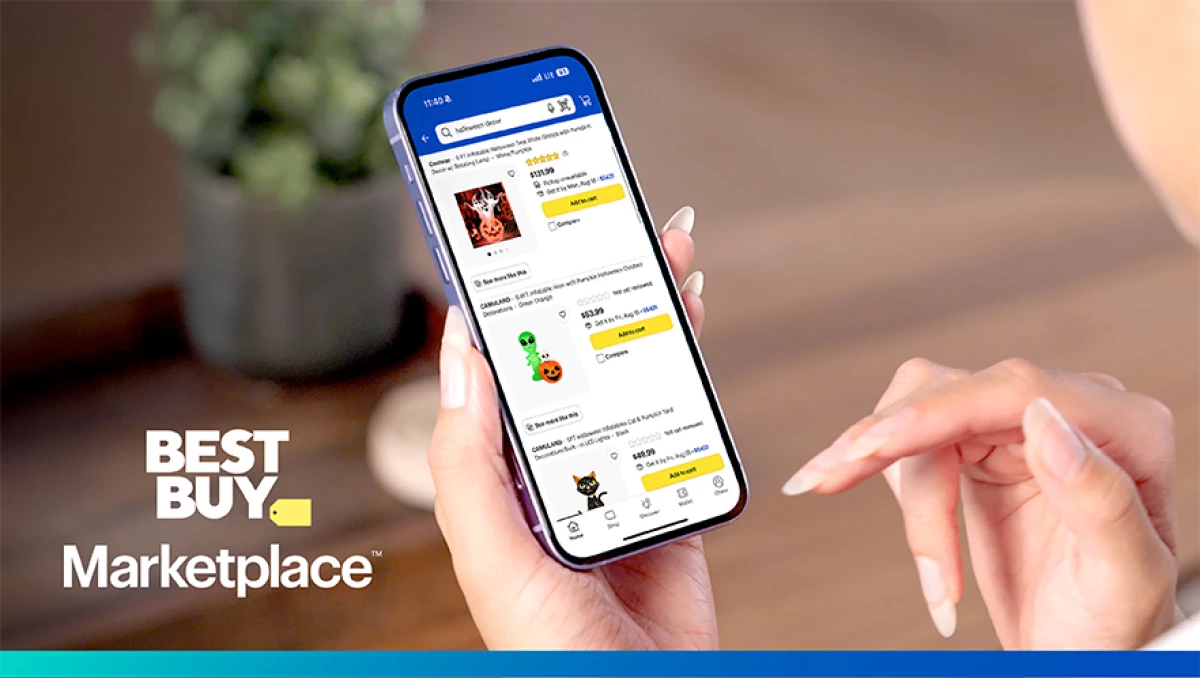
Best Buy has officially launched its third-party digital marketplace, adding over 500 new sellers and significantly expanding its online product selection.
Shoppers on BestBuy.com and the app can now browse a wider mix of categories, including home goods, automotive tech, and seasonal décor.
"In addition to the products you know and love from Best Buy, you’ll now also see items sold by third-party sellers, all in one seamless experience on our site and app.
Think of it like a collection of items that complement what we already offer," Frank Bedo, chief marketplace and eCommerce officer at Best Buy, said in a Q&A.
The expansion marks the company’s largest assortment update to date and reflects its push to become more than just a destination for electronics.
What's more interesting for brands is that the Mirakl-powered Best Buy Marketplace comes with fresh advertising inventory.
Each seller fuels placements through Best Buy Ads, the retailer’s in-house media engine.
This expansion comes at a time when Best Buy’s traditional electronics sales have softened, with annual revenue falling from $51.8 billion in 2022 to around $41.5 billion in 2025.
Ads, tied to curated third-party goods and sponsorships, represent a more margin-friendly growth path.
This is, I think, the most logical path for Best Buy to take, especially with the percentage of its online sales steadily increasing over the years.
For agencies, this is about Best Buy positioning itself as an ad platform with a clear angle: curation, trust, and high-intent audiences.
Why Amazon and Walmart Still Rule
I think Amazon Ads is still the benchmark for retail media.
In 2024, it generated $56 billion in ad revenue, placing it behind only Google and Meta in the U.S. digital ad market.
Walmart Connect, while smaller, has been gaining ground.
Its ad business brought in $4.4 billion in 2024, growing nearly 27% year-over-year.
The company also completed its $2.3 billion acquisition of Vizio, which adds a connected TV angle to its ad offering.
Agencies already allocate heavily to Amazon and Walmart because of their reach.
And Best Buy can't compete on scale yet.
But it does offer something more targeted: electronics-heavy, purchase-ready audiences in a trusted buying environment.
Why Agencies Need to Rewire Their Plans
Retail media is no longer a side project.
A forecast by eMarketer suggests U.S. ad spend will reach $97.9 billion by 2028, an 88.5% increase from 2024.
Another layer of urgency comes from the way retail media is merging with other parts of marketing.
A 2025 report by Koddi, 96% U.S. marketers are "open to buying on-site retail media through a DSP."
Meanwhile, 8 in 10 marketers said they’d move more ad dollars into retail platforms if they could buy the inventory through a demand-side platform (DSP).
In practice, this means influencer budgets, retail ad spend, and media dollars are all colliding.
For agencies handling CPG, DTC, or electronics clients, Best Buy’s marketplace represents another must-track channel.
What makes it unique is its control. Only a third of sellers were approved, and all must meet strict fulfillment and return standards.
This type of discipline gives brands more confidence that their campaigns won’t sit next to questionable products.
And it seems that the market is seeing Best Buy's new launch as something positive, with its stocks rising 2.78% after the announcement.
🚨 $BBY popping +2.78% to $74.58 after launching its new digital marketplace (powered by Mirakl), more than doubling products + adding new tech categories.
— Schaeffer's Investment Research (@schaeffers) August 19, 2025
BUT that $75 level ceiling has capped rallies since March. Can BBY finally break through? 📈 pic.twitter.com/dx6yVgB0mL
Retail media is increasingly behaving like programmatic advertising.
On Amazon, DSP spending grew from 8.7% of ad dollars in 2023 to 15.6% in 2025 during Prime Day.
This trend signals the rise of automated buying and targeting inside retail platforms.
Best Buy isn’t there yet, but it has already integrated with ad-tech partners to strengthen its targeting capabilities for higher precision.
Here’s how agencies can translate Best Buy’s launch into ROI for clients:
- Budget with fragmentation in mind. Amazon still dominates, Walmart offers scale, and Best Buy delivers curated, high-intent audiences.
- Build on trust and returns. Best Buy vets its marketplace sellers carefully and lets customers return items at more than 1,100 U.S. stores. Highlight this in pitches as a reason campaigns will convert better.
- Track real conversions. Electronics shoppers are closer to purchase. Agencies need full-funnel reporting that connects placements to sales or in-store pickups.
- Prepare for programmatic. Retail media is moving toward automated buying. Train buyers now so your team is ready to act quickly as Best Buy expands capabilities.
Each of these steps helps agencies move beyond testing and into measurable ROI.

Amazon proved the model, Walmart scaled it, and now Best Buy is adding a curated, premium twist.
For agencies, this is about recognizing the value of high-intent audiences in a trusted environment built for performance.
Agencies that embrace it early will have proof points before competitors catch up.
Best Buy entered the $100 billion retail ad race, and agencies now have the chance to use it as a new lane for ROI that their clients can see.
With Amazon, Walmart, and now Best Buy shaping the retail ad landscape, your media mix needs to adapt. These firms guide brands through the shift: