
Audible is giving audiobook fans a place to gather offline.
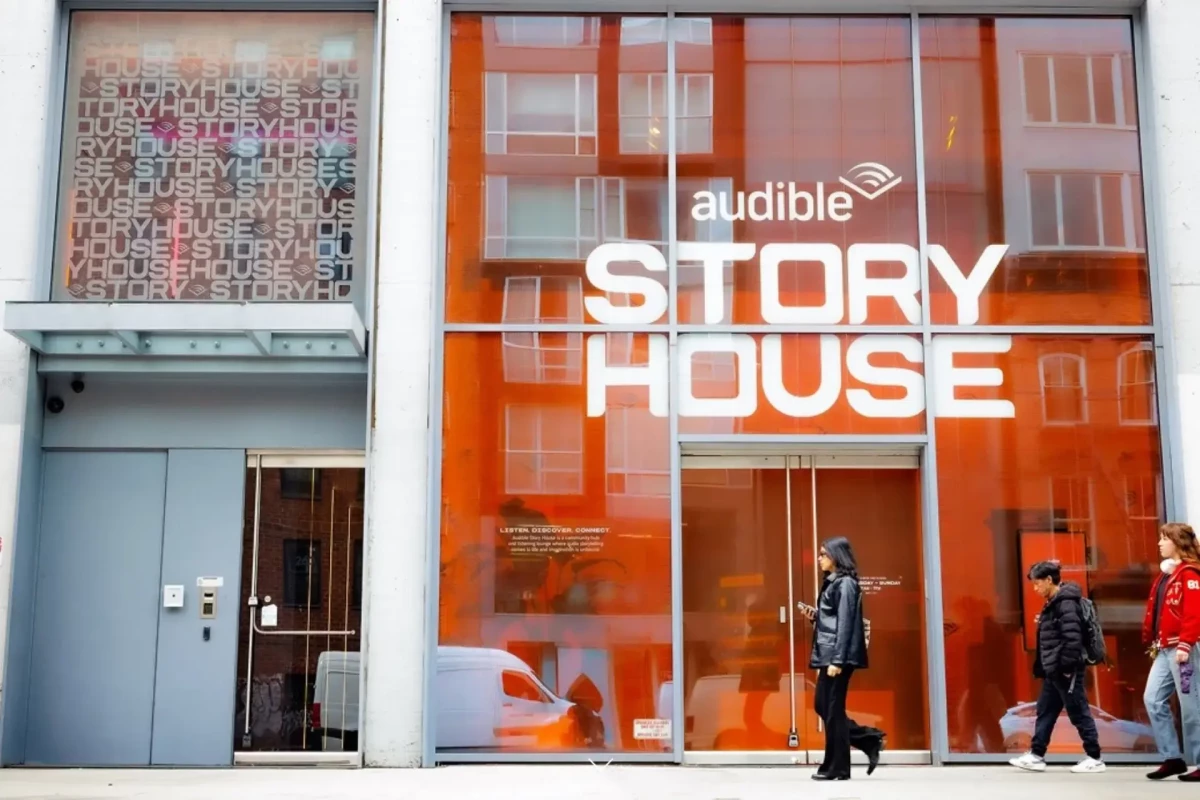
The Amazon-owned audio platform has opened Audible Story House, a 6,000-square-foot pop-up at 260 Bowery in downtown Manhattan.
The space is open from May 1 to May 31 and is free to the public and open Wednesday through Sunday from 11 a.m. to 7 p.m.
View this post on Instagram
The idea is simple: take the discovery behavior of a bookstore and rebuild it around listening.
Visitors can browse more than 300 audiobooks using physical "Story Tiles," then play them at listening stations or tap the tiles with a smartphone to open the title in the Audible app.
The pop-up gives Audible a physical brand experience at a time when audio fandom is growing beyond private listening.
Audible Makes Audio Browsing Physical
Audible Story House spans three floors and includes six listening spaces.
The setup includes Sony headphone stations, a Dolby Atmos Lounge for immersive audio, a Listening Bar with staff recommendations, and a studio showing Audible’s synchronized text and audio reading feature.
A cafe from Brooklyn-based Land to Sea gives visitors a place to sit, talk, and stay longer inside the space.
View this post on Instagram
"We developed Audible Story House by asking a simple question: what does a bookstore look like without any books?" James Finn, Audible’s Global Head of Brand and Content Marketing, said in a statement.
"The answer became a place where audio storytelling comes alive and where people connect, celebrate what they love and find communities that matter to them."
The setup makes the app feel browseable in a way a screen often doesn’t.
People can pick up a Story Tile, sample a title through headphones, or sit in the Dolby Atmos Lounge to hear Audible Originals in a more immersive setting.
It gives Audible a way to make audio discovery feel closer to browsing a bookstore, while still sending listeners back to the app.
Why Audible Is Building a Third Space
The programming gives the pop-up a bigger role than product discovery.
Across May, Audible is hosting panels, creator meetups, crafting activities, live music, Harry Potter trivia, and a teacher appreciation event with Teach for America, Crayola, and Reading Rhythms.
View this post on Instagram
Creative marketing and communications agency Civic worked on the store design, PR, communications, and marketing for the pop-up.
Civic and Audible saw strong audiobook fan engagement at events like Sundance, SXSW, and Comic-Con, but those moments only lasted a few days. Story House gives the brand a month-long space to test what in-person audio fandom can look like.
Julie Safer, managing director of PR at Civic, described the campaign as focused on community and third spaces, adding: "Audio is everything right now. It is everywhere."
Audible CEO Bob Carrigan also framed the project around changing fan behavior.
"The cultural fandom for audiobooks is at an all time high," Carrigan said, adding that customers want an offline, physical experience around the format.
View this post on Instagram
For brands, the strongest lessons are clear:
- Make digital products tangible. Audible uses Story Tiles, listening stations, and spatial audio to turn app-based discovery into a physical action.
- Build around fan behavior. The pop-up responds to audiobook fans seeking community, events, and shared listening.
- Treat the space as a test. A one-month run gives Audible room to learn what works before building future experiential marketing formats.
This is where the pop-up becomes more than a showroom.
It gives Audible a way to study how audio storytelling works when listeners are gathered in the same room.
Our Take: Can Audiobooks Build Offline Fandom?
We think Audible Story House works because it gives a private habit a public setting.
Audiobooks are usually consumed alone, through headphones, during commutes, chores, walks, or downtime.
Audible is taking this personal behavior and building a space where people can browse, listen, talk, and meet others around the same stories, which is useful for a subscription brand.
It gives customers a reason to experience Audible outside the app, while making the catalog feel more social and easier to explore.
View this post on Instagram
The smartest part is the format: a pop-up gives Audible cultural presence without committing to a permanent retail footprint.
It also creates content, events, press, and community touchpoints during a concentrated window.
For audio, publishing, and entertainment brands, this is the bigger takeaway: digital fandom often needs a physical place to become visible.
Looking to build brand experiences that turn digital products into real-world engagement? Explore these top experiential marketing agencies in our directory.