
Formula 1 may be powered by cutting-edge technology, but one team wants fans to focus on the people making crucial split-second decisions.
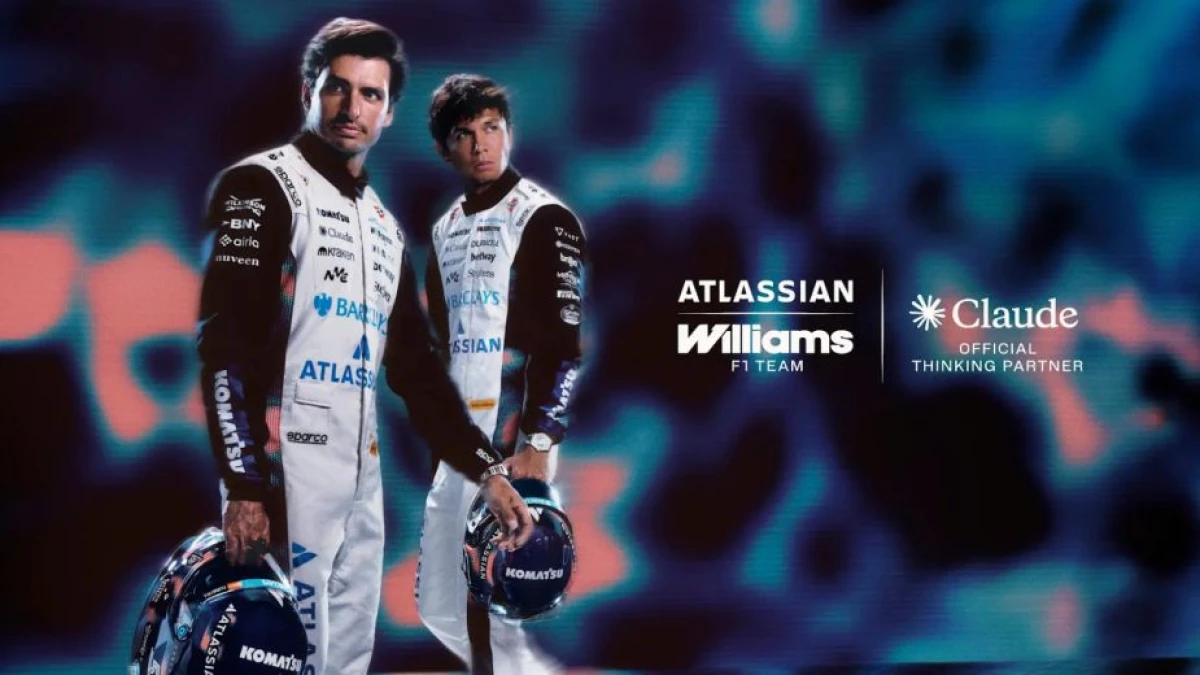
Atlassian Williams Racing and AI assistant Claude unveiled "Pattern of Thought," a new campaign that creates visual artworks out of driver, engineer, and team leader reactions.
From agencies Mother and Run Deep, the campaign launched ahead of the Monaco Grand Prix.
It operates on the idea that while fans admire the cars and their speed, they rarely see the judgment, focus, and decision-making that determine the winners.
To bring this invisible process to life, Williams team members wore consumer headsets while working in simulators and carrying out their day-to-day responsibilities.
Claude then interpreted their emotional responses, which Williams' designers transformed into the bold visual patterns featured throughout the campaign.
The work includes drivers Alex Albon and Carlos Sainz, alongside Team Principal James Vowles and other Williams personnel.
The resulting designs will appear on special-edition helmets, race suits, and throughout the Williams garage during the Monaco race weekend.
"In Formula 1, we are constantly striving to find our edge as we push to go faster and innovate better than our competitors," said James Vowles, Team Principal of Atlassian Williams Racing.
"By thinking with Claude, we have the capacity to unleash that creativity in pursuit of our ultimate goal to win multiple World Championships."
For Anthropic, the campaign is an attempt to humanize AI.
This is an important distinction as AI brands look for new ways to communicate their value through marketing that speaks to consumers.
The campaign also marks Claude’s first major brand campaign with Williams since becoming the team's Official Thinking Partner in February.
How Claude Pictures Human Thinking
"Pattern of Thought" is marked by a hero spot that visualizes the emotions of the people working behind the scenes.
Viewers see moving gradients and shapes that reflect these emotional responses, before they're ultimately placed on the racers' helmets in time for race day.
"Team thinking, visualized by Claude," the screen writes, as the spot ends.
The visual identity created through "Pattern of Thought" won't start and stop at Monaco.
Williams plans to carry the campaign into future race weekends, including activations at Silverstone, Singapore, and Las Vegas.
This makes the artwork both a creative asset and a physical part of the team's race environment, appearing across equipment, apparel, and fan-facing experiences.
The campaign also arrives as the brand partnership between Williams and Claude pushes past marketing.
Since February, the two have launched hundreds of projects and training programs to support learning, development, and efficiency across the team.
Earlier this season, Williams engineers began using a Claude-powered regulations agent to help analyze technical information more quickly.
"Everyone sees the car. Almost no one sees the thinking," said Andrew Stirk, Head of Brand at Anthropic.
"'Pattern of Thought' makes it visible: the focus, teamwork and judgment."
Instead of seeing AI as a replacement for expertise, the campaign presents it as a tool that supports human intelligence.
After all, race is a sport built on tiny margins, so this framing may be more compelling than any technical feature list.
The Thinking Behind the Partnership
Early AI marketing largely focused on capabilities and performance benchmarks.
As the category matures, brands continue looking for ways to demonstrate how AI fits into real-world workflows and decision-making environments.
In fact, Claude's first brand campaign centered on the messaging that it's more of a thinking partner than a replacement for human thought.
Together with Williams, the AI company continues this narrative, using Formula 1 as a proof point for that strategy.
Here, technology isn't the hero, but something that helps drivers, engineers, and strategists with their work.
Claude becomes the lens through which those moments are visualized.
The approach offers several useful lessons for marketers:
- Make expertise visible. For a platform like Claude, spotlighting the people behind the race can humanize the service.
- Use human stories to amplify technology. The strongest AI campaigns still put people first, because at the end of the day, who really benefits from the tech?
- Don't stop with advertising benchmarks. Bringing the visual identity into helmets, race suits, and race-week activations increases audience impact.
Williams uses AI to celebrate human performance, which makes for a relatable story that also pushes Claude's role within the organization.
Our Take: Is a Human-Centered Narrative Obligatory?
Many AI campaigns still struggle with the problem of focusing on what the technology does.
But this alone is not enough to make people care.
Williams and Claude avoid that trap by grounding the story in emotion, pressure, and performance.
The visualizations are interesting, but the real idea is that elite competition is ultimately driven by human judgment.
As more brands enter the category, the winners will likely be those that make people the hero and technology the supporting character.
Looking to build campaigns that don’t rely on starting from scratch?
Explore these top brand strategy agencies in our directory to turn existing equity into something that still lands.