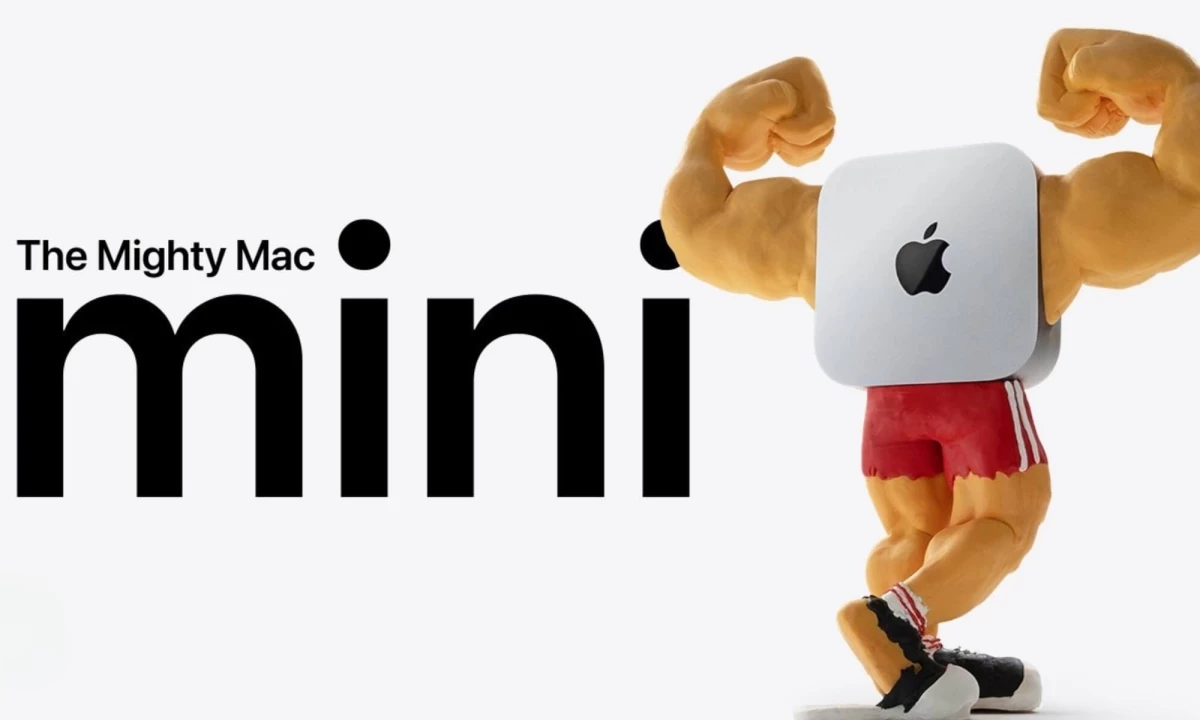

A five-by-five-inch box just flexed harder than most gym-goers ever will.
Apple has unveiled "The Mighty Mac Mini," a handcrafted claymation film marking the launch of the new Mac mini powered by the M6 chip.
The spot sells a chip that Apple says runs AI four times faster than the last one, but every frame of it was sculpted, painted, and shot by hand.
The irony is that Apple is using human craft as proof that its AI hardware is worth buying.
The iPhone maker is also asking $899 for the machine, the highest starting price a Mac mini has ever had.
Created with longtime agency partner TBWA\Media Arts Lab, the spot was shot through Blinkink and Stoopid Buddy Stoodios under director Nicos Livesey.
Trafik handled post-production, and Racket Club handled sound.
The premise is simple. Apple gave a tiny desktop computer a body, and let that body do the explaining.
Stop-motion clay figures act out the spec sheet, and faster CPU, faster graphics, and faster storage all become something an audience can watch happen.
Notably, the soundtrack, "Pili Pili" by Polo & Pan, runs underneath the entire 40-second cut.
It continues Apple's inventive brand storytelling, filtering performance claims through engaging visual metaphors that get the point across.
A voiceover opens with "Say hello to the new Mac mini" and walks through the CPU and graphics gains while the clay does the demonstrating.
On screen, the film closes with restrained Apple-type reading: "The Mighty Mac mini with M6."
Nothing else in the frame explains the product, which leaves the animation to do the persuading.
Three Clay Forms for Three Spec Claims
In the film, the Mac mini's transformation happens in stages.
First, it shudders and its casing splits as a bodybuilder's arms and legs burst out to demonstrate raw CPU muscle.
It then morphs into a race car with jagged energy bolts trailing behind it, spotlighting the dual neural accelerators.
Next, it sprouts a brain, robot legs, and several busy little arms to stand in for the 4x AI gains.
Finally, the mini straps onto a handcrafted rocket and blasts into the stratosphere, the ceiling on heavy creative and coding work.
The new Mac mini is here. Small in size. Big on performance. From everyday productivity to all things AI, it can help you do it all. pic.twitter.com/GopxcHM5od
— Tim Cook (@tim_cook) August 25, 2026
Apple announced the Mac mini on August 25, with preorders open and shipping starting September 22.
It's the first Mac to run Apple's 2nm M6 chip.
On top of faster AI performance, Apple says the new Mac mini delivers a 40% faster CPU, and up to two times faster graphics and storage.
The price moved, too. It starts at $899, up from the $599 that the M4 version launched at in October 2024.
It's aimed at both everyday users and developers running heavier workflows.
The pitch is that a machine this size can now handle demanding coding and creative work once reserved for larger desktops.
The making-of film goes out of its way to point out that no AI tools were used to produce the ad.
It shows animators Justin Rasch and Scott DaRos sculpting and painting each prop, while art director Josh Mahan is walking through the sketches and rigs.
The proof of human labor sits directly against the AI-performance claims the machine is selling.
Apple wants the emotional weight of this launch to rest with the people who made the film, which turns the production credits into part of the pitch.
Human Craft Buys Trust That AI Output Can't
Handmade production functions as a differentiator in modern advertising.
A 2026 study on what its authors call the struggle premium surveyed 70 students on how they judge creative work.
It found that 72.9% of respondents would pay more for human-made work over an AI-generated equivalent.
Apple is claiming this premium by naming and showing the animators who sculpted every frame.
Here are three takeaways for marketers working in a similar territory:
- Let the making-of do persuasion work: A behind-the-scenes film is both supplementary content and proof of labor, and the latter is what builds trust.
- Translate specs in a visual way: Benchmarks mean little to general audiences, but a flexing arm or a rocket launch makes the same claim obvious in a second.
- Let contrast do the branding: Using faster AI hardware against "built without AI" craftsmanship gives a product two distinct stories.
Apple is selling a faster chip alongside an argument that better tools leave more room for human work.
Its own production process is the proof, which makes the making-of film a piece of brand strategy in its own right.
Our Take: Does the Contradiction Work?
Apple has a price problem with this Mac mini, and the clay is quietly helping with it.
We think that the contradiction works, and the payoff is mostly commercial.
The "no AI" lets Apple claim the technology gains without ceding the warmth that comes from visible human labor.
Somebody in that building knew the tension would get noticed and decided it was worth the risk of looking a little contradictory.
At its core, Apple wants to convince you that the Mac mini is more powerful than its predecessor.
However, it also wants to convince you that creativity within the company is thriving, and human-made work is still worthy of celebrating.
Brands pursuing ambitious creative need partners who are all in on their ideas. Take a look at these top creative agencies in our directory.