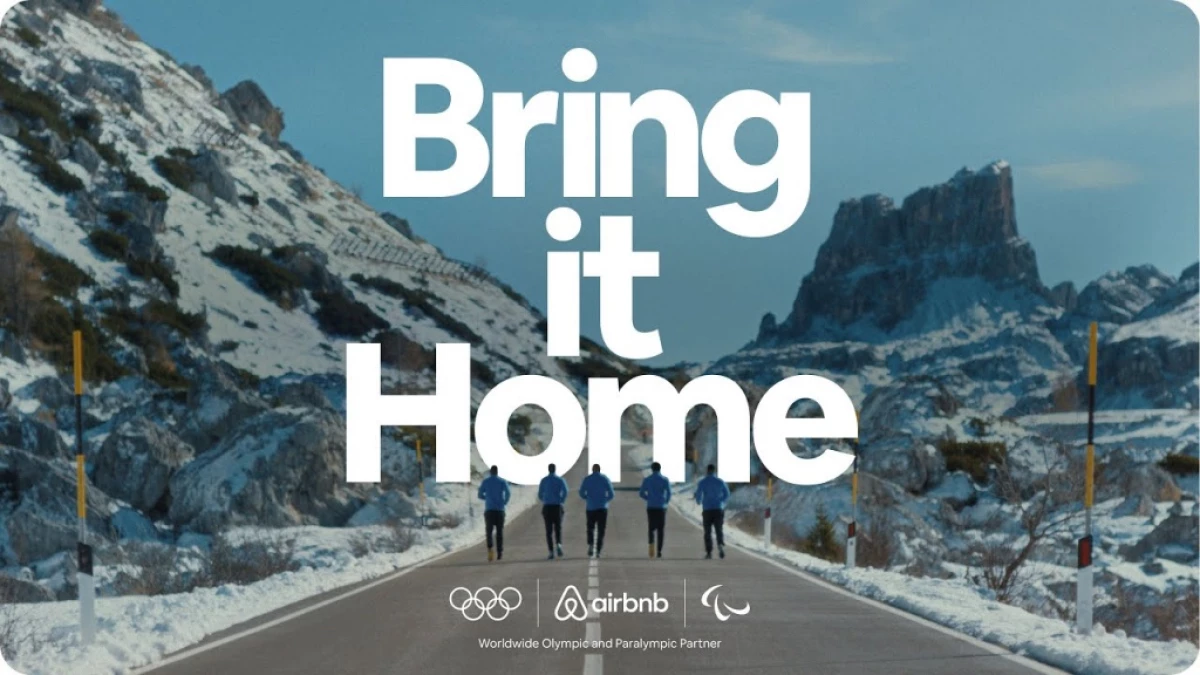

AirBnB's Winter Olympics Campaign: Key Findings
- Airbnb launches a documentary series ahead of Milano Cortina 2026, focusing on housing stability and daily training realities rather than competition outcomes.
- The 15-minute film ‘Bring It Home’ documents athletes training inside ordinary living spaces to reflect how preparation unfolds outside formal facilities.
- Early distribution through an NFL Conference Championship teaser expands reach, placing the campaign before the Olympic advertising cycle intensifies.

Campaign Snapshot
Airbnb’s Olympic storytelling this year arrives quietly and well ahead of the Games themselves.
The platform has released a short docuseries in advance of the Milano Cortina 2026 Winter Olympic and Paralympic Games, choosing preparation as its narrative center.
Instead of ceremonies or medal moments, the films stay with the repetitive stretch of training that defines most athletes’ lives.
Here, home functions as infrastructure, placing Airbnb alongside the work that happens long before they compete.
The series spends time inside temporary homes, borrowed training spaces, and unfamiliar cities.
Routines take precedence over recognition, and the spaces themselves are treated as tools.
The athletes featured receive support through Airbnb’s Travel Grant and Airbnb500 programs, which address the housing burden that often accompanies qualification cycles.
Releasing the work months before Olympic coverage dominates the media enables Airbnb to align itself with the long stretch of preparation that precedes the Games.
The timing allows the story to settle before attention compresses around the opening ceremonies.
It also establishes brand relevance without competing inside one of the densest advertising windows in sports.
Where Real Training Actually Happens
The centerpiece of the campaign is "Bring It Home," a 15-minute documentary produced internally by Airbnb.
The camera observes without embellishment, allowing kitchens, garages, and shared rooms to function as practical environments.
One of the film’s central threads follows Brazil’s bobsled team as they train across improvised spaces, adjusting workouts around limited access to formal facilities.
The film also features Andrea, an Italian Paralympic hockey player training from a Milan loft, and Donovan, a figure skater preparing in Ontario as Mexico’s first Winter Olympian in 30 years.
These settings are familiar conditions for athletes operating without deep institutional support.
Airbnb CMO Rebecca Van Dyck addressed this approach in a statement tied to the campaign.
“Whether they need extra space to stay together with family while training or a kitchen for home-cooked meals, Airbnb offers the right environment for each athlete, so they can compete at their best.”
The brand stays embedded through practical support, giving the athletes’ routines room to unfold without narrative interruption.
Housing as Part of the Competitive Equation
The campaign focuses on a side of Olympic preparation that rarely receives sustained attention.
For athletes without extensive federation support, housing stability plays a direct role in how training unfolds over time.
Qualification cycles often require constant travel, repeated relocations, and long stretches away from family, all of which affect sleep, nutrition, and recovery.
Airbnb’s presence emerges through access to stable living spaces that support those routines, positioning housing as a condition that shapes performance.
To broaden reach, a 30-second teaser for "Bring It Home" will also air during the NFL Conference Championship games.
Airbnb is also rolling out more than 25 exclusive Airbnb Experiences around the Games, offering access to athletes and Olympic-adjacent events across Italy.
As Milano Cortina 2026 approaches, Airbnb’s work introduces a different lens on the Games, offering several insights for brands operating inside global cultural events.
- Process earns trust. Audiences respond to work that reflects recognizable effort rather than finished outcomes.
- Product relevance strengthens credibility. Brands carry weight when their role solves a practical need inside the story.
- Early timing creates room to breathe. Campaigns released ahead of peak attention avoid repetition and compression.
Airbnb maintains a clear brand position grounded in utility and access, which gives the work the clarity and consistency of editorial storytelling.
Our Take: What Does Early Commitment Communicate?
I see this as Airbnb defining its role through timing.
Entering the story during training months frames the brand as part of the conditions athletes rely on.
The reality is that Olympic followers do not know the background on how athletes deal with normal assets and how athletes improve their training with what they have or are provided.
The campaign shares with the viewers how this elite performance is built through repetition, routine, and compromise.
Over time, this steady presence builds trust through consistency, with relevance compounding quietly.
Warner Bros. Discovery has taken a similarly selective approach to Olympic storytelling.
It is focusing its Winter Games strategy on streaming-first audience behavior rather than traditional broadcast reach.
See the leading Top Video Production Agencies helping brands turn real moments into lasting narratives.