
AI Video Editing for Enterprise: Key Findings
- Enterprise video production is shifting beyond traditional editing teams, enabling marketers and internal teams to create content directly.
- Demand for video content is rapidly increasing across organizations, driving the need for faster and more scalable production workflows.
- Modern editing platforms are solving workflow bottlenecks, reducing reliance on centralized teams while maintaining brand control.
Video has become the language of modern marketing, but producing it at scale has rarely been simple.
Across large organizations, internal creative teams often struggle to keep up with the growing demand for video across marketing, product launches, training, and internal communication.
While Adobe’s recent Quick Cut feature update gives a glimpse into how quickly editing is evolving, a new wave of AI-powered video editing tools is beginning to reshape how enterprise teams approach the entire production process.
Instead of starting from scratch, teams can now generate a rough cut in seconds, making it much easier to get from footage to something workable.
Kevin Sloan is the Affiliate and Influencer Growth Marketing Manager at Descript, an AI-powered video editing platform.
He says the biggest change to enterprise video production workflows isn’t just about new features.
“Companies are increasingly exploring AI-assisted editing tools as a way to scale video production without expanding already stretched creative teams,” Sloan says.
The video below shows just how easy Descript is to use and how it saves people hundreds of hours:
Editor's Note: This is a sponsored article created in partnership with Descript.
AI Opens Video Production to Entire Enterprise Teams
Previously, video production inside large companies followed a familiar rhythm.
Marketing teams submitted requests, internal media groups handled editing, and projects moved through a queue that could stretch across multiple departments.
That model is starting to shift as collaborative editing platforms gain traction across teams.
Tools like Descript are changing which teams produce video.
Now, editing tasks aren’t reserved to just the video department. Instead, any team can get involved.
How does it work?
Creative teams remain in control of brand standards by building templates, rules, and workflows that guide how videos are produced.
But the actual editing process is becoming more distributed across the organization.
Why Enterprise Video Production Is Growing Fast
The growing interest in AI-assisted editing is closely tied to the rapid expansion of video across business communication.
Recent research shows that companies are producing far more video than they did just a few years ago.
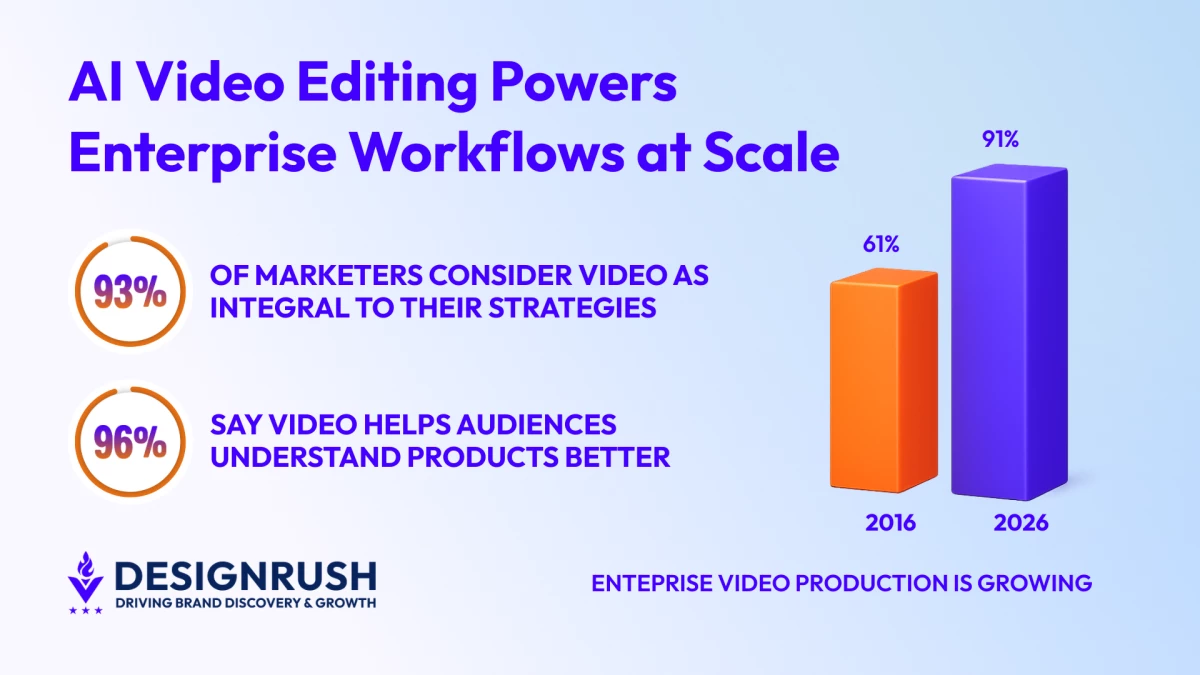
In fact, Wyzowl reports that 91% of businesses now use video as a marketing tool, up from 61% in 2016.
The same report found that 93% of marketers consider it integral to their strategies, while 96% say video helps audiences understand products and services more clearly.
Despite this, some marketers still haven’t adopted video for a variety of reasons.
HubSpot reports that 37% don’t know where to start, 26% cite a lack of time, 16% are concerned about ROI, and 11% perceive video as too costly.
And with short-form video ranked as the highest ROI format by 21% of marketers, teams that fail to scale production risk falling behind.
Hidden Bottlenecks Slowing Enterprise Video Production
Scaling video production across a large organization introduces a familiar challenge. Internal media teams often field requests from multiple departments, all needing fast turnaround.
Without the right tools, those requests quickly pile up.
Sloan says modern editing platforms are designed to distribute the workload across teams while still maintaining brand control.
“Large companies often rely on a central content or media team that fields requests from different departments,” Sloan says.
“Modern platforms allow other users to handle their own editing while still working within established brand guidelines.”
This shift reduces production delays and allows marketing teams to move faster when creating campaigns or responding to new opportunities.
It also changes how organizations evaluate editing platforms.
Rather than focusing solely on editing capabilities, enterprise teams increasingly prioritize tools that integrate with existing workflows and enable collaboration.
“Look for platforms that integrate with existing systems, remove bottlenecks, and allow teams to collaborate easily,” Sloan says.
“A single platform that combines editing, storage, and version control can simplify the entire workflow.”
AI Is Fast, But Lacks Human Creativity
AI-powered tools are now stepping into the earliest stages of production, where teams have traditionally spent the most time.
Descript allows users to edit video through transcripts, making it possible to cut, rearrange, and refine content without relying on a traditional timeline.
To this end, Sloan believes that organizations should view AI as a production assistant rather than a replacement for human creativity.
“AI can help make large cuts and reduce manual editing work,” Sloan says.
“But collaboration between teams is still important to make sure messaging is accurate and aligned with company goals.”
Learn the basics of Descript here:
What’s Upcoming for Enterprise Video Teams
Yes, AI video editing tools typically cut down on production time.
For enterprise companies, AI-assisted video tools do a whole lot more than just boost efficiency.
They’re changing how creative work gets done by making it possible for any employee (no matter their department) to create video content.
How they’re doing it?
Instead of funneling every project through a small team of specialists, organizations are enabling more employees to participate in content creation.
Here’s a quick list of how democratizing these skills can help:
- Marketing teams can launch campaigns more quickly
- Product teams can produce updates without waiting in line for editing support
- Internal communications teams can respond to events in real time.
In sum, achieving success with AI isn’t just about doing things faster. It’s also about providing every employee more control over their work, and then scaling the approach company-wide.