
AI as a Higher Education Marketing Channel: Key Findings
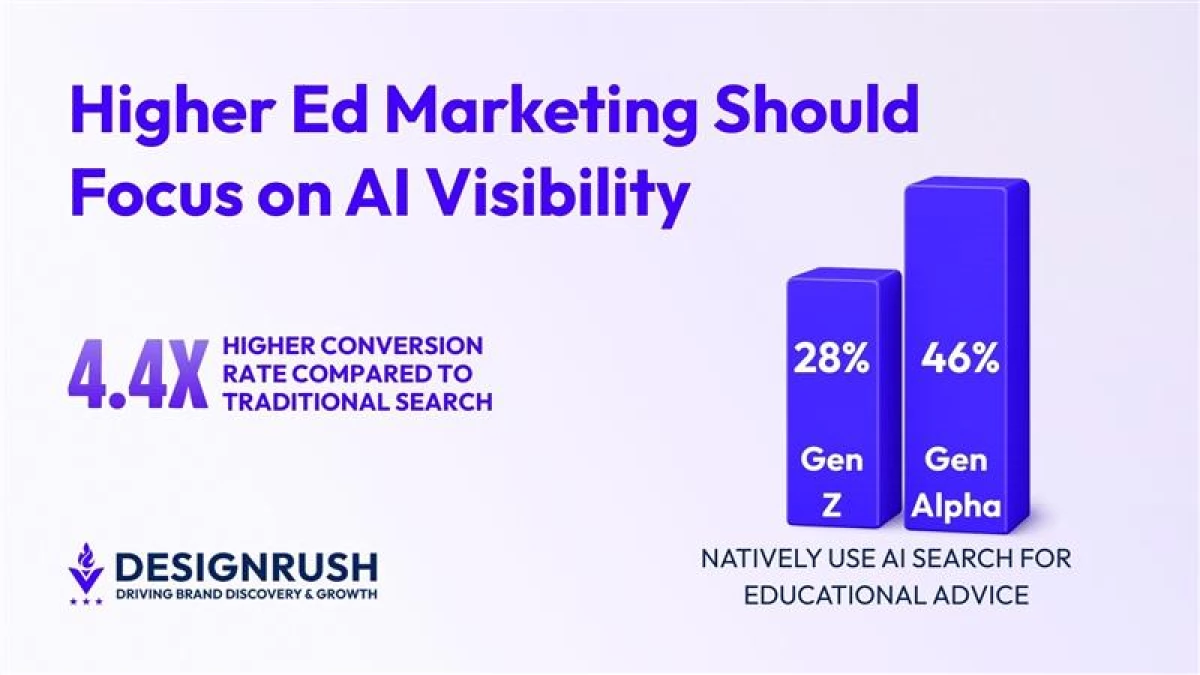
- 28% of Gen Z and 46% of Gen Alpha now use AI tools for search, forcing colleges to rethink how prospective students discover institutions.
- AI search visitors convert at 4.4 times the rate of traditional organic traffic, turning AI visibility into a measurable enrollment lever.
- Colleges that treat AI as a core recruitment channel instead of an SEO add-on will influence student decision-making earlier in the funnel.
For years, higher education marketing revolved around carefully curated brochures and open houses. Then, strategies began to focus on search rankings and digital campus tours.
Today, higher education leadership needs to draft a new playbook yet again.
Why?
Recent data from Inside Higher Ed shows that 28% of Gen Z and 46% of Gen Alphause AI tools like ChatGPT or Gemini for search.
This includes advice about higher education.
This matters because such behavior is changing how potential students discover colleges and universities online.
Plus, Semrush data shows that AI search visitors convert at 4.4 times the rate of traditional organic visitors.
So if you aren’t being recommended by AI search engines, your institution won’t even be on a student’s radar.
This is an issue that award-winning digital agency eDesign Interactive regularly assists higher education leadership navigate.
“As AI tools become a primary point of discovery, institutions can no longer assume prospective students will navigate directly to their website,” said eDesign Interactive Managing Partner Vincent Mazza.
“Visibility now depends on how cohesively your digital presence works together — and on the strength of the end-to-end online brand experience you create for prospective students.”
Editor's Note: This is a sponsored article created in partnership with eDesign Interactive.
Rethink Discovery Beyond the University Website
To say that using university websites as a central recruitment hub is "traditional" may seem contradictory at first.
Yet, if you really think about it, it makes sense.
University websites, which host program details and other important information, have long served as a digital replacement for traditional brochures and flyers.
And that’s been the case for decades.
Now, AI search is quickly taking over that role, especially as more and more generations become AI-native.
As such, higher education marketing must adapt.
For the most part, colleges and universities have begun to adopt Generative Engine Optimization (GEO) in an effort to get themselves more attention from AI search engines.
However, just GEO alone isn't enough since AI models draw from what is already visible and authoritative.
For example, a university mentioned consistently in news coverage, faculty thought leadership, student testimonials, structured web content, and video productions is more likely to surface in AI responses, as illustrated by this eDesign–produced video showcasing RVCC’s role in cultivating a skilled local workforce and regional growth.
Given this, Mazza highly recommends higher education leadership to think in a holistic, multi-channel way when it comes to their marketing and recruitment.
“You cannot optimize for AI in isolation,” he said.
“The broader and more coherent your digital footprint, the stronger your presence becomes inside AI-generated answers. It also increases the likelihood of actually recommending users to check out one of your marketing channels.”
Key Channels to Focus On
But which channels should colleges and universities focus their efforts on? After all, there’s no shortage of online channels to choose from.
However, it’s important to note that attempting to be everywhere all at once runs the risk of diluting or fragmenting your message.
This is why eDesign Interactive emphasizes being strategic when it comes to multi-channel strategies.
“Colleges don’t need to dominate every channel,” Mazza said.
“They need to ensure that the channels they do invest in reinforce one another. AI systems look for consistency across these different touchpoints. That’s the key to compounding AI visibility.”
While any channel can be effective at showcasing what makes an institution the ideal fit for a student, a few stand out as particularly effective:
Website
The university website remains crucial to an institution’s online presence. What’s changed is how websites should be structured.
Today, it’s more than just a digital brochure. It’s become a knowledge base for AI systems to reference and summarize.
That’s why institutions should prioritize creating:
- Clear program pathways that outline prerequisites, timelines, and career trajectories
- Structured content using semantic headings and schema where applicable
- Outcome-driven pages that articulate measurable value
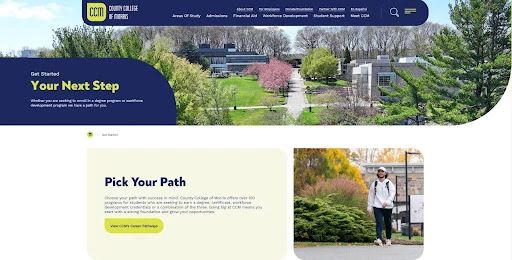
A great example of this is eDesign Interactive’s award-winning work for County College of Morris (CCM).
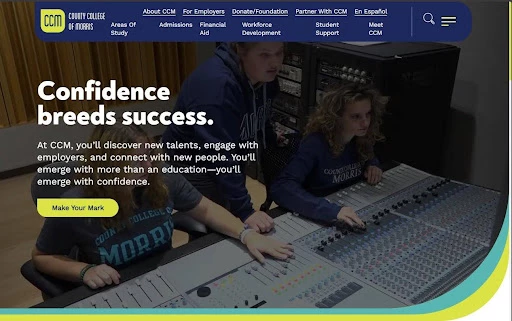
CCM wanted to revamp an outdated website that lacked clarity and failed to represent the institution’s credibility to prospective and current students, faculty, and staff.
In order to accomplish this, eDesign Interactive made significant changes to the website’s visuals and content structures.
Both were anchored around four key themes:
- Confidence: Headlines and content were crafted to promise confidence-building experiences for personal and professional growth.
- Vibrance: Bold colors were used to energize the website's visual identity.
- Energy & Momentum: Animations and interactive elements were integrated to create a dynamic, engaging UX for the community.
- Curiosity: Clear, active button shapes and text were strategically placed to invite visitors to explore.
Video
Video is easily one of the best media for user engagement. It also happens to be a great way to get attention from AI.
AI systems increasingly reference video platforms for context, sentiment, and corroboration.
Effective video strategies often include:
- Short-form program overviews tailored for mobile viewing
- Faculty-led discussions on industry trends and research impact
- Student stories that reflect authentic campus life
While working with Passaic County Community College, eDesign Interactive knew it needed to develop a way to drive interest in the college’s redesigned academic program.
This led to the production of a visually appealing and fully animated explainer video:
Social Media
For Gen Z and Gen Alpha, social platforms have become primary sources of research, validation, and peer insight.
In their eyes, content designed specifically for TikTok, Instagram, or Snapchat carries more weight than repurposed assets.
Institutions can leverage social media through:
- Authentic student-generated content
- Transparent conversations around outcomes and campus culture
- Consistent visual and narrative identity across social media platforms
Paid Advertising
Paid media remains a strategic accelerator, particularly when aligned with conversational search behavior.
As students frame questions in natural language, paid campaigns should mirror that intent.
Rather than bidding exclusively on branded terms, institutions benefit from targeting long-form, intent-driven queries that resemble AI prompts.
Strong paid strategies include:
- Search campaigns structured around decision-stage questions
- Retargeting campaigns that support multi-touch journeys
- YouTube placements reinforcing brand recall
Treat AI as a Core Recruitment Channel
To be clear, AI isn’t replacing traditional search. Instead, it’s adding another layer on top, shaping which institutions appear first when prospective students ask it questions.
That’s why institutions that invest in structured storytelling, authoritative content, and cross-channel consistency will influence discovery earlier in the funnel.
After all, it may not be long before the most persuasive campus tour in an admissions cycle begins with a prompt.