
AI-Ready Frontend Design: Key Findings
- 89% of retailers say AI has already increased their annual revenue, showing that AI is now a growth driver, and not a future initiative.
- Designing an AI-ready frontend (with structured data, modular components, and real-time updates) helps sites work smoothly with AI agents, reducing friction and improving operational efficiency.
- Websites built for AI-driven operations let teams focus on strategy and creativity, delivering faster, clearer, and more human-centered experiences for shoppers.
Eighty-nine percent of retailers say AI has already increased their annual revenue, according to NVIDIA’s State of AI in Retail and CPG report.
That datapoint alone resets the baseline for how seriously AI is already affecting retail revenue.
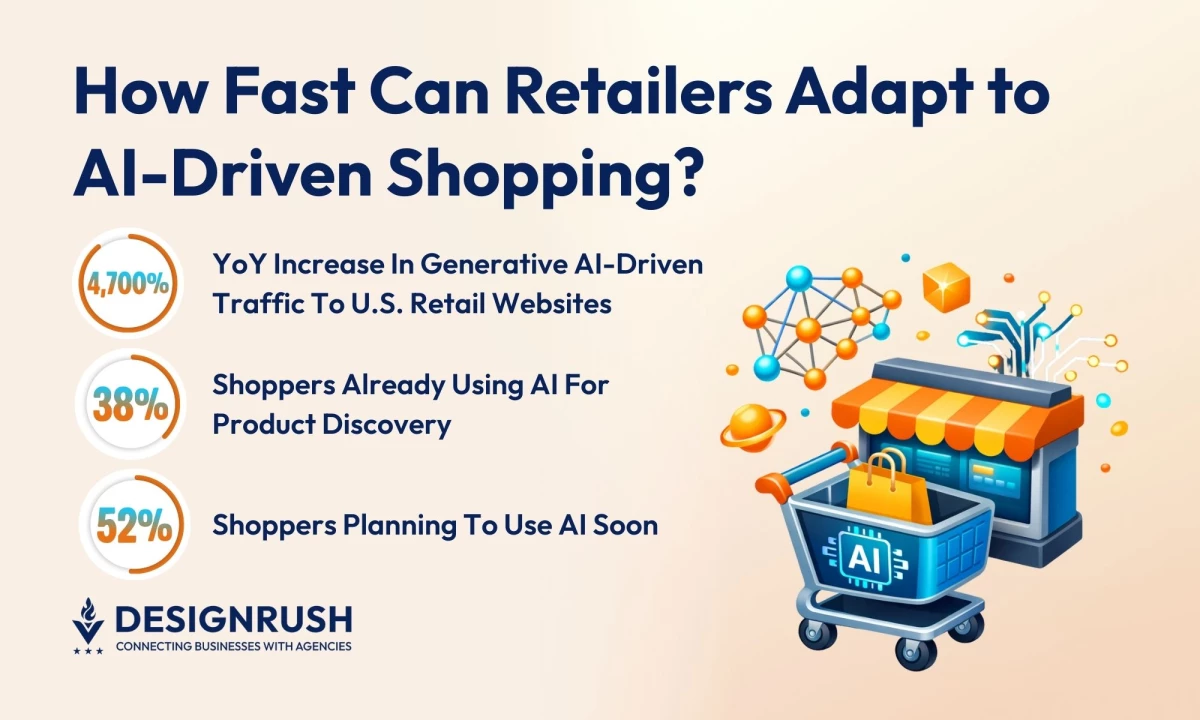
About 38% of shoppers use it now, and another 52% say they plan to, according to the IAB report via eMarketer.
The impact can be seen in traffic.
Generative AI-driven traffic to U.S. retail websites jumped 4,700% year-over-year by July 2025, Adobe Digital Insights found, sending a wave of AI-referred shoppers straight to brand sites.
For retailers, using AI to drive revenue, influence shopping behavior, and generate traffic is not a short-term trend.
As a result, the frontend must respond by transforming AI-generated intent into something clear, useful, and easy for shoppers to act upon.
View this post on Instagram
Editor's Note: This is a sponsored article created in partnership with Isadora Agency.
Websites have to handle real-time updates and work with AI tools managing inventory, fulfillment, and recommendations.
At Isadora Agency, the team has been actively testing ways to use AI to make development faster, while keeping the focus on the people using the website.
Its team highlights that AI can enable conversational interactions, personalized experiences, and better information matching on eCommerce sites.
This improves both user experience and operational workflows.
“AI is more than a tool for efficiency. When used thoughtfully, it helps sites feel more human, delivers personalized interactions, smarter recommendations, and content that matches what users actually need,” said Isadora Agency founder Isadora Marlow-Morgan.
For retailers, this translates to smarter product pages, dynamically updated recommendations, and interfaces that respond to AI insights as quickly as they respond to human clicks.
Isadora Agency’s work shows that automation and AI-assisted content tools free teams to focus on strategy and creativity, while the site itself adapts to user needs.
Front ends built with AI in mind stay relevant and intuitive.
They make every interaction feel natural and keep the experience running smoothly, no matter how users or AI behave.
Based on Isadora Agency’s experience in AI web development and platform design, a few priorities stand out for retailers getting ready:
- Clear product details, pricing, availability, and shopper intent help AI understand and surface the right information.
- Pages can be updated without a full redesign, allowing AI to adjust layouts, recommendations, and messaging in real time.
- The website updates instantly when inventory, demand, or user behavior changes, keeping information current for shoppers.
- Pages offer guided discovery, contextual help, and interactions that match how people actually shop.
Together, these elements help websites respond quickly to AI-driven decisions while keeping the experience clear, fast, and easy to navigate.
Why AI-Driven Traffic Changes How Front Ends Must Perform
More visitors are coming from AI tools, and they expect sites to give answers fast and clearly.
A 2025 FedEx report shows AI is spreading across eCommerce, which means front-end design has to keep pace with how decisions and operations are happening behind the scenes.
Generative AI tools and AI-powered search assistants are becoming the first stop for product discovery, and the visitors they send behave differently from traditional traffic.
AI-referred visitors arrive with different expectations and behaviors:
- Intent is pre-formed. AI tools often filter options before users click, so pages need to deliver clear answers, accurate pricing, and availability immediately.
- Structured content is crucial. Product details, specs, and policies must be easy for AI systems to read and surface correctly.
- Decisions happen faster. AI-assisted discovery shortens the time shoppers take to decide, making page speed, clarity, and hierarchy more important than ever.
- Deep landing pages matter. Many users bypass the homepage entirely, putting pressure on every page to function as a starting point.
The front end becomes the bridge between AI-driven insights and human shoppers, helping both operate efficiently and without confusion.
View this post on Instagram
A recent TechRadar report found that more than 70% of retailers are already piloting AI agents across operations, including:
Yet for many, a gap remains between automated decision-making in the backend and what shoppers actually experience on the frontend.
Closing that gap requires treating the website as a live operational interface instead of a static catalog.
At Isadora Agency, the team has been putting this approach to work, using AI to speed up development while staying focused on real human behavior.
Their experience shows that when frontends are designed to interpret and surface AI-driven insights clearly, efficiency rises and the site feels more intuitive to shoppers.
“Sites must act as a live operational interface, translating automated insights into actionable experiences that users can trust. Without this, even the most advanced AI can fall short of its potential,” said Marlow-Morgan.
When AI drives decisions, but the interface cannot reflect them quickly or clearly, shoppers encounter friction.
As retailers expand AI across operations, the front end becomes the point where automation earns trust or loses it.
What an AI-Ready Front End Looks Like in 2026
Websites that perform well in 2026 respond to AI inputs in real time while staying easy for people to use.
A front-end ready for AI has a few clear features:
- Product availability, pricing, delivery times, and recommendations all reflect what’s happening right now.
- Modular components let teams change content and layouts quickly without rebuilding pages from scratch.
- AI informs logic, but users still need clarity. Interfaces guide choices, reduce friction, and avoid overwhelming shoppers.
For retailers, this is less about adding tools and more about aligning design with how decisions already happen behind the scenes.
Front ends built to work with AI make technology easier to trust, easier to use, and more effective at scale.