
AI Advertising Automation: Key Findings
- AI is shifting from assisting campaigns to running them, where platforms like Yahoo’s DSP are embedding agentic AI that can autonomously set up, optimize, and troubleshoot ad campaigns in real time.
- Automation already dominates digital advertising, and programmatic systems now account for the vast majority of display ad spend and are expanding alongside a global ad market approaching $1 trillion.
- Marketers must shift from operators to strategic overseers, strengthening first-party data, creative intelligence, and governance to guide AI-driven campaigns while maintaining accountability and brand alignment.
For years, performance marketers have lived inside dashboards, tweaking bids, adjusting budgets, and chasing marginal gains.
Now, AI advertising automation is beginning to make more of those decisions automatically.
In January 2026, Yahoo DSP introduced agentic AI capabilities that enable AI agents to automate campaign setup, troubleshooting, and optimization, according to reporting by PPC Land.
With Amazon and Google accelerating similar capabilities, Sudarshan Nath, SEO Team Lead at performance-focused digital agency Viacon, says automation is moving beyond recommending campaign optimizations.
In some cases, the platforms are starting to set up campaigns, diagnose delivery problems, and adjust performance without waiting for a marketer to intervene.
“Yahoo’s DSP now embeds AI agents to run campaigns instead of just suggesting optimizations,” Nath says.
“For those in the industry, this goes beyond a feature update. It changes how media buying happens at scale.”
Yahoo DSP’s Adam Roodman explains how the company uses AI within the product:
Editor's Note: This is a sponsored article created in partnership with Viacon.
Programmatic Now Drives Digital Advertising
Automated buying is no longer viewed as the future of media. It’s the infrastructure that most campaigns already run on.
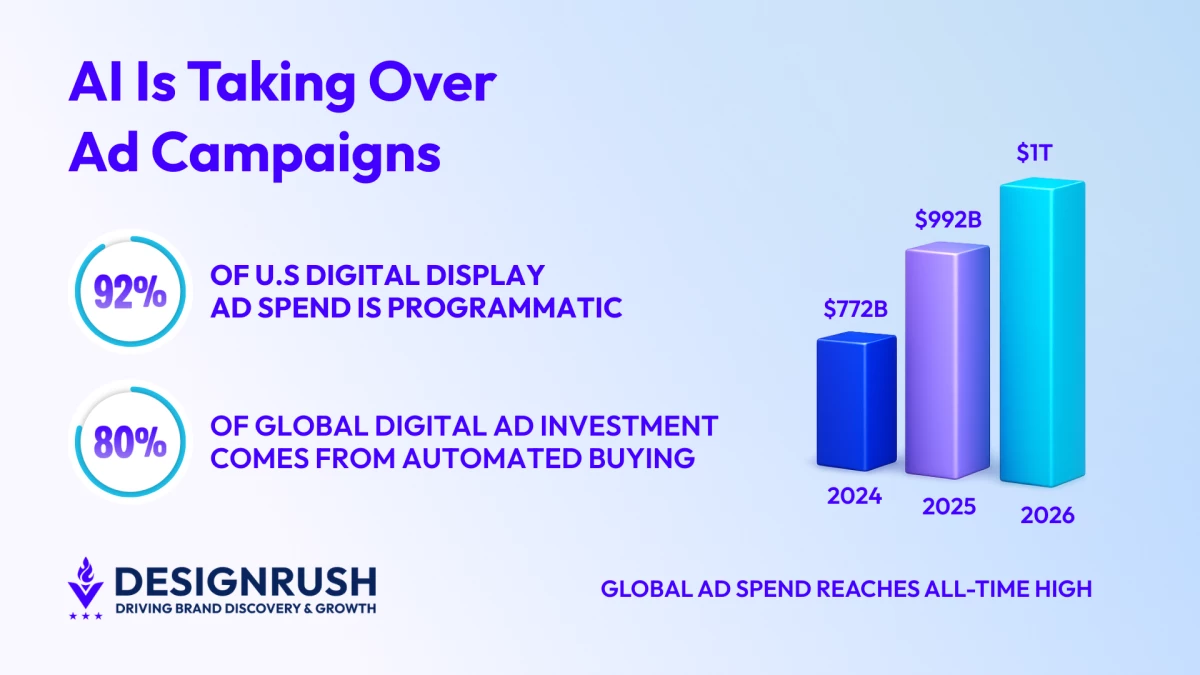
This is backed by insights from eMarketer, which shows that in the United States, programmatic advertising now accounts for roughly 92% of digital display ad spend.
Programmatic advertising continues to grow globally. Insights from BYYD indicate that automated buying represents well over 80% of global digital ad investment, with projections climbing higher as platforms refine AI-driven decisioning.
At the same time, total ad spend is entering new territory.
Dentsu forecasts show global advertising investment reaching roughly $772 billion in 2024 and climbing to about $992 billion in 2025.
Looking forward, the firm predicts the market will surpass $1 trillion for the first time in 2026, with programmatic accounting for more than four-fifths of digital investment.
Moreover, programmatic ecosystems in the U.S. continue to grow, topping $200 billion in spending and maintaining strong momentum as a share of digital ad transactions.
This shows growth is not slowing as automation matures.
And if anything, it’s accelerating alongside it.
Automation and agentic AI are not overturning that system so much as building on it, gradually shifting control from assisted optimization toward more autonomous execution.
AI Is Moving From Optimization to Campaign Execution
The shift from recommendation to execution is where the tension begins.
“When AI shifts from recommending to executing, campaign control accelerates from manual optimization to algorithm-driven, real-time decision velocity,” Nath says.
For many, that efficiency sounds appealing, where faster decisions can lead to stronger performance in auction-driven environments, and campaigns can adapt in milliseconds instead of hours.
However, when AI is making all the decisions, how much visibility and influence do you still retain?
HubSpot shows how AI-led campaigns are created:
Human Oversight Still Matters in Marketing
While automation is powerful at detecting patterns, it does not inherently understand brand nuance or long-term positioning.
“Human oversight must remain anchored in strategic direction, budget governance, brand safety, and measurable performance accountability,” Nath says.
That means that marketers cannot drift into passive supervision.
Strategic direction still requires context, budget governance requires discipline, brand safety requires judgment, and performance accountability requires clear business objectives that go beyond short-term efficiency metrics.
Essentially, execution may be automated, but intent cannot be.
The video below dives into the human vs AI paradox:
The Risks of Fully Automated Advertising
Once results start to look good on paper, there’s increased temptation to surrender control entirely. Nath, however, advises against this.
“Over-reliance on AI introduces risks such as black-box spending, brand misalignment, algorithmic bias, and erosion of strategic differentiation,” Nath says.
Black-box systems reduce transparency. Over time, these can create blind spots in how budgets are allocated or why certain audiences are prioritized.
And if every advertiser leans on similar optimization logic, campaigns can start to look and behave the same.
The video below explains the brand safety risks associated with programmatic advertising:
What This Means for Agencies
For agencies, this shift is particularly significant.
“Agencies must transition from campaign operators to AI supervisors, data architects, and performance strategists guiding automated systems,” Nath says.
The future agency model will be less about adjusting bids and more focused on designing the conditions under which AI operates.
This includes actions such as structuring first-party data, setting guardrails, validating outputs, and ensuring alignment with broader brand objectives.
This is where agencies, such as Viacon, can help shape the conversation and assist brands to balance automation with accountability and measurable outcomes.
The Marketer’s Role in Automated Advertising
As most companies already have some form of automation in place, the competitive edge will not come from simply adopting AI automation tools.
“Performance teams should strengthen first-party data, elevate creative intelligence, build AI fluency, and implement real-time validation frameworks immediately,” Nath says.
As AI-run advertising becomes reality, the real risk is not that machines will move too fast.
It’s that marketers will fail to redefine their strategic value while the mechanics quietly become automated.
Want to learn more about AI automated advertising to give your company the upper hand?
Check out our list of the Top AI Companies of 2026.