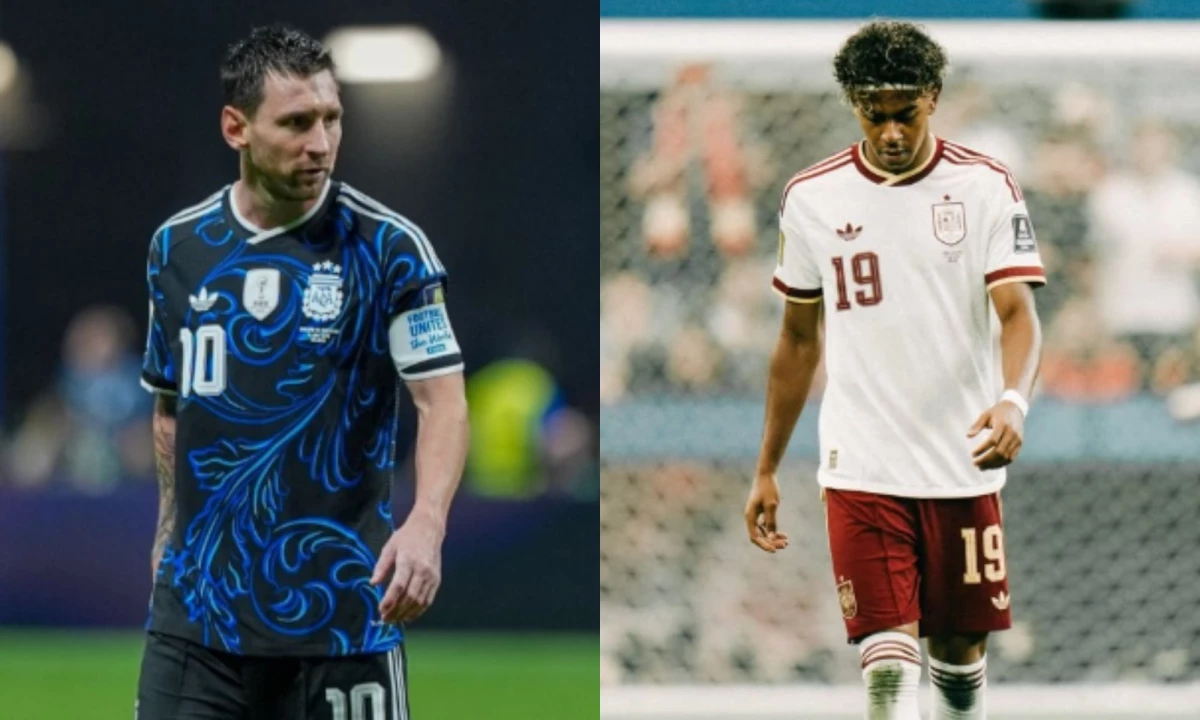

The FIFA World Cup final has become a dream scenario for adidas.
After Argentina eliminated England in Wednesday's semifinal, Nike's last remaining team exited the tournament.
This leaves adidas dressing both finalists on July 19.
Spain and Argentina wear adidas kits, and Lamine Yamal and Lionel Messi headline the brand's roster of signature athletes.
Adidas' hold on the final runs deeper than the kits both teams are wearing.
As FIFA's official partner, it supplies the match ball and the referees' uniforms. It even dresses roughly 50,000 tournament volunteers.
Adidas has made every World Cup ball since 1970, the longest-running equipment deal in the sport, now locked through 2030.
This year, it even designed a separate Trionda Final ball, a first for the brand, instead of just recoloring the group-stage one.
All of these moves stitch the three stripes into nearly every frame the cameras catch: the boots, the ball, and even the officials.
Yet the marketing battle runs on a different scoreboard. On the field, adidas owns the final.
Online, Nike owns the conversation, with its World Cup film already surpassing 80 million views.
Together, the brand campaigns show two very different ideas of what winning a World Cup looks like.
Adidas Let Football Do the Selling
Rather than trying to outshine the tournament, adidas positioned itself as part of football culture.
Developed with creative agency LOLA USA, the "Backyard Legends" campaign leaned into nostalgia.
Street football, local legends, and generational icons reinforced the brand's decades-long relationship with the sport.
This advertising strategy became even stronger as the tournament progressed.
Adidas entered the World Cup with 14 national team partnerships compared to Nike's 12.
By the semifinal stage, both brands had two teams remaining.
Spain knocked out France on Tuesday, while Argentina's victory over England completed the sweep.
This guarantees Adidas will dress both finalists and benefit from boot endorsements with Messi and Yamal.
Few brands could ask for more organic exposure than having nearly every major tournament element connected to their brand identity.
This fact is the quiet power of owning the assets. The exposure is locked in long before the final kicks off.
Nike Built a Bigger Online Conversation
Nike approached the tournament from the opposite direction.
Created by ad agency Wieden+Kennedy, its six-minute "Rip the Script" film abandoned traditional football storytelling in favor of controlled chaos.
It blended football stars with pop-culture celebrities into one interconnected football universe.
Without a FIFA sponsorship, Nike treated the World Cup as cultural entertainment.
It designed the campaign to generate clips, memes, Easter eggs, and repeat viewing across social platforms.
This approach paid off. Within weeks, "Rip the Script" reached 80 million views on YouTube alone.
This number dwarfs the audience for adidas' brand film at only 8.3 million views.
Even without official FIFA rights, Nike still took one of the tournament's biggest marketing wins.
The Numbers Tell Two Different Stories
The commercial battle reflects the action on the pitch.
Adidas apparel spending jumped 70% year over year in May as demand for World Cup jerseys spiked.
Visits to its U.S. stores climbed 47% during the tournament's opening week.
Nike remains the world's largest sportswear brand, but its global market share has fallen from 29.2% in 2022 to 22.9%.
This finding prompted CEO Elliott Hill to acknowledge the company had "lost its obsession with sport."
Nike clearly won the attention game, but attention and sales measure different things.
Adidas' jump in jersey sales and store traffic shows its ownership reaching the register, something viral views rarely deliver.
This conversion is the deeper reason adidas comes out ahead, since attention fades while sales and market share are what keep a business growing.
The adidas and Nike rivalry shows that major sporting events reward brands that connect media investment with on-field relevance.
- Own distinctive assets, not just media. Invest in exclusive partnerships, IP, or sponsorship rights to create unmatched visibility.
- Build campaigns for multiple channels. Develop long-form creative with short-form moments built in to extend engagement.
- Support brand storytelling with retail execution. Align campaigns with product launches and merchandise availability to convert excitement into sales.
The strongest World Cup marketers created connected brand systems that keep consumers engaged from kickoff to checkout.
Our Take: So Who Really Won?
Adidas and Nike chased two very different definitions of winning this World Cup.
We'd argue that both got what they came for: Nike the conversation and adidas the tournament.
But only one of these wins scores where a business keeps count.
When the trophy goes up on July 19, adidas will be everywhere the cameras point, 50 years into a partnership no campaign can rent.
Nike will have to conjure another viral hit in four years, while adidas' ownership runs through 2030 and pays out on its own.
So we think that adidas won this round and possibly the next one unless Nike does something about it.
Nike pulled off a brilliant campaign, but campaigns end, and adidas' grip on football doesn't.
Looking to build a sports marketing campaign that cuts through the noise?
Explore these top sports marketing agencies to find the right partner for your next brand activation.