
Adidas cast the World Cup final as a blockbuster before a single ball was kicked.
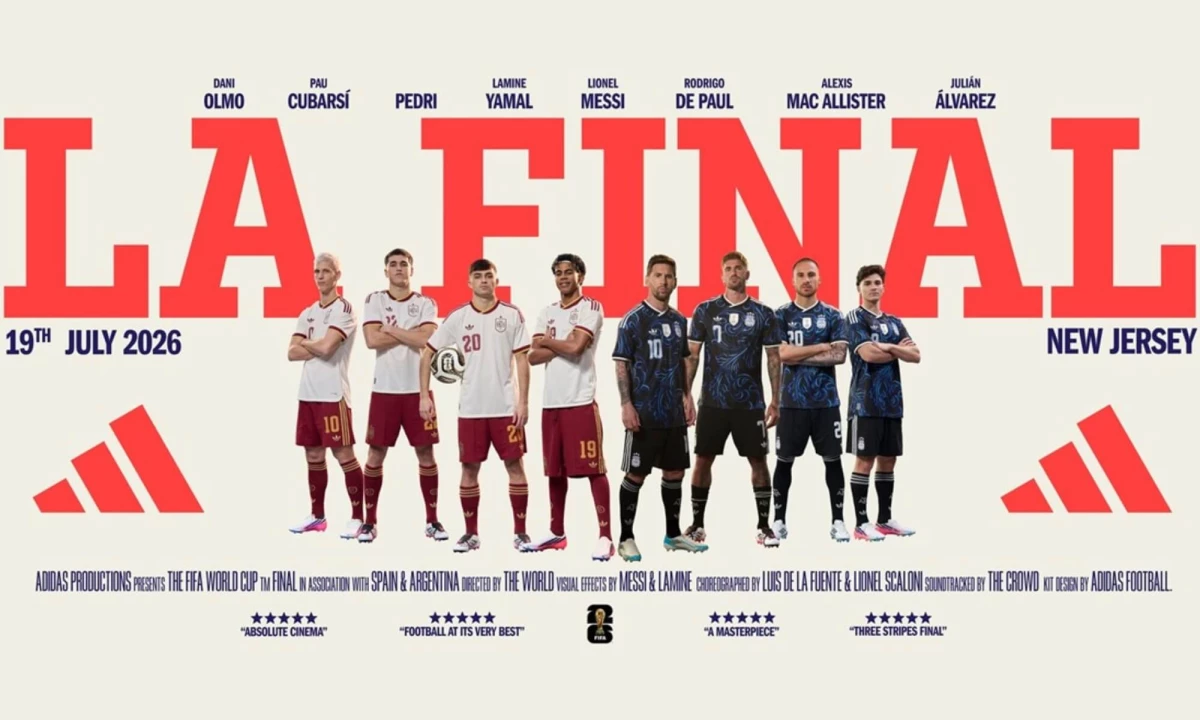
The brand unveiled "LA FINAL" on July 19 in New York City, featuring Argentina and Spain, the contenders in the FIFA World Cup 2026 final.
The visuals borrow directly from movie poster design, placing players from both squads as the lead characters in football's biggest story.
The roster included Argentina's Lionel Messi, Rodrigo De Paul, Alexis MacAllister, and Julian Alvarez.
They're accompanied by Spain stars Lamine Yamal, Pau Cubarsi, Pedri, and Dani Olmo.
The Official Match Ball appeared throughout the imagery, too, linking the campaign back to adidas' role as FIFA's longtime equipment partner.
Sam Handy, general manager of adidas Football, tied the concept back to the players themselves.
"The FIFA World Cup Final is the biggest stage in football, where the world's best players create moments that live forever," he said.
"[T]he poster may set the stage, but the story will always belong to the players."
The brand's latest move aligns with the marketing strategy it utilized throughout the tournament: letting the athletes and the sport carry the message.
Two Teams, One Ball, No Film
The visuals boasted dramatic lighting and staged compositions, with players positioned mid-action against dark, cinematic backdrops.
The format echoed classic film promotion, complete with typography and formatting meant to evoke a movie release.
"LA FINAL" rolled out globally across adidas' communication channels and in key cities starting July 19, timed to the final itself.
There was no film component attached to this push, a departure from the brand's earlier World Cup work.
It included "Backyard Legends," a five-minute street football film that kick-started adidas' WC26 push, starring Timothée Chalamet, Messi, and Bad Bunny.
"LA FINAL," on the other hand, kept the focus on the two teams and the ball, without a celebrity to push it further.
The World Cup final match itself carried enough weight to sell the campaign on its own.
Adidas entered the final with built-in advantages already locked in.
Argentina and Spain wore the three stripes, meaning adidas dressed both finalists, supplied the match ball, and outfitted the officials.
This combination gave "LA FINAL" a reach no rival campaign could match this cycle.
Nike generated plenty of noise with its own tournament marketing earlier on, but it didn't get to have this kind of access and reach.
The Business Case for Owning the Final
The World Cup final was expected to draw over 1.8 billion viewers, one of the largest audiences in sports.
Advertisers were projected to spend $10.5 billion around the tournament, per WARC Media figures reported by Forbes.
Adidas has supplied every World Cup match ball since 1970, the sport's longest-running equipment deal, now extended through 2030.
This time, it designed the Trionda Final ball as a standalone piece, a first for adidas at a World Cup.
The three stripes were already everywhere on the pitch, so the campaign didn't need to sell the logo.
Its job was to show off an advantage that already existed on the pitch.
So "LA FINAL" played like a receipt for a decade of sponsorship spending.
Whether Argentina or Spain lifted the trophy, adidas already won the final days ago.
Three moves show how adidas turned years of sponsorship into a campaign it barely had to sell.
- Sponsorship locked in exposure before the campaign existed: Whoever reached the final, adidas knew its stars and its ball would be on the pitch.
- Design carried a sponsorship story without a tagline: The movie poster let the campaign communicate stakes and prestige without lengthy ad copy.
- A quiet final push protected a loud tournament: After a run of splashy, celebrity-driven work, ending on a stripped-down visual signaled confidence.
Treat the sponsorship contract itself as the creative brief, so the brand assets only have to show what the deal guarantees.
Our Take: Can Sponsorship Do the Talking?
We watched brands spend months trying to out-shout each other for World Cup attention.
Adidas' answer, in the final stretch, was to hand the microphone to two nations and a ball.
This move was a flex you could only pull off when the situation is already in your favor.
What struck us most was how this was a closing statement dropped when the whole planet was already looking.
Adidas trusted a movie poster and two kits to carry a global final with no film, no stunt, no tagline.
This whole campaign is brand power on display, decades of sponsorship money turned into a poster that adidas didn't have to explain.
Looking to build sports campaigns that connect culture, entertainment, and brand storytelling? Explore these top sports marketing agencies in our directory.