
Reoptimizing for Top-of-Funnel Strategies: Key Findings
- Chasing the 5% of consumers who are ready to buy is a lost cause because they’ve already made a decision.
- Targeting the 95% of undecided consumers offers real upside since early narrative-shaping creates the biases that drive future purchases.
- Rising customer referrals signal top-of-funnel success because they show early bias turned into advocacy.
It’s only human to want to extract the maximum value out of every dollar spent. That goes for both consumers and businesses alike.
This is especially true for marketing and sales teams, who often face shrinking or stagnating budgets.
In fact, Gartner’s 2025 CMO Spend Survey revealed that marketing budgets for 2025 have remained flat at 7.7% of overall company revenue.
In turn, marketing teams are forced to allocate more dollars into ways that prioritize conversions and squeeze the maximum ROI.
In most cases, marketing teams are pouring significant money into capturing the 5% of consumers who are ready to buy right now.
At first glance, this sort of strategy checks out. If you’re trying to improve conversions/sales, it makes sense to go after potential customers who have already made up their minds to buy.
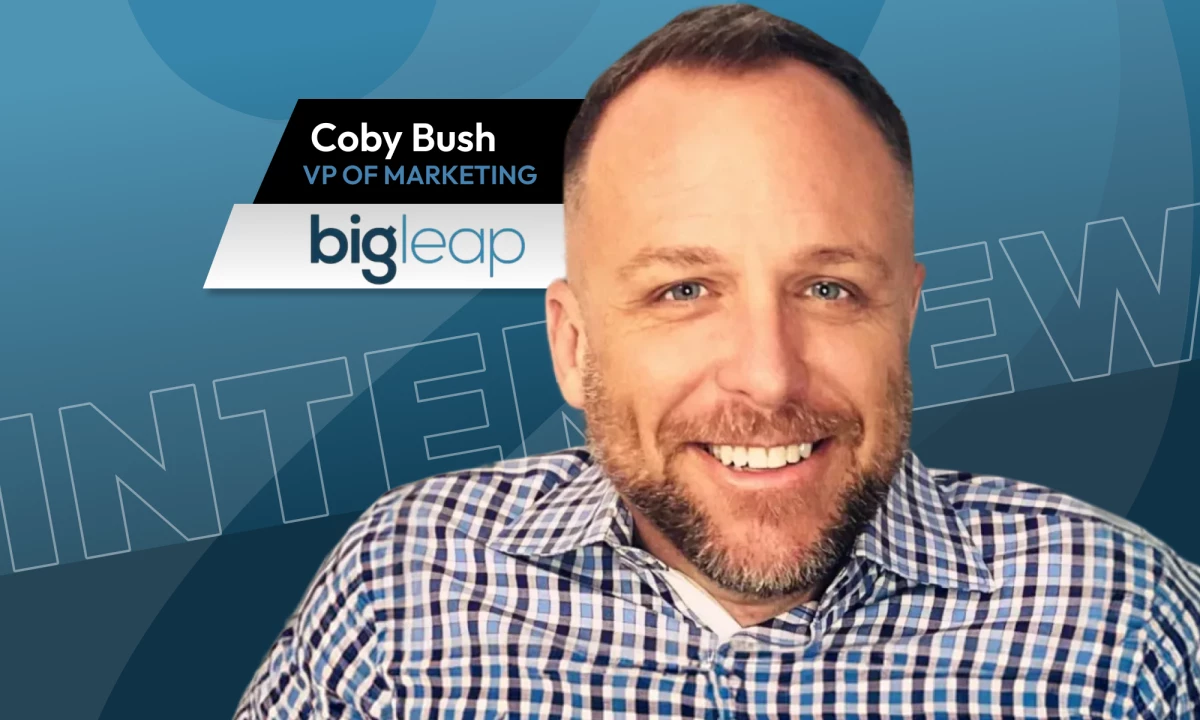
Unfortunately, Coby Bush, VP of Marketing at Big Leap, says that over-investing in such a strategy can easily backfire.
In our interview, Bush explains why competing for the 5% is a losing strategy, why top-of-the-funnel strategies are the true battlegrounds for marketing, and how brands can maximize their ad spend simply by engaging with potential customers earlier in their journey.

Who Is Coby Bush?
Coby Bush is the VP of Marketing at Big Leap, where he leads strategic initiatives to drive brand growth and market impact. Coby brings more than two decades of experience in marketing, brand development, and strategic communications across the tech and advertising sectors, helping shape go-to-market strategies and elevate brand presence.
Why Chasing the 5% Rarely Works
Numerous studies over the years have claimed that roughly 5% of consumers are actually ready to purchase a product or service.
For many, this means that the dollars are there for the taking. You just have to find a way to convince these 5% of consumers to give it to you instead of a competitor.
Again, it makes sense at first glance, but this line of thinking is based on three erroneous assumptions:
- Consumers haven’t made a decision until they reach the bottom of the funnel.
- Consumers will compare all relevant vendors on an apples-to-apples basis.
- Consumers will always go with the brand that offers the best value.
“All three of these are completely untrue. I already know who I want to buy from and what I want to buy to solve any sort of problem or opportunity," Bush said.
"Vendor-centric vendors, seller-centric sellers, guys that are in it to make money for themselves and to compete in that market, approach it and go, well, if there's only 5% that are ready to buy, I need to talk to the 5%."
"That 5% isn’t buying from you. If the first time they hear about you is when they're ready to buy, you're paying money to come in second place."
In other words, the further down the funnel someone is, the higher the chance that they’ve already made an internal decision, one that they very rarely stray from.
Why?
Because of confirmation bias.
“Humans prefer to stick with the decision they've already made rather than make a new one. The longer they have this bias, the more they seek to reinforce that bias,” Bush explained.
This is where the “chase the 5% strategy” begins to crack.
To get someone who has already made a decision to reconsider, brands will need to use a wide range of ads, campaigns, content, and more.
Even then, it isn’t guaranteed that such efforts will yield the desired result.
And that’s ad spend that could’ve been allocated to other, more effective strategies that target the top of the funnel instead.
This is because consumers are making up their minds earlier and earlier. This holds true for small purchases like tech to major purchases such as a car:
"If I want to sell you a Volvo, for example, in three years, I have to start doing it now, Bush said.
"When I reach out to you when you're at the 'bottom of the funnel,' it's going to be a lot harder to change your mind because of the sunk cost fallacy. You're much more open to change at the top of the funnel.”
Of course, shifting the focus to the top of the funnel also requires a shift in the target audience of your strategies. In this case, marketers should start targeting the 95% that aren’t ready to buy.
Marketing to the 95% Without Wasting Budget
The reason why marketers should turn their attention to the 95% who have yet to make a decision to buy is two-fold:
- More control in shaping the decision-making process
- Less bias that has to be “undone”
For Bush and his team at Big Leap, targeting the 95% “flips the script,” turning the disadvantages of marketing to the 5% into an advantage.
This is best seen in how targeting consumers at the top of the funnel can create the very biases that make it nearly impossible to change the minds of the 5%, but in a way that works in your favor.
“If I understand your psychology or why you're making the decisions you're making, I can align my messaging with the why behind your decision-making, and I can be very compelling in how I talk to you,” Bush said.
This allows brands to create a narrative that consumers can start telling themselves, getting their confirmation bias to work for the brand instead of against it.
“There's so much value in the narrative that is assigned to the product than the product's actual utility that to compete on utility that it just makes no sense.”
In other words, brands should focus less on competing and more on creating their own value.
“There is no waste of money if you can do that because it goes directly to the gravy that you'll earn over and above the product utility’s value,” Bush added.
Elements of a Strong Top-of-Funnel Narrative Strategy
For Bush, there are three main elements that all effective top-of-funnel strategies share:
1. A sense of community
A strong top-of-funnel narrative starts by making people feel like they’re part of something bigger than a transaction.
This often comes in the form of “9 out of 10 moms think this” or “9 out of 10 trust this.”
Statements like these create a sense of belonging and offer potential customers a semblance of external validation for their decision.
2. A sense of purpose
Effective brands anchor their early-stage stories in a clear “why,” giving audiences a reason to care even when they’re nowhere near a purchase decision.
Likewise, consumers are more likely to conflate their personal sense of purpose with your product.
3. A sense of identity
Generally, consumers want to see a reflection of themselves in a brand. If they do, they’re more likely to buy.
“If you can tell somebody who their identity is and they buy into it, they'll buy from you for the rest of their lives,” Bush said.
To illustrate how effective these three elements can be, Bush recalled a highly successful campaign by the peanut butter brand, JIF.
When JIF was set to enter the market, Skippy was one of the leading peanut butter brands.
In the grand scheme of things, both cost more or less the same and were made the same.
So instead of only focusing on how JIF “tasted more peanut-y” than Skippy, they launched their Choosy Mothers Choose JIF campaign.
-content-large-webp.webp)
The campaign targeted consumers at the top of the funnel, ones who haven’t decided to buy Skippy. It offered a simple premise:
By simply choosing this peanut butter, you’re a more discerning and therefore better mom.
Although some may argue that such a message is manipulative, no one can deny that it’s effective, especially since the message easily touches on the three elements of a top-of-funnel strategy.
"Great brands are not all-inclusive. They're delineators. They're polarizing," Bush said.
How Not to Implement a Top-of-Funnel Strategy
Top-of-funnel strategies work because they create a strong narrative that resonates with the 95% of undecided consumers and guides them down the funnel naturally.
However, some brands make the mistake of trying to rush the process and sell too early.
"The biggest mistake folks make is that they try to close a deal in the first meeting."
"They're trying to close a deal before somebody has gone through their natural decision-making process. And honestly, it just makes you feel like they're there just for your money.
And anybody who makes me feel that way, I'm never doing business with again. Ever," said Bush.
He provides a great analogy: proposing marriage to someone after the first date.
In such a scenario, the normal reaction would be discomfort. And that’s putting it mildly.
In the end, the person who was proposed to would likely actively avoid the other person.
It’s the same when brands sell too soon and too aggressively.
Instead, brands have to match the pace of their potential customers and allow the process to play out naturally.
How to Measure The Effectiveness of Top-of-Funnel Strategy
Companies typically look to metrics like reach, engagement, brand lift, and audience growth to understand whether their top-of-funnel efforts are actually landing.
These numbers help teams justify spend, track momentum, and benchmark whether their narrative is attracting the right early-stage audiences.
Unfortunately, overfocusing on metrics causes teams to miss the forest for the trees, something that Bush says teams should avoid.
“There’s something called ‘Goodhart’s Law,’ which states that when a measure/KPI becomes a target, it ceases to be a good measure, because you begin optimizing for the KPI as opposed to what the KPI wants to help you achieve,” he said.
However, he does point to one metric that can give teams an insight into whether their efforts are paying dividends, and it’s a metric that not many brands track: referrals from current customers.
"It's the only KPI that matters because if that's going up, your business is organically scaling. Scale is a post-purchase problem. Scale comes from your current customers evangelizing for you," he explained.
Measuring this is simple because it relies on closed sales:
How did you hear about us? “From my friend.”
Do you know his name? “John Doe.”
Then try to match the information with what’s in the CRM, after which, Bush says, you have a KPI that tells you how many of the people who have bought from you are now showing up as evangelists and doing your sales and marketing for you.
“This doesn’t happen if a customer only bought from you because you were the cheapest option. It happens because they gained a bias at the top of the funnel, and you helped reinforce that bias mid-funnel and justified the cost of your service or product at the bottom of the funnel.”
Flip the Funnel Before It Flips Your Budget
Top-of-funnel strategies aren’t about casting a wider net. They’re about shaping the conditions that make buying feel inevitable long before anyone reaches a product page.
When teams stop treating the 95% as “not ready to buy” and start treating them as “not yet anchored,” marketing transforms from a tactical chase into a compounding asset.
Do that well, and the funnel stops feeling like a battlefield and starts feeling like gravity working in your favor.