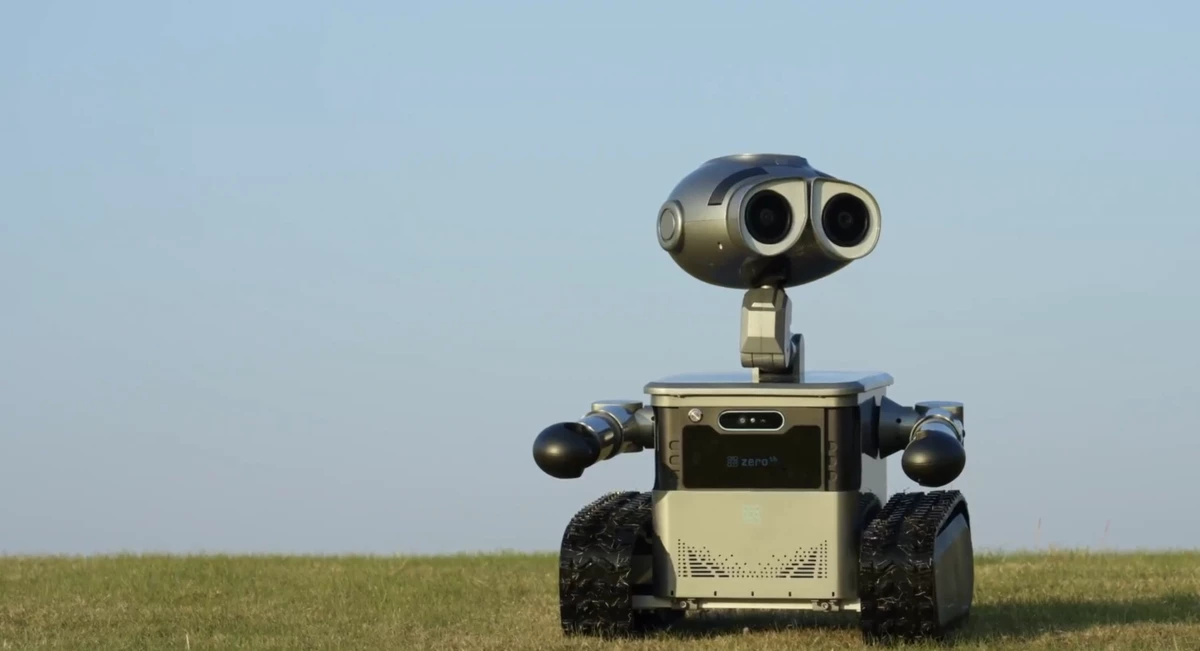

Zeroth's 'WALL-E': Key Findings
- Zeroth leads its U.S. debut with a WALL·E robot to lower barriers around consumer trust in robotics.
- Pairing familiar design with practical demos establishes AI robots as helpers, not experimental tech curiosities.
- A unified consumer and commercial lineup helps Zeroth look established despite entering a still-nascent market.

Campaign Snapshot
Zeroth Robotics knows exactly what gets people to stop and look.
At CES 2026, the AI robotics startup emerged from stealth in the U.S. by anchoring its debut lineup to a character that feels instantly familiar: Pixar's beloved post-apocalyptic robot.
Among its five-product reveal is "WALL•E," an expressive companion robot created using designs from Disney and Pixar.
It's made for classrooms, retail spaces, and other high-engagement environments, and is a deliberate choice signaling Zeroth's plans to enter a category that still makes many consumers uneasy.
Rather than leading with specs and technical capabilities, Zeroth is using the character's recognition and warmth to frame what comes next.
Its lineup includes consumer-facing and commercial robots built around the same underlying technology stack, but WALL•E sets the tone.
That strategy becomes clearer when looking at "W1," a wheel-based robot that closely resembles WALL·E in form, if not branding.
Designed for homes and light commercial use, W1 can carry heavy loads, navigate grass and gravel, and follow users using lidar, RGB cameras, and onboard sensors.
Priced at $5,599, it’s meant to be a functional helper capable of transporting items, hosting games, and even acting as a mobile camera platform.
Alongside W1, Zeroth is launching "M1," a 15-inch humanoid robot designed for the home.
Starting at $2,899, M1 focuses on companionship and light assistance, offering reminders, fall detection, and conversational interaction powered by Google’s Gemini AI model.
Zeroth says the robot can operate on both desktops and floors and can recover on its own after a fall.
Beyond these two models, Zeroth Robotics is previewing A1, a developer-ready quadruped for universities and R&D teams, and Jupiter, a full-size humanoid built for real-world tasks using a mix of autonomous and remote control.
Together, the lineup is a sign that Zeroth wants to span consumer curiosity and enterprise practicality without splitting its brand identity.
How It Shows Up at CES
Zeroth is demoing its robots throughout CES 2026 at Booth #10748 in the North Hall, offering hands-on time with M1 and W1 while previewing WALL•E, A1, and Jupiter capabilities.
The demos prioritize real movement, navigation, and interaction over theatrical reveals.
Underpinning all five robots is what Zeroth calls its Technology DNA: a shared foundation of motion control, interaction models, and proprietary actuator engineering.
The idea is to allow robots to evolve through software updates, strengthening long-term value rather than one-off purchases.
Zeroth expects its full lineup to roll out across the U.S. throughout 2026, starting with M1, while interested buyers can join preorder and demo programs through the company’s site.
What We Can Learn from Zeroth’s WALL·E Angle
Zeroth is reminding us that familiarity can accelerate acceptance, especially in a category as new and nuanced as everyday robotics.
- Leading with recognizable characters and design cues can soften resistance to unfamiliar technology.
- Live demos build credibility faster than high-concept advertising in trust-sensitive categories.
- Connecting consumer and commercial products under one story helps new brands feel established.
Last year, global service robotics revenue exceeded $22 billion, emphasizing the tech industry's race to normalize robots in everyday environments.
Our Take: Is Familiarity the Real Breakthrough?
Tech launches keep failing because they ask people to trust first and understand later.
From a consumer perspective, we do not adopt technology just because it exists. If something feels unfamiliar or unsettling, hesitation is the natural response.
Zeroth seems to understand that instinct. By leading with a WALL·E reference, the brand meets people where they already feel comfortable, then quietly introduces the technology underneath.
If Zeroth keeps building trust before scale, it has a real shot at making robots feel normal instead of novel.
In other news, Microsoft’s recent “Microslop” backlash showed what happens when technology is forced on users before it proves its value, underscoring why Zeroth’s slower, trust-first approach feels timely.
Want to spark a creative revolution with your ideas? Discover the top creative agencies making waves in our agency directory.