
Hidden Causes of CRM Failure: Key Findings
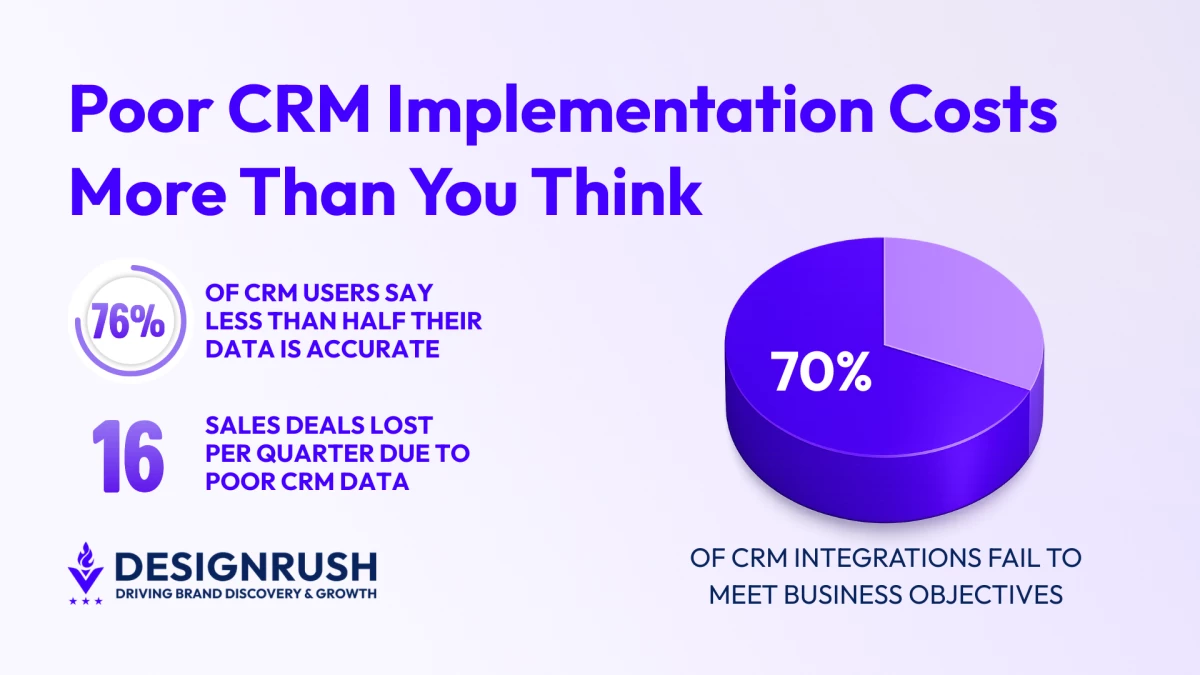
- 70% of CRM implementations fail to meet business objectives, largely because inaccurate data and unclear goals undermine ROI from day one.
- Companies lose an average of 16 sales deals per quarter due to bad CRM data, turning technical debt into a direct revenue drain.
- Instinctools emphasizes CRM readiness over speed, helping organizations align data, integrations, and workflows before configuration begins.
Being one of the most basic tools of the majority of businesses’ arsenals, it’s still a bit surprising that CRM implementation tends to bring subpar results in most cases.
Similar to AI and ERP implementation, data remains the cornerstone of most problems.
But let’s be blunt. It’s hard to expect any other outcomes when 76% of CRM adopters admit that less than half of their data is accurate.
Similarly, as much as 70% of CRM integrations fail to meet their business objectives, according to a study from ResearchGate.
As such, it’s time to figure out what exactly drives poor user adoption and negative ROI of CRM implementation.
The Most Common Breaking Points in CRM Projects
Most businesses, understandably, want to get CRM adoption off their checklists.
When it comes to CRM consulting services, deployment speed is unequivocally one of the most misleading "advantages" a vendor can promise.
Pulling your data into the system is trivial, but configuring the tool to make sense of that data is another story.
Given the abundance of CRM solutions today, including incredibly cost-efficient vibe-coded shortcuts to failure that small business owners tend to fail for, it’s imperative to understand the exact outcomes you want the system to achieve, way before the first Google inquiry.
Data quality
Regardless of the industry or tool you want to implement, your decision-making is only as good as your data.
When it comes to CRM, this problem becomes more exposed.
On average, companies lose 16 sales deals per quarter due to inadequate data quality.
Today, with machine learning consulting services increasingly shaping core CRM configurations, inaccurate insights become less prevalent.
Overcustomization
Most organizations are tempted by the appeal of a system that caters to their unique business logic.
And while precision can be valuable, it often comes at the expense of performance and smooth integration. This is especially true for organizations still tied to older external systems.
Plus, trying to satisfy every department's wishlist of features makes it easy to slip into feature creep and overcustomization.
Adoption resistance
Even with perfect data quality and CRM configuration in place, the implementation can still fail because of cultural resistance.
Most departments have refined workflows developed over the years that get the job done.
Rapidly introducing these people to new, “superior” ways of doing things often leads to low adoption rates. This often manifests in subtle reluctance to change or even borderline sabotage.
Eight Steps to Build a CRM That Works
To reap the most benefits from a CRM deployment, teams should approach implementation as a long-term journey instead of a one-off project.
Essentially, there are three core areas that an organization needs to cater to: people, processes, and technical infrastructure.
And when you take a strategic, patient, and methodical approach to this, you set yourself up for sustained success.
In our experience, adopting this approach can be broken down into eight key steps:
1. Align business goals with the right CRM platform
When rolling out a CRM, leadership should remember to set goals that are realistic, measurable, relevant, and achievable. Likewise, clear KPIs should also be set.
Put into practice, it's better to ask your team to "Shorten the sales cycle for cold leads by 15%," instead of giving a vague demand like "achieve higher customer satisfaction."
The first request clearly states which part of the cycle needs the most attention, as well as a measurable target for success.
Interview intended CRM users to detect their specific pain points. Based on your findings, narrow down the list of possible CRM providers and spend time trying demos and talking to sales reps.
CRM platform configuration should stem from clear business objectives. Firms often lean towards well-known CRM platforms without taking into consideration their goals and current architectural flaws.
If you’re operating in a highly regulated industry, your options narrow to platforms with strong compliance and security features.
But if your business is gearing up for rapid growth, you’ll want to focus on API flexibility and infrastructure that can handle heavy data loads.
Ignoring these needs often means paying the price later with an expensive platform migration.
2. Design a clear implementation roadmap
When it comes to CRM implementation, improvisation won’t cut it.
Define scope, outline an iterative roadmap that prioritizes low-complexity modules first, set clear deadlines, and leave as much time for testing as possible.
Always keep in mind how much of a disruption this endeavor will cause and prepare people and the budget accordingly.
The end goal of your implementation roadmap is to start realizing value as soon as possible with the intention to continuously add features and scale in the long term.
3. Engage the right stakeholders
Everyone is going to use your CRM, but only a select few should implement it.
One of the most recurring mistakes companies make is assigning the wrong people as process leaders, while keeping the actual end users in the dark.
Besides project managers, business and data analysts, and senior management, involve core sales, marketing, and accounting people whose roles are aligned with the project goals in the adoption process.
4. Prepare, cleanse, and structure your data
In the context of CRM integration, the importance of clean data can’t be overstated. It’s rarely worth the effort to try to extract value from redundant information.
What’s more, most companies fail to gauge how inaccurate their data really is.
In essence, making your data right is a separate, equally complicated process that can take time to finish.
Treat it as a complete overhaul of your business’s source of truth.
This is especially important for firms planning to leverage AI and machine learning services, as predictive models and AI-driven insights are only as reliable as the underlying data.
From incomplete customer profiles and duplicated data to inconsistent formats and random Excel sheets, every bit of data needs to be thoroughly cleansed and validated before migrating it to a new system.
5. Architect integrations from day one
The probability of CRM to bring positive ROI is inherently tied to its ability to talk to other systems within your workflows.
BI systems, ERPs, task tracking software, and everything in between need to share data with each other, fast and without hiccups.
Most of today’s systems have tested APIs that streamline integration, but some of your tailored legacy tools will most likely need custom synchronization.
Think through integrations early in the adoption and never overlook the speed of data traveling between the systems.
6. Build security and compliance into the foundation
While security breaches involving high-profile companies like Discord dominate headlines, the wrongdoers are indifferent to sectors and company sizes.
Discord says 70,000 age-verification ID photos may have been leaked in recent security breach that also includes names, usernames, emails, credit cards, and IP addresses https://t.co/P6xnDR8HnK
— PC Gamer (@pcgamer) October 9, 2025
Your new CRM system is as much of a target as Instagram for those who make a living out of finding architectural vulnerabilities.
To avoid breaking user trust and maintain reputation, it’s crucial to adopt as many security measures as possible, including robust authentication methods, data encryption, and rigorous security auditing.
7. Drive change management and user adoption
In a nutshell, it’s impossible to realize value from CRM implementation if the intended users are reluctant to use it.
Communicate value from the early stage, conduct multiple training sessions for separate departments, and set up a ‘hotline’ for troubleshooting in the initial adoption phase.
On top of that, establish detailed documentation that will allow staff to self-learn independently.
Lastly, it’s especially important to make sure that power users and veteran employees see the benefits of leaving behind their decade-tested workflows in favor of a new system.
8. Plan for post-implementation management
Regardless of how much effort you put into planning, some parts of the system will inevitably have to be adjusted or completely redone.
Establish a flow for routine feedback collection, collect and analyze usage metrics, and run data security audits.
If you have enough resources, it makes sense to designate a manager or a specialized team to handle application support and maintenance to proactively monitor and fix CRM issues, at least in the first few months after implementation.
Why The Right Implementation Partner Makes a Difference
Simply put, approaching CRM implementation as a long-term commitment is crucial for any organization looking to maximize the benefits of CRM deployment.
To do this, teams should focus on three core areas:
- People
- Process
- Technical infrastructure
And if these core areas are overlooked? Well, that's when problems come one after the other.
This is why vendors who overpromise rapid deployment speeds often deliver subpar results that usually end up in costly revisions and fixes.
Conversely, working together with a competent implementation partner ensures your CRM is both built on solid foundations and has the necessary support that enables growth.
And when you're operating in competitive markets and industries, that seemingly small change in mindset easily gives your organization a decisive advantage.