
Is your data driving growth — or just sitting idle?
In 2023, over 90% of companies had data initiatives planned for the year,. yet almost 60% of them faced challenges in realizing business value from their data use and 70% needed help turning data into actionable business insights.
This disconnect raises a critical question: how can businesses bridge the gap between data collection and decision-making?
Ivan Burban, head of marketing at Coupler.io, a reporting automation and data analytics platform, joins us to discuss the transformative power of simplifying data processes.
He also shares tips on building an effective data management strategy and best practices for optimizing data management across various platforms.

Who Is Ivan Burban?
Ivan has over 12 years of experience in marketing and product management. He is on a mission to help SaaS organizations grow quickly and build proper workflows that help increase business revenue faster. Ivan strongly believes that marketing is the first driver of business growth and is always ready to share his knowledge.
An average business uses hundreds of online tools, generating vast amounts of data.
Given this, Ivan believes the biggest challenge is turning this data into actionable insights — actually making it work rather than just collecting and storing it.
Additionally, he highlights three related challenges:
- Unifying data management and analytics flows: Businesses struggle to consolidate data from sources with differing structures, APIs, and formats.
- Lack of resources and skill gaps: Many companies lack the expertise and budget for tools to validate and manage data effectively, compromising decision-making accuracy.
- Over-reliance on third-party data: Without robust first-party data, businesses depend on limited data from external sources. For instance, the transition to Google Analytics 4 shows how this shift can reduce data usability and clarity.
But what role do data analytics and automation solutions play in helping businesses overcome these challenges effectively?
“Data analytics and automation platforms serve as a hub for gathering and managing data in one place. They simplify and unify the processes of getting and managing data from third-party services, enabling the interpretation of raw business data,” Ivan answers.
In the case of Coupler.io, the solution integrates all analytics and automation capabilities into a single platform. With no coding required, organizations can:
- Collect data from apps like HubSpot, GA4, Meta Ads, etc.
- Organize and unify this data, ensuring consistency and readiness for analysis.
- Transform and enrich datasets from multiple sources to uncover cross-channel insights.
- Visualize results in tools such as Google Sheets, Excel, or BI platforms.
“As a result, organizations can eliminate hundreds of hours of manual work each month and ensure they have fresh, reliable data to make informed decisions quickly. By providing simple setup and customization capabilities, Coupler.io empowers businesses to unlock the full potential of their data and scale effectively,” he adds.
How Coupler.io Empowered Clarity Seed to Save 40+ Hours a Month
Ivan shares a case study on Clarity Seed which faced significant time and resource constraints due to manual data extraction and reporting processes.
Coupler.io helped Clarity Seed to automate data extraction and reporting which resulted in significant time savings (over 40 hours a month), improved accuracy, and real-time access to critical metrics.
“This case represents Coupler.io’s mission well: to make data accessible for everyone, ensuring businesses of all sizes can scale effectively.
Whether it's marketing, sales, or finance, our platform transforms complex data workflows into seamless processes, empowering teams to innovate and drive results,” he highlights.
What Key Features Should You Look for in Data Integration Solutions?
Next, Ivan and I discussed the features and capabilities businesses should look for in a data integration solution to ensure they’re getting maximum value.
“Apart from the ability to collect data from all necessary sources, a solution should have data transformation capabilities. Many data integration tools lack this feature, while it's critical for simplifying, filtering, and processing data in a cost-efficient and timely manner,” he says.
He highlights that flexibility and compatibility are also critical.
While many platforms offer numerous integrations, businesses must ensure the solution adapts to their needs and supports evolving workflows.
“Additionally, you should pay attention to data security and compliance. Your business data has to be protected, so the tool must comply with the current regulations and privacy standards,” he shares.
I agree that data security is essential to safeguard key information, especially since the risk of cyberattacks and data breaches is higher than ever.
Ivan also shares a common pitfall to avoid — underestimating the value of a data integration service.
“Given the complexity and cost of building custom integrations internally, a platform with stable access to hundreds of data sources and transparent pricing provides more value in the long run,” he notes.
Making Data Work Harder and Smarter
For companies that are just starting with data integration, Ivan advises them to build an effective data management strategy:
- Identify goals for managing data
- Understand its current state and volumes
- Define responsible people
- Choose a tech stack
- Proceed with implementation/polishing
He also explores the importance of data analysis in modern marketing and how it influences data management strategies.
“In modern marketing, being data-driven and flexible is a must, so data analysis plays a paramount role in data management.
Collecting and organizing data are part of this journey while making data accessible and simple for analysis increases the value of data management strategy; it promotes a data-driven culture within the organization,” he says.
Ivan mentions that he and his team use auto-updated reports and dashboards, both multi-channel and per-channel, which allow them to monitor performance, optimize processes, and adjust strategies.
Additionally, Ivan shares two best practices for businesses looking to optimize data management across various platforms:
- Focus on accessibility and usability. Transforming your raw data into actionable insights is key. For this, use dashboards and reports to combine metrics, get real-time updates, and present data in an easy-to-read, visual format. Highlight only essential data rather than overwhelm stakeholders with excessive information.
- View your data strategically. Diverse and enriched datasets are equally important. Businesses can ensure their insights are comprehensive by collecting data from multiple sources and filtering out irrelevant information. This will reveal the true power of data, which lies in its ability to drive decisions.
And that’s the whole idea behind Coupler.io — to simplify data management and empower businesses to identify gaps in their data. When businesses can use their data as a strategic asset rather than just a set of numbers and make smarter decisions, they can grow sustainably.
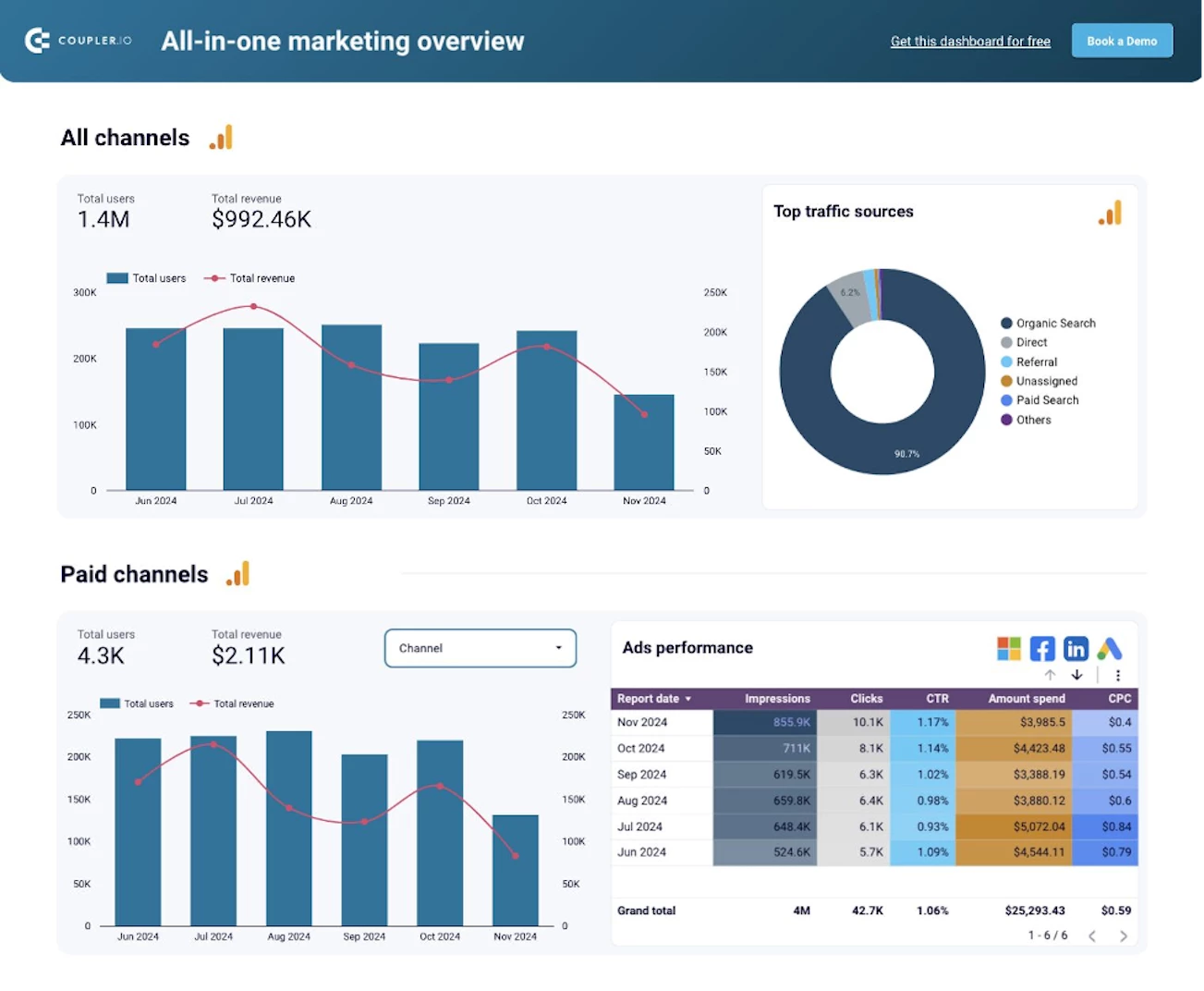
By providing real-time, unified data insights through secure dashboards, Coupler.io has helped clients streamline decision-making, identify operational inefficiencies, and optimize resource allocation.
Several features make this possible:
- Automation: It helps abandon manual and time-consuming reporting, minimizes errors, and allows organizations to extract insights from their data.
- Dashboards: These enable analyzing and optimizing marketing and sales funnels. The data clarity users get with the platform’s reports shows them blind spots, and challenges per each activity as well as overall. This way, marketers can be more effective with cross-channel analysis and proactive with polishing customer experience.
- Transparency and independence: Users control their data; they don't need expensive services or special knowledge. Saved time and resources can be used for new campaigns attracting more target audience segments and experiments.
Simplifying Data Management for Businesses Managing Multiple Sources
With data from so many sources, it’s easy for companies to feel overwhelmed.
Hence, I asked Ivan what he recommends when organizations are prioritizing and simplifying their data management approach.
“When managing data from multiple sources, businesses must focus on what truly matters. Start with essential metrics and KPIs (conversions, sign-ups, traffic, etc.) — the ones that directly impact decision-making and align with your core business goals.
Instead of reinventing the wheel, leverage ready-made solutions such as reporting automation tools, pre-defined transformations, and report templates to get up and running quickly,” he answers.
Ivan explains that once companies have established a solid foundation, they should gradually move towards customized reports and delve into advanced dimensions and indicators. This approach helps avoid overwhelming while building a deeper understanding of your data.
“For businesses struggling to get started, seeking consultation or expert assistance can be invaluable for setting up data collection and reporting.
Focus on your business operations while platforms like Coupler.io handle the complexity of integration, automation, and data management. Simplifying your approach this way ensures you have insights without losing focus on your core objectives,” he adds.
Your business likely produces a wealth of data from various sources, but without the right strategies and tools to integrate, transform, and analyze it, the value of that data remains untapped, holding back its full potential to drive meaningful outcomes.
Ivan’s tips can help you make better decisions in turning your raw data into valuable assets and redefining how you unlock business growth from it.