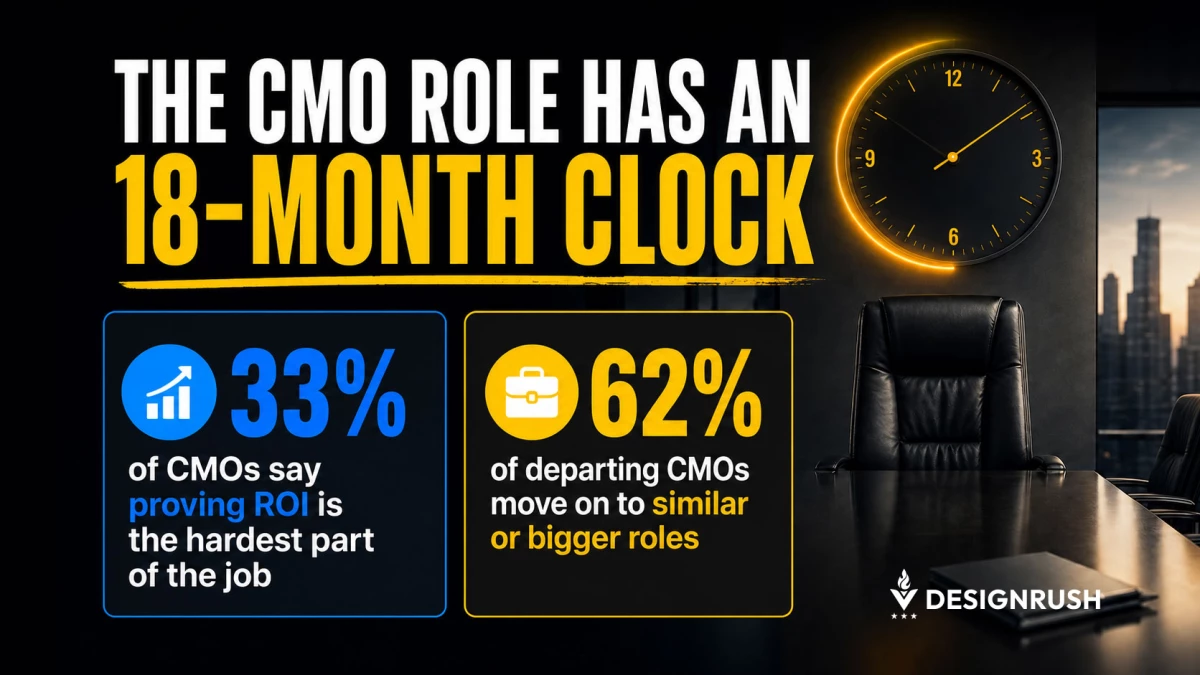

The S&P 500 average for CMO tenure sits at 4.1 years, according to Spencer Stuart's 2026 CMO Tenure Snapshot.
But in B2B tech and financial services, some data put the average closer to 18-24 months.
Separately, around 33% of CMOs say proving ROI is now the hardest part of the job, per HubSpot’s 2026 State of Marketing report.
Disruptive Advertising, a performance marketing agency, calls this the Trust Gap, where marketing leaders cannot translate activity into revenue logic that the C-suite trusts.
Jacob Baadsgaard, founder and CEO of Disruptive Advertising, argues that this is one of the biggest reasons marketing leaders struggle to earn organizational confidence despite having more data than ever before.
“Executives aren't asking whether a campaign generated more traffic. They're asking whether it created revenue, improved profitability, or accelerated growth,” Baadsgaard says.
“The further those two conversations drift apart, the harder it becomes for CMOs to earn trust and maintain influence at the executive table.”
Marketing leaders are hired to grow revenue, but many of the factors that shape it sit elsewhere.
Finance controls pricing. Engineering owns the product. Sales decides whether interest turns into business.
Yet marketing is responsible for pipeline and lead generation, and it is often held accountable when conversion rates decline.
A CRO is accountable for revenue. A CMO is accountable for everything that influences it.
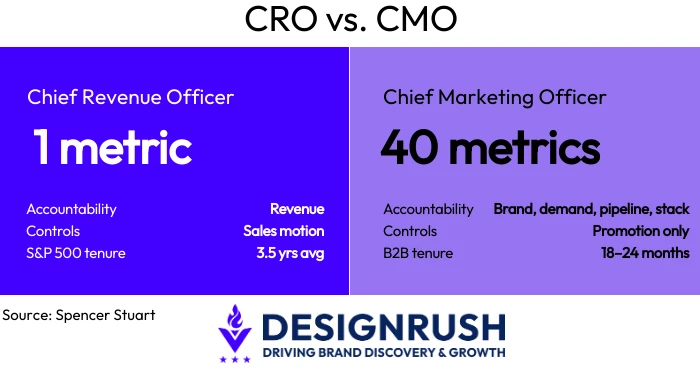 The Dashboard Nobody Believes
The metrics most marketing teams report on and the metrics leadership makes decisions on are rarely the same ones.
Marketing budgets are increasing for 79.2% of organizations in 2026, but that growth comes with stricter demands for revenue proof, per HubSpot's report.
"The board wants to know what marketing did to the revenue line, and most teams can't say it in a sentence," Baadsgaard says.
"Clicks and impressions are activity. Customer acquisition cost, pipeline contribution, and lifetime value are the language finance already speaks."
At the same time, traditional attribution models are losing credibility as buyers move across more channels, WARC's Future of Measurement 2026 finds.
This has a trickledown effect that makes it difficult for many marketing leaders to track campaign effectiveness accurately, which leads to difficulties in proving ROI consistently.
The result is a role where performance is continuously measured against outcomes that marketing does not fully own.
Own the Scoreboard Before Anyone Asks
Surviving in the CMO role requires more than strong campaign results. It requires a documented system that connects marketing activity to business math before leadership asks for one.
Disruptive Advertising built the Indispensable Marketer Assessment to diagnose exactly where that system breaks down. The audit covers vision, strategy, execution, and team.
Each pillar maps to a specific way marketing leaders become expendable, and the assessment identifies which one represents the biggest exposure.
"The leaders who survive document the vision, build the strategy math the CEO can believe, and show whether it's working in terms the business already trusts," Baadsgaard says.
To close the Trust Gap before anyone asks, Disruptive Advertising reminds CMOs to address three things first.
- Map metrics to revenue outcomes. Every marketing metric needs a direct line to a number the CEO already tracks, or it stays in the wrong conversation.
- Build the scorecard before the review. A scorecard that answers the "is it working" question removes the defensive dynamic from budget conversations entirely.
- Document the strategy math. Documented strategy math explains performance gaps before leadership interprets them as failure.
The Real Tenure Killer
The tenure numbers say less about the people in the CMO role than about how companies define it.
Spencer Stuart found that 62% of departing CMOs move on to similar or bigger roles, which means most of them did not fail.
Most of them left a structure where accountability exceeded control.
For marketing leaders who feel the pressure building, that data reframes the problem.
For companies preparing another CMO search, it raises a harder question about what they are actually hiring someone into.