
I've watched a lot of marketing budgets get spent badly, and the pattern is nearly the same every time.
A marketing leader brings their CFO a dashboard with strong ROAS, healthy CPA, and channel performance data broken down neatly. Everything looks good. The budget gets approved.
But a year later, revenue hasn't moved the way anyone expected.
The dashboard wasn't measuring what the business needed to know. It was measuring what was easy to track. The marketing team had been answering the wrong question for years, and nobody on either side of the table knew it.
That's the real problem with click-based attribution. The data isn't wrong. The question underneath it is.
Which channels touched my conversions was never the question a business needed answered. The question is, did our marketing drive sales we wouldn't have gotten anyway?
Click-based models can't answer that, and quite frankly, they were never built to.
And until marketing teams shift their mindset from tracking clicks to measuring contribution, they'll keep producing reports that look defensible and budgets that quietly underperform.
The Mindset Behind Better Marketing Measurement
Most measurement conversations get pulled into a tool debate.
Marketing Mix Modeling (MMM) or attribution? Incrementality testing or modeling?
Those are fine questions, but they're also the wrong place to start.
Click-based attribution shows correlation like which channels showed up near a conversion, in what order, at what frequency.
But it doesn't show causation. It can't tell you whether the channel did the work or just happened to be there when the work was done.
Marketers know this, but they build their budgets on it anyway because the dashboards are convenient and the numbers feel real.
The irony is that even many marketing leaders admit they can't fully prove marketing's business impact.
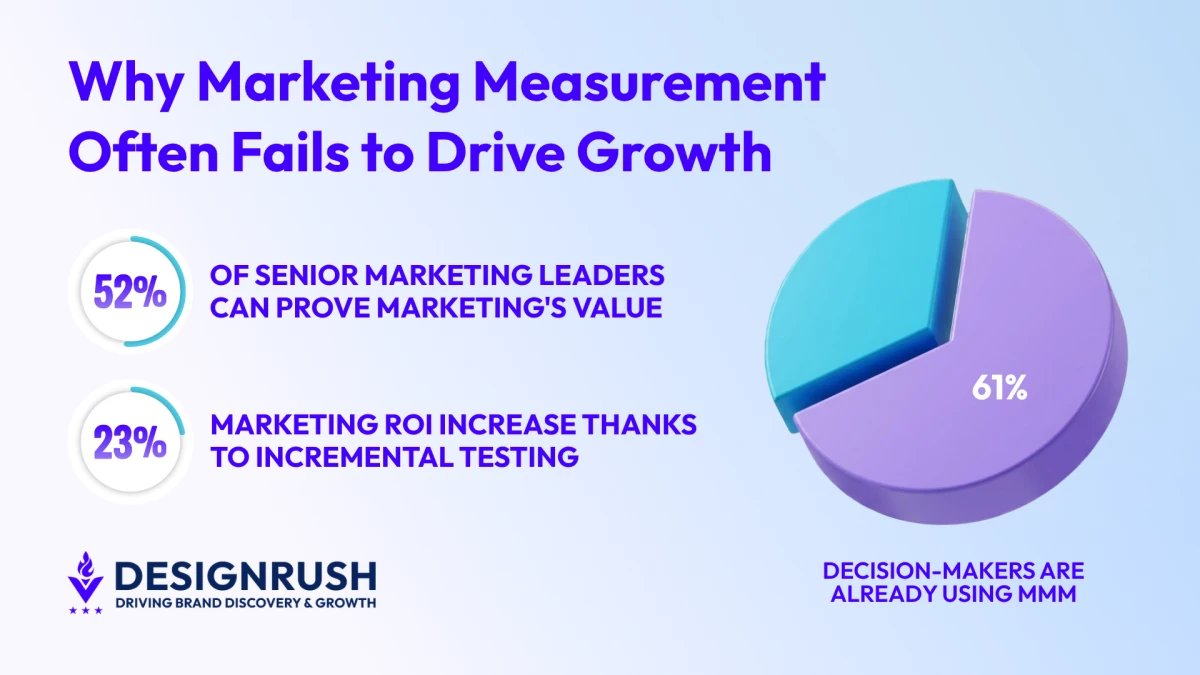
In fact, only 52% of CMOs and senior marketing leaders can prove marketing's value and receive credit for its contribution to business outcomes, per Gartner.
Allocating digital marketing budget on correlation is how money ends up over-funding the channels that are easiest to track and starving the ones doing the real work.
A contribution-based mindset starts from a different question. Not what did this channel deliver, but what would have happened if this channel didn't run?
The reframe sounds small but everything downstream changes.
The Three Tools That Measure Marketing Contribution
Measuring contribution isn't one tool. It's a triangulation across three.
Attribution tells you what's happening inside a channel in real time. While it's useful for optimization within the channel, it's also built on clicks, so the picture is incomplete.
Incrementality testing measures one channel at a time. You change spend in some markets, hold matched markets constant, and see what moves. The output is a real answer to what would have happened anyway.
MMM estimates contribution across every channel at once.
While open-source frameworks like Meta's Robyn and Google's Meridian have dropped the cost, they still need several years of clean marketing data and real variance in spend, which not every company has.
Even so, adoption is growing. Case in point, 61% of retail decision-makers are already using MMM to measure incrementality, according to an eMarketer report.
However, none of these tools are enough on their own. But when used together, they tell you what your marketing is actually contributing. That's the difference.
What Incrementality Testing Reveals
The first real incrementality test a team runs almost always produces an uncomfortable result.
One of our clients was running heavy paid brand search spend with a stellar reported ROAS. Every conversion on a branded term got the credit, so the channel looked untouchable.
Our hypothesis was the opposite. The brand search budget was harvesting demand other channels had created. We cut 42% of the brand search spend, moved it into non-brand search, and tracked what happened.
Organic purchases grew 61% year-over-year. Overall revenue grew 12%. Media spend dropped 10%.
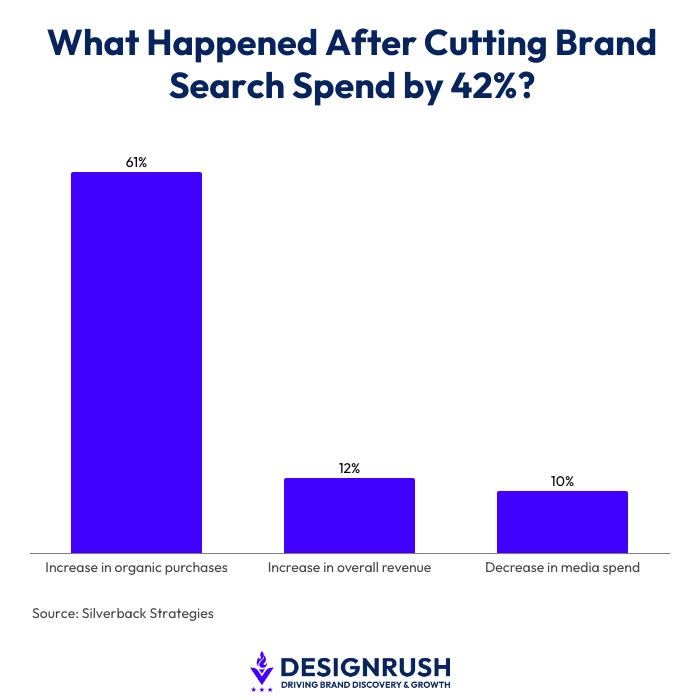
That decision wasn't possible on click-based attribution. It became obvious as soon as we asked the right question.
How Contribution-Based Measurement Improves Performance
Three things change.
1. The budget conversation gets sharper
It stops being a debate about whose channel deserves credit and becomes a debate about what the business would actually lose if a channel went away. That's the conversation CFOs are willing to fund.
2. The relationship with finance gets better
CFOs don't trust marketing dashboards because they've seen too many that didn't match the P&L. Tying marketing investment to incremental revenue gives them a report card they can actually defend to their own board.
3. Decision-making gets faster
Teams that triangulate across attribution, incrementality, and MMM move budget with more conviction. They know which channels they can scale, which ones are at the ceiling, and when a platform recommendation is misleading.
The payoff is measurable, with Gartner's 2025 marketing analytics research cited by InfluenceFlow finding that organizations who use incrementality testing improved marketing ROI by as much as 23%.
Why Marketing Attribution Needs To Change
Click-based attribution has been the marketing industry's default for most of its history and made sense when buyers took linear paths and platforms didn't share inventory.
Neither is true anymore. The data has eroded. The buyer journey is messier. The cost of being wrong is higher.
Marketers are also dealing with more complexity than ever. Supermetrics reports that marketing teams are working with 230% more data than they were in 2020, while 56% say they don't have enough time to analyze it properly.
The tools to measure contribution properly, however, have gotten more accessible, meaning that the old excuse of real measurement being too expensive can’t hold up anymore.
The leaders who make this shift keep their budgets growing, keep their CFOs trusting them, and keep their businesses growing. The ones who don't keep defending channels that aren't contributing and cutting the ones that are.
The mindset comes first. The tools come next. Growth comes after that.