
Most enterprise buyers assume that their localization vendor is the one completing the work.
But in reality, a single project can pass through multiple agencies, subcontractors, freelance linguists, production specialists, and engineering teams before it gets delivered.
What was once predominantly a language service now often combines translation with engineering, multimedia production, accessibility, and technical integration, all of which requires expertise from multiple specialist teams.
Among the companies working in that space are 2002 Studios Media, which specializes in multimedia localization, and localization technology company, Voxabot.
Speaking with DesignRush, 2002 Studios Media CEO and Voxabot Co-Founder, Steven Gurevitz, and Voxabot Founder, Gilbert Segura, discuss the current localization market and a delivery model that many organizations rarely see until something goes wrong.

Who Are Steven Gurevitz and Gilbert Segura?
Steven Gurevitz is the CEO of 2002 Studios Media and co-founder of Voxabot. With more than a decade of experience in multimedia production, localization, and content technology, he works with organizations to deliver multilingual content across video, e-learning, websites, gaming, and other digital media.
Gilbert Segura is the founder of Voxabot and a localization technology specialist with more than 20 years of experience in localization strategy, workflow design, and global content delivery. He has led localization initiatives across enterprise technology, media, and multilingual content, helping organizations scale localization through process optimization and technology.
For Gurevitz, it's a scenario he is all too familiar with, having witnessed instances where agencies split a single enterprise project among three different corporate vendors, only for all three vendors to secretly outsource the actual engineering to companies such as his.
"The problem here is that the end-buyer has absolutely no idea they are paying three massive markups for a single production house to do the heavy lifting," he says.
Why Localization Projects Pass Through Multiple Vendors
The increased scope of localization has seen demand grow across software, websites, e-learning courses, marketing campaigns, video, and other digital content.
As a result, the global language services market was estimated at $31.7 billion in 2025, per Slator’s 2025 Language Industry Market Report.
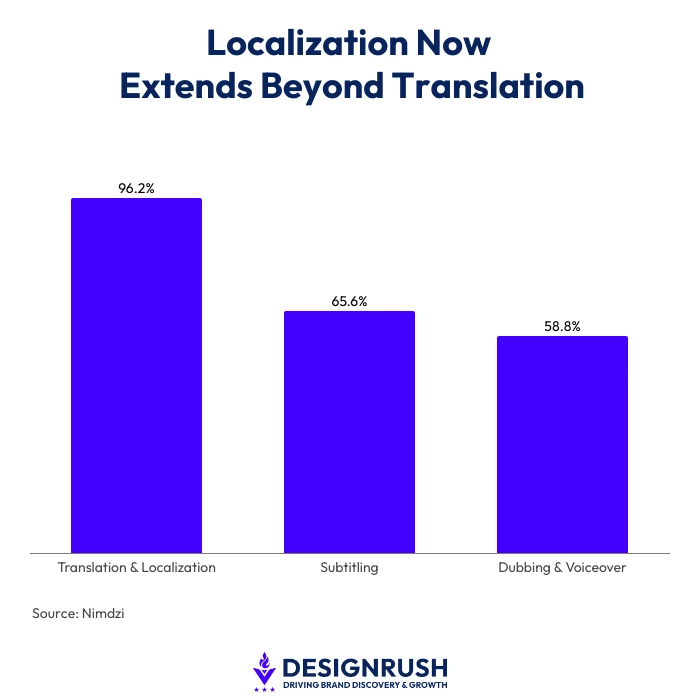
Insights from Nimdzi suggest that 96.2% of language service providers offer translation and localization, while 65.6% provide subtitling and 58.8% deliver dubbing, voiceover, or other audio services.
Some localization providers have responded by relying on external specialists to supplement capabilities they do not maintain in-house.
But in doing so has also increased the number of organizations that may contribute to a single project before it reaches the client.
Delivery models such as these can leave organizations working with vendors that coordinate projects while technical production is carried out elsewhere.
And even though communication may continue through a single vendor, freelance linguists, production specialists, and subcontractors may all contribute to the project without the client ever seeing how many organizations are involved before delivery.
"Localization vendors don't like to talk about how the sausage is made, because who wants to admit that a large share of the work is already being outsourced?" Segura says.
"That lack of visibility, however, protects the layered margins and the supply chains that depend on the buyer not looking too closely."
How Hidden Layers Affect Localization Quality and Accountability
Every additional organization involved in a localization project creates another point where information, files, and decisions change hands.
But as those handoffs increase, it makes it more difficult to maintain consistency and impacts the time taken to resolve problems.
The problem is that many of these challenges begin even before production kicks off.
These include technical requirements that may be agreed before engineering teams have reviewed the source material.
Likewise, multimedia projects can also be affected because engineering, integration, and production all compete for the same delivery timeline.
Often too much time is given to translation compared to other steps, as that is the one area the lead agency truly understands and they assume the engineering 'just happens'.
Responsibility can then also become fragmented.
When different vendors oversee translation, engineering, desktop publishing, audio, and video production, it's more difficult to identify who owns a technical issue when they arise.
Coordinating between suppliers can also take longer than resolving the technical issue itself. And without end-to-end ownership, even routine debugging can become a much longer process.
"When a localized app, video, or course breaks, a distributed model disintegrates into finger-pointing," Gurevitz says.
"And because no single vendor owns the source files or understands the full ecosystem, debugging takes weeks instead of hours."
And even though each supplier is often responsible for their own work, differences in processes, communication, and decision-making can introduce delays and inconsistencies that aren't always obvious until the project is well underway.
Compounding the issues, it is common for the lead account manager or project manager at the customer facing agency to be a jack of all trades and master one none.
Hence, the client is not getting the advice and guidance they would expect to be receiving.
Instead, clients say 'jump', and Project Managers ask 'how high', and then they push down on all their vendors to support them in committing to what was blindly agreed to.
Segura compares this to looking after our health.
"We often don't give much thought to it until something happens, at which point we have to take notice," he explains.
"But by the time we do something about it, the issue is far more serious than it needed to be."
How to Evaluate a Localization Vendor
Understanding who will actually complete the work can reveal a lot about a localization partner as pricing, turnaround times, or language coverage.
Gurevitz recommends asking to speak directly with the lead media engineer, reviewing how content is created before it is localized, and requesting a breakdown of how much media engineering remains in-house versus how much is outsourced.
Those conversations, he believes, provide a better indication of technical capability than sales presentations alone.
"If your localization partner cannot natively create content from scratch, they don’t understand how to properly deconstruct and rebuild it," Gurevitz says.
Segura recommends taking the same approach with a vendor's supply chain.
Asking how subcontractors are selected, who remains accountable throughout the engagement, and who will stay responsible from kickoff through delivery can reveal if buyers are working with a coordinated production team or a series of disconnected handoffs.
"That single question tells you whether you're buying expertise or just paying for a chain of hand-offs," Segura adds.
When Multiple Localization Vendors Make Sense
Not every localization project is structured the same way, particularly when large international launches can require specialist linguists, regional reviewers, technical teams, and production experts who work across multiple countries and languages.
In those cases, involving more than one vendor may be unavoidable.
The challenge is to decide where specialist expertise adds value and where additional layers would only increase complexity.
Segura believes that large-scale projects, such as theatrical releases which span multiple countries, or are an example of where multiple vendors would be necessary.
He adds that success here would lie in experienced coordination, trusted supplier networks, and delivery schedules that allow work to move through each stage without unnecessary delays.
However, even then, why not have a vendor that specializes in this internally as your lead agency, and then they bring in partners to help deliver it.
They are in a better place to vet and choose partners rather than a generic localization agency.
"A complex project such as this would require roughly as many vendors as there are languages," Segura says.
"The trick is finding someone who has successfully run this play before and will run it again without a hiccup."
Gurevitz makes a distinction between language expertise and technical production, where he believes that raw translation, cultural transcreation, and in-country linguistic review are strongest when handled by specialists based in the target market.
However, production, engineering, integration, and final quality assurance should remain under the direction of a single technical team to reduce unnecessary handoffs and maintain accountability throughout the project.
"The phases where external distribution is acceptable and sometimes preferable are in raw translation, cultural transcreation and final linguist and functional checks," Gurevitz says.
"However, the production, engineering, integration, and final QA phases must remain strictly centralized within one single, highly capable technical house."
How AI Is Changing Localization Delivery
As with the majority of industries, AI is becoming more influential as ever, with localization being no different.
Insights from Nimdzi suggest that 82.4% of language service providers now offer machine translation and post-editing alongside their broader service portfolios.
And while it has become commonplace, engineering, production, and quality assurance still depend heavily on human oversight.
Software releases and other structured projects are generally easier to automate than marketing campaigns, multimedia content, or regulated training materials, where creative judgment, context, and compliance remain part of the process.
Segura believes that AI delivers the greatest value when it supports predictable workflows instead of replacing human decision-making.
"Because localization is a varied and largely unstructured process, AI is a practical and useful technology to use when combined with human oversight and control," he says.
"For something well-defined, such as a software release, a simple automation or integration can solve most of the problem. But for a marketing campaign or a product launch, you have to be ready for the unpredictable."
The use of AI has also seen technical teams needing to adapt to new ways of working.
Machine-translated content still needs to be integrated into layouts, user interfaces, multimedia assets, and video timelines before being reviewed for formatting, functionality, and context across different languages.
Here, Gurevitz says the work often involves correcting AI-generated output rather than building localized assets from scratch.
"The industry is finding that AI doesn't eliminate engineers, but changes their job from building to cleaning up sloppy, broken AI-generated outputs," he adds.
Despite this, automation doesn't change who remains accountable for the final result.
This is particularly critical in sectors such as compliance training, workplace safety, healthcare, and other regulated industries, where translation errors can carry consequences that extend well beyond language.
Three Things Every Localization Buyer Should Know
Throughout the conversation, Gurevitz and Segura's insights point to three things every organization should keep in mind when reviewing its localization strategy:
1. Localization should be measured by business outcomes rather than operational costs
Customer engagement, market expansion, sales, and customer support provide a stronger indication of value than budget or turnaround time in isolation.
2. Higher costs don’t automatically reflect higher quality
AI may reduce costs in one part of the process, but those costs often reappear elsewhere. Price alone is no longer a reliable indicator of quality.
3. AI may accelerate parts of the workflow but don’t replace accountability
Faster translation still requires engineering, cultural adaptation, technical review, and human oversight. Organizations remain responsible for the quality of the final result, regardless of how much of the process is automated.
At the heart of the localization conundrum is one simple idea.
Choosing a localization partner shouldn’t be focused only on price, language coverage, or delivery times.
It should be about understanding how the work will be delivered, who remains accountable throughout the process, and where expertise adds the most value.
Because in the end, knowing who won the contract is one thing, but knowing who's actually doing the work is another.
So ask yourself. If your localization project failed tomorrow, would you know who to call first?