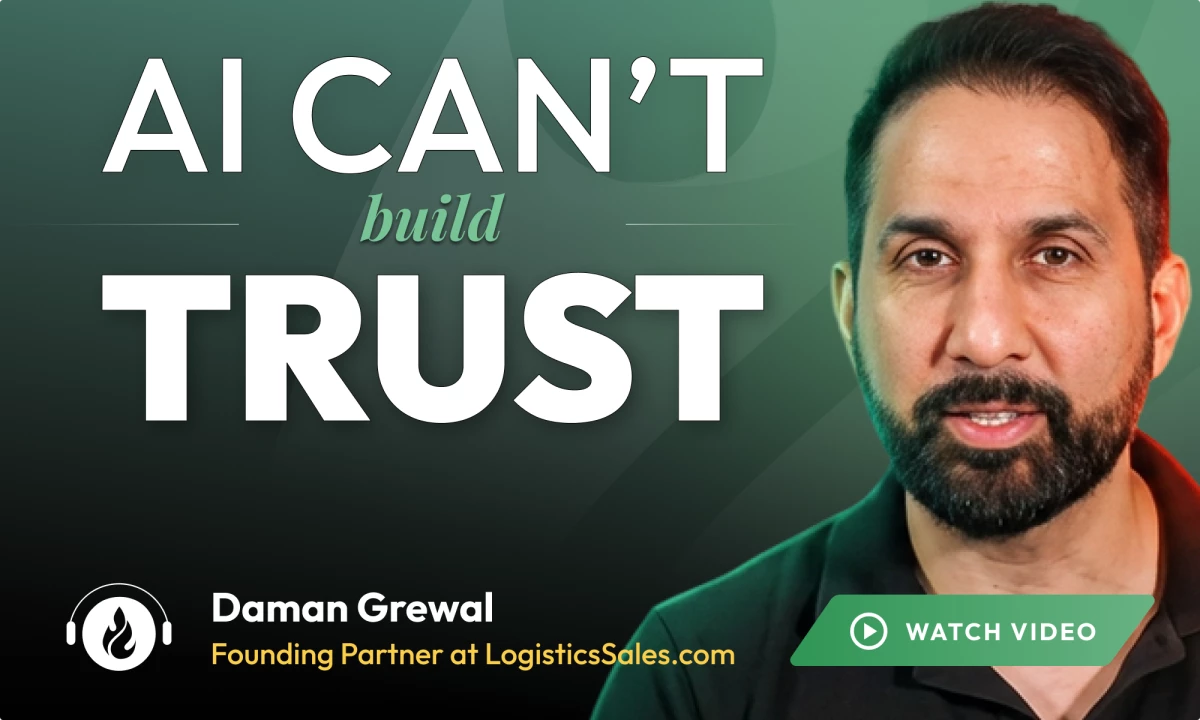

More customers are usually a good thing.
But growth becomes risky when the business behind the sale isn't ready to support it.
"If you don't build that foundation, then whatever you build on top is gonna crumble. And all it takes is one weak leg for that table to tilt," says Daman Grewal, founding partner at LogisticsSales.com.
It's a lesson Grewal learned while helping grow a logistics company recognized on Canada's PROFIT 500 and Growth 500 lists.
In episode No. 139 of the DesignRush Podcast, he explains why selling isn't the hard part. Delivering on the sale is.
According to Grewal, companies run into trouble when they miss three things:
- Don't Sell What You Can't Deliver: The service discipline behind long-term growth
- Customers Feel Every Mistake: How accountability can save a relationship after something goes wrong
- Knowledge Doesn't Scale by Itself: Why founder-led sales eventually hit a ceiling
Don't miss the full conversation!
Watch it now on YouTube or listen on Spotify.

Who Is Daman Grewal?
Daman Grewal is a founding partner at LogisticsSales.com, where he teaches entrepreneurship and sales fundamentals. His work draws from experience in logistics, operations, sales, and business development.
The Sales Risk Founders Often Miss
Few founders need to be convinced that revenue matters.
The harder question is whether the operation can absorb the expectations created by new accounts.
Grewal says many owners assume other people will understand the organization the way they do.
In founder-led sales, business owners can often navigate customer conversations with ease because they understand the operation behind the service.
That becomes harder to replicate as the team grows.
A founder may know how to handle a client, solve a problem, and protect the relationship when something goes wrong. A new hire does not automatically inherit that judgment.
“As a leader, it's you that everyone's following.”
Without that structure, growth stays tied to the founder.
In logistics, Grewal focused first on the two groups that determined whether the operation could function properly: customers and drivers.
“Well, in logistics and transportation, we had two key drivers that we focused on in the beginning,” he says.
Customers created demand. Drivers made delivery possible.
If either side were weak, sales could not fix the business.
According to Grewal, growth starts to break down when companies miss three things:
1. Selling Without Service Discipline
Many companies treat customer service as work that starts after the deal is closed.
Grewal sees it as the discipline that determines whether the deal was worth closing in the first place.
For him, trust starts with clarity about what the organization can honestly do for the client.
“Are we truly there to serve them?” he says.
That question changes the sales conversation.
Instead of chasing the account first, leaders have to know where the team can help and where it cannot. That honesty protects the relationship before it comes under pressure.
“We can't do everything, but here's what we do really well. And this is where we could truly partner with you to solve these problems that you're having.”
That applies to any business where the promise reaches the client before the service system is ready.
If the organization accepts work it cannot serve well, revenue can become the next operational problem.
That is where clear customer feedback can help teams understand whether the issue is pricing, expectations, service delivery, or fit.
2. Treating Trust as a Sales Promise
Trust is easy to talk about when things go well.
It’s tested when the company fails, the client is angry, or a contract is at risk.
Grewal says businesses can lose accounts even when they believe they delivered strong service.
Sometimes the client sees the relationship through price alone, and sometimes the team is not speaking with the person who makes the final call.
That’s when the relationship can start to look transactional, and according to Grewal, some customers focus exclusively on price.
“They just look at it as a commodity versus, you know, there's a company and people behind it.”
When service fails, Grewal says the response has to start with accountability.
“If we failed on service and it broke that relationship, it's taking accountability for it.”
That doesn’t mean the client forgives the company immediately.
They may stop buying for a while, but accountability can leave a memory that helps the relationship recover later.
"When people realize like you're a true partner and you're really there to help service them and help them go through any of those challenges or any problems that they're facing," Grewal says.
"Then we've been able to win a lot of these customers back eventually over time as well."
For business leaders, the lesson is direct.
Trust is often created through the way a company handles the problem that follows the sale.
That is why a clear digital marketing sales funnel still needs to match what the company can deliver once the customer says yes.
3. When the Founder Becomes the Sales Bottleneck
Founder-led selling can be powerful because the founder understands the whole organization.
They know the client problem, the cost of the promise, where the operation can bend, and where it can’t.
That same strength can become a bottleneck.
Grewal explains sales changes over time, and a message that works today may lose its effect as customers hear it again and again.
“What you are doing today may not work tomorrow. What you're doing tomorrow may not work five years from now," Grewal says.
Commercial teams need operational intelligence, not just a pitch.
A salesperson coming into the business may not know the founder’s reasoning.
They need information from the people handling service, pricing, client issues, and delivery.
Without that, reps can end up repeating a script instead of helping the customer think through the decision.
Grewal says companies that train teams on market conditions, client pressure, and service limits can create better conversations.
“Knowing what those components are allows you to have stronger conversations,” Grewal says.
A rep who understands the account’s pressure and the company’s limits can offer judgment.
“You go from being a sales rep to becoming an advisor, and a trusted advisor is what really actually helps you build those relationships and build accounts," he adds.
For companies trying to scale this process, working with sales funnel agencies can help turn founder knowledge into a clearer path for lead nurturing, conversion, and customer handoff.
Early-Stage Companies Need Fit Before Volume
For founders without a sales process, Grewal says the first step is knowing who the business is built to serve.
“Well, one is just knowing who you're going to go after," Grewal says.
“Who's my target audience and how am I going to service that person?”
A clear ideal customer profile helps founders avoid chasing accounts the business cannot serve well.
If the founder is handling sales, service, and operations alone, each part of that work should become easier to teach later.
That is where training procedures matter.
“I won't be doing this for much longer, I'm gonna have to create systems in place to be able to teach people on how to do this and have the infrastructure,” Grewal says.
Grewal says early companies also need to know their numbers.
A founder is not only funding their own role. They are building the future roles the company will need to serve customers properly.
If that is missing, revenue growth can create cash flow strain. Client complaints can also become expensive to fix after the fact.
For Grewal, one of the quickest ways to damage an early business is selling what the company can’t deliver.
"You don't want to go into a situation where you can't oversell or you can't deliver," Grewal says.
That's the fastest way to burn your company down is by not being able to deliver on what you do."
The work starts with knowing the target audience, but it has to continue through pricing, delivery, hiring, and customer support.
The Sales Work AI Still Cannot Carry
Grewal also sees value in the role of AI in CRM workflows, including prospecting and customer follow-up.
He says CRM systems and AI agents can help teams stay in touch with clients, personalize simple messages, and respond to basic questions.
“Having good systems in place is going to help you when we have, again, powerful CRMs that allow us to stay in touch with our clients.”
That is one reason more teams are testing AI for sales prospecting, especially when they need better targeting and faster outreach.
But Grewal draws a line when the sale requires trust.
"When you have high ticket items, you have to say, OK, when do I get away from technology and get into that relationship-building aspect of things? And you can't forget about that," Grewal says.
The real value of technology lies in the feedback it gives the business. It can show which emails get opened, where customers lose interest, and which questions keep coming back.
And so, Grewal says successful companies listen to customer feedback and adapt accordingly.
But lead generation alone is not enough.
Sales teams still need to nurture leads, understand timing, and know when a person should step in.
For high-value deals, customers want to feel seen, respected, and understood.
“AI cannot make you feel respected, right?” Grewal says.
AI can help the team see patterns, but it can't keep the relationship afloat.
Sales is tested when something goes wrong, and the company has to decide how it will respond.
The companies that keep trust are still the ones that listen, take ownership, and deliver what they promised.