
You may not think twice about buying a T-shirt online.
But buying something expensive, like industrial machinery, without seeing it? That’s a whole other ball game.
A product photo on a website isn't going to answer all the questions buyers are really asking. How does it work? What will it look like in a different finish or configuration?
That’s where CGI comes into play.
One company helping brands solve this problem is Tonic, a full-service visual production studio specializing in CGI, 3D animation, and interactive visualization.
In this interview with DesignRush, the studio’s founder, Ashay Kshirsagar, explains why photography can sometimes leave customers with unanswered questions and how CGI can help them answer those questions before buying.

Who Is Ashay Kshirsagar?
Ashay Kshirsagar is the founder of Tonic, a visual production studio focused on CGI, photoreal imagery, and animation for commercial and automotive brands. After starting out in photography, he launched the agency in 2012 to help brands manage CGI, animation, and visual production work through one team instead of multiple vendors.
Since then, he has produced campaign visuals, automotive renders, branded content, and commercial imagery for brands including BMW, Maserati, Volkswagen, Tata Motors, Royal Enfield, Nike, and Griffin.
Kshirsagar regularly speaks about AI’s role in creative production, particularly where it helps with research, preparation, and repetitive production tasks while human judgment still guides the creative direction and decision-making.
"Photography answers one question really well. Does this look desirable?" he says.
"But before making a big purchase, people are usually trying to answer a lot of other questions because they're looking for ways to reduce risk."
Kshirsagar says those questions usually fall into three areas, namely scale, spatial understanding, and what he calls "material truth."
Photography Can't Answer Every Buying Question
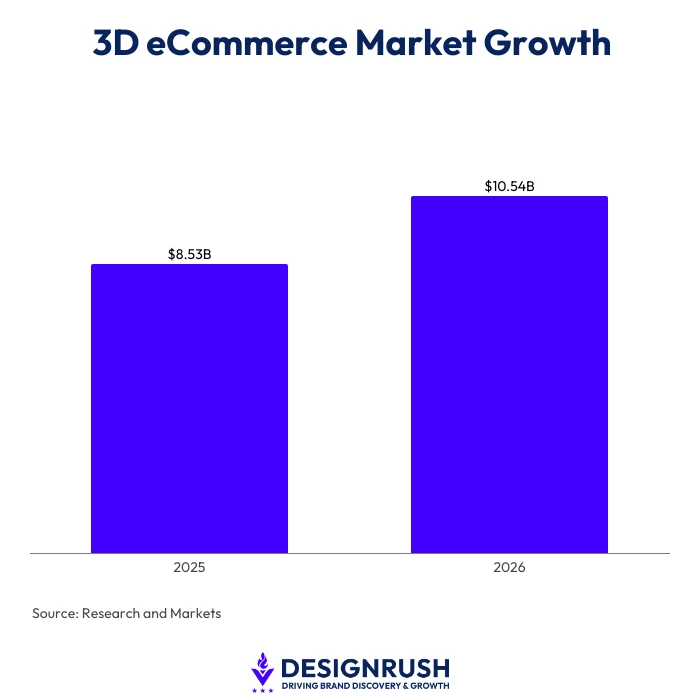
This is why businesses are spending more on product visualization. The global 3D eCommerce market is expected to grow from $8.53 billion in 2025 to $10.54 billion this year, according to Research and Markets.
Kshirsagar knows exactly why more businesses are turning to interactive product visualizations, having once ordered what he thought was a standard IKEA armchair, only to find out when it arrived that it had been designed for small children.
"No amount of studio lighting can indicate if a chair is meant for an adult, if a vehicle fits a garage, or if a machine fits a floor plan," he says.
"Photography also struggles to show what it's like to stand inside, behind, or underneath a product. And while wide-angle lenses can approximate those perspectives, they also distort the very dimensions that customers are trying to judge."
The same applies to finishes, where Kshirsagar recalls working with a paint manufacturer whose metallic finishes and textured coatings couldn't be accurately represented in a single image.
To meet these requirements, the Tonic team developed a virtual digital swatch that customers could rotate and see how the finish would change from different angles as light moved across the surface.
"Material truth is the single most decisive factor in whether something reads as premium," Kshirsagar says. "A static frame, like in still photography, freezes that out entirely."
Why CGI Excels With Customizable Products
Some products can’t be photographed because they don't exist yet.
A luxury apartment could still be under construction. A yacht, vehicle, or piece of industrial equipment may be built to order. Premium furniture can be available, but in hundreds of materials, finishes, and configurations.
Here, taking a photo of every variation just isn't practical.
CGI, on the other hand, allows every option to be created from the same digital source. This can give buyers an accurate view of different configurations without the need to produce thousands of separate images.
The same approach also makes technically complex products easier to understand.
"Rather than punting technical specifications, brands can use CGI to show how a product works, why it matters, and how different choices can affect the final result," Kshirsagar adds.
This is particularly useful for buyers who research products remotely as it makes it easier to compare options and understand what they're buying before they ever need to speak to a sales representative.
Interactive Product Visualization Gives Buyers More Control
Photography and video both have their benefits but still don’t give customers control over what they want to look at.
"When customers can rotate a product, inspect details, compare finishes, switch configurations, or see it within a realistic environment, they become active participants instead of passive viewers," Kshirsagar explains.
That changes the buying experience and creates a stronger sense of ownership before they purchase.
In fact, 78% of consumers say 3D visualization gives them greater control over their purchasing decisions, according to insights from 3D Cloud.
"The goal of interactive product visualization isn't to impress people with technology, but to remove any form of doubt that they may have," Kshirsagar says.
CGI Is Becoming Part of the Sales Process
A lot of people still think that CGI is something used only for advertising campaigns or product launches. But Kshirsagar believes that this assumption is changing.
CGI can help shorten sales cycles, reduce the need for physical prototypes, support dealer networks, simplify product launches, and help buyers understand a product before they speak to a salesperson.
The automotive industry is one such sector that has already moved in that direction, where CGI has helped buyers compare colors, materials, trim packages, and optional extras online without having to visit a dealership.
"In many industries, visualization is becoming part of the sales infrastructure rather than just a marketing asset," Kshirsagar explains.
"I believe that the use of CGI will become more common across industries that sell products that are expensive, configurable, or technically complex."
Realistic CGI Builds Trust Before the Sale
As CGI becomes more common, just creating impressive visuals isn't enough.
Kshirsagar says that buyers notice when materials, proportions, lighting, or finishes don't look like the real product. When that happens, it breaks their loyalty and trust. And once this is lost, it's difficult to win back.
"The biggest mistake is to create images that look spectacular but don't accurately represent the product," he says.
CGI should help buyers understand the product, compare their options, and decide what works for them.
"The best CGI is often the visualization people don't notice because it feels authentic and real," Kshirsagar explains.
Where CGI Could Have the Biggest Business Impact
Manufacturing may have the most to gain from CGI, particularly where products are difficult to explain before buyers ever see them in person.
This is especially useful for industrial equipment, warehouse automation systems, medical devices, renewable energy infrastructure, and commercial building projects.
Kshirsagar says CGI can help buyers understand complex products before they speak to a salesperson.
"Manufacturing will benefit the most from CGI, particularly as many in the industry still rely on brochures, CAD screenshots, or technical drawings to promote a product," he says.
He also sees CGI being useful in healthcare, education, and industrial training, where interactive visualization can improve understanding while also supporting marketing.
"I think visualization will become less about creating attractive images and more about communicating information," Kshirsagar adds.
"That's where I feel that the greatest long-term business value lies."
As buying journeys become more self-directed, every unanswered question becomes another opportunity for a customer to delay a decision, compare another option, or walk away.
At the same time, every interaction shapes how confident buyers feel about moving forward.
Ask yourself: Are your product visuals helping customers reach a decision, or are they simply giving them something to look at while they keep looking elsewhere?