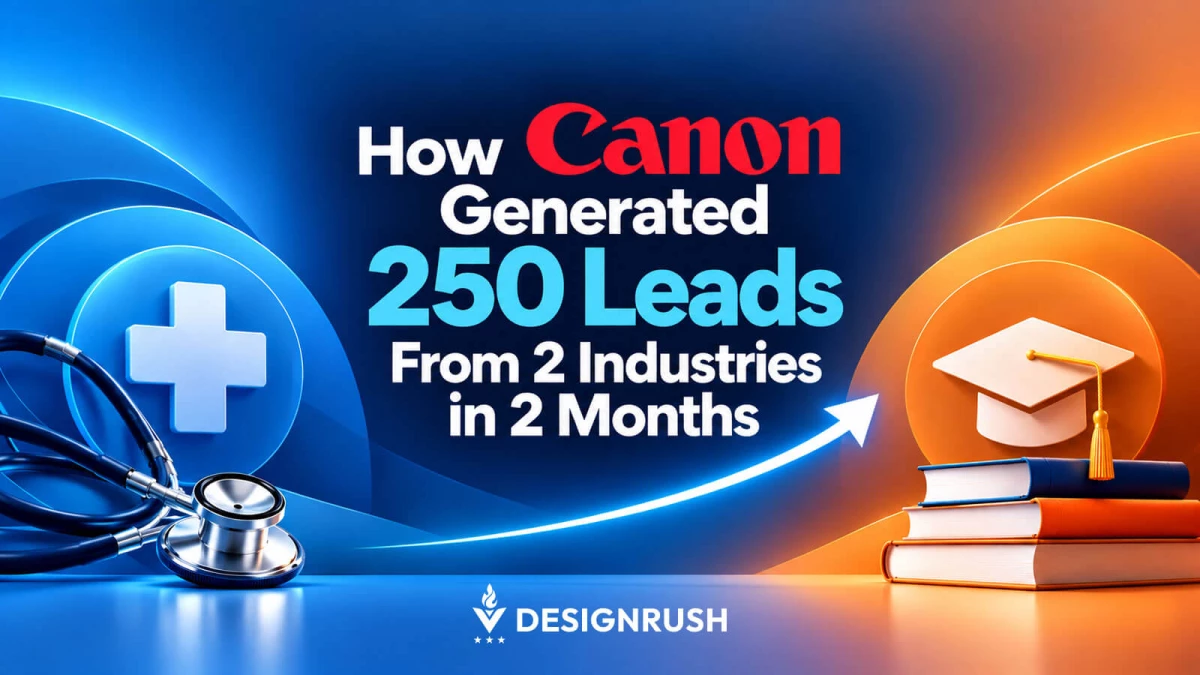

When we worked on Canon’s healthcare and education campaigns at Lounge Lizard, we had two audiences to reach, each with different reasons to consider Canon’s products.
We created separate landing pages, segmented the advertising, and gave each audience its own content and nurture paths.
And in two months, the campaigns generated 250 high-quality leads.
The campaign raises a question for B2B marketers: How do you reach different industries with the same product without giving everyone the same reason to buy?
How to Segment B2B Marketing by Industry
Changing a few words in an ad won't do much if everyone who clicks it ends up on the same landing page.
At Lounge Lizard, we recommend giving those differences room in the campaign.
A healthcare team may want to know how a product fits into its daily workflows. An education buyer could be weighing its value across several departments or campuses.
The campaign needs to address those concerns on the landing page and in the content prospects receive afterward.
That takes more than swapping a few words in an ad. It means giving each audience information that reflects what it needs to know before making a purchase.
Market leaders appear more likely to take this individualized approach. In McKinsey’s 2026 Global B2B Pulse Survey, 20% used one-to-one personalization, compared with just 5% of lower-performing peers.
One-to-one personalization goes beyond segmenting audiences by industry, so the figures don't tell us how much vertical campaigns contributed to that difference.
Still, they support the case for moving away from one-size-fits-all marketing.
Canon’s campaign applied that thinking across Google, Meta, and LinkedIn, with separate landing pages and segmented ads for healthcare and education audiences.
Newsletter sponsorships reached IT and operations decision-makers, while gated articles and whitepapers gave prospects more information to consider.
Nurture campaigns then kept the conversation going after the first interaction.
HubSpot’s 2026 State of Marketing research found that 93.2% of surveyed marketers said personalized or segmented experiences had generated more leads and purchases.
The question is how much that holds true across different industries.
Comparing lead quality and conversion rates can show if industry-specific messaging makes a difference.
That difference in audience needs also affects what happens after someone clicks an ad.
Consider a healthcare buyer who clicks an ad about document management, only to land on a page full of generic product features.
They still have to work out how the product fits their organization's needs.
The landing page needs to make that connection and give buyers a reason to share their contact details. They need enough information to assess the product and know what happens next.
More than 50% of B2B buyers create supplier consideration lists early in the purchase process, according to Gartner’s July 2026 research.
Buyers are still weighing their options at this stage, so the information they find can influence which suppliers they consider.
The follow-up should reflect what brought someone to the campaign. Sending every lead the same email sequence ignores the reason they showed interest in the first place.
When Should B2B Companies Create Industry-Specific Campaigns?
Separate landing pages, content, and nurture emails take time and money.
Before creating them for each industry, companies need to know if the differences between their audiences justify the extra work.
Start with the buyers. Do prospects ask different questions or use the same product in different ways? Does a shared campaign leave either audience without the information it needs to make a case for buying?
Customer research, sales conversations, search behavior, and recurring prospect questions can help answer those questions.
Campaign results then show which messages and channels attract suitable leads
Lead volume alone won't tell companies if the approach is working.
Canon’s campaigns generated 250 high-quality leads in two months.
The next step is to compare how healthcare and education prospects progress through the sales process.
If separate campaigns attract more sales-ready prospects, the additional cost may be justified.
If both audiences produce similar sales outcomes, a shared campaign could be enough.
The decision comes down to whether the extra investment brings in better-qualified leads.