
During the Great Resignation, more than 50 million workers in the U.S. quit their jobs in search of better work-life balance, flexibility, increased compensation, or strong company cultures.
Today, American businesses continue to create jobs, and many are still actively seeking new hires, but workforce participation remains low, even against post-pandemic levels.
The U.S. Chamber of Commerce surveyed the numbers and found that 46% of Americans are not willing to take jobs that don’t offer remote work, while 36% are more focused on personal growth and education.
Gershon Goren, the founder and CEO of Cangrade, an enterprise cloud-based science-driven hiring platform, says if companies don’t focus on what makes an employee happy, they might find their growth limited.
In this interview, Gershon shares how companies can hire the right people with the right skills, retain them, and foster a supportive ecosystem for business growth.

Who Is Gershon Goren?
For seven years, Gershon led the engineering group at WebDialogs, which was later on acquired by IBM. He then spearheaded many innovation initiatives as the Chief Software Architect in the Lotus group of IBM, including the cloud-based collaboration suite Lotuslive, better known now as IBM SmartCloud. At Cangrade, he has built a strong reputation with trusted brands including Wayfair, Four Winds Casinos, and Ibex.
Companies with staying power should not only focus on hiring the right people but also on retaining them, by keeping them engaged and motivated, as well as ensuring that they don’t suffer from burnout.
Doing so results in a supportive, fair, equal, and sustainable company culture, he says.
“These might sound like lofty goals, but only to those who are trapped in the shackles of a ‘growth over anything else’ mentality. As practice shows, companies driven by this mentality eventually find hard limits to this growth and often cease to exist.
With this in mind, make sure all your employees are the best employees by mastering the art and the science of hiring and retaining them.
You can do this by allowing them to make meaningful contributions to something bigger than themselves, caring about their well-being, and treating them with respect and dignity,” he explains.
Gershon notes that bypassing the fact that all businesses are operated by people and for people usually leads to disaster — for both the business and society.
Nurture Your Talents for Sustainable Business Growth
Many businesses often overlook the retention side of the human resource management process.
In most cases, they focus only on experience and relevant skills, and Gershon says this greatly limits the pool of qualified candidates.
“Their typical goal is to find employees who get to full productivity as quickly as possible. It’s not an unreasonable aspiration, but they often forget about the retention side of the talent management process.
Focusing solely on hard skills and experience often leads to neglecting soft skills and personal fit. This can result in high early attrition and the exact opposite of the desired effect on the efficiency and productivity of the team.
Hence, the challenge that companies are usually unaware of is how to lower the barrier to entry even for higher-skilled jobs, while identifying and investing in the long-term potential of employees rather than instant productivity,” he adds.
As such, Gershon advises hiring managers to focus on two key factors to predict workplace success: soft skills and past experiences.
“When left to their own devices, people often make incorrect judgments about the connections between these factors and the probability of job success for any given candidate,” he points out.
To this end, he notes that organizations should rely on data and well-structured processes.
“Recruiters and hiring managers are still the ultimate decision-makers in bringing new employees on board, but they need to be assisted with data-informed tools and processes,” he adds.
For example, Cangrade uses organizational data to determine which soft skills are linked to whatever it is employers are looking to achieve.
This data is then used to build a predictive model that helps companies identify candidates with a high potential of achieving these results. According to Gershon, this process eliminates any biases and increases the chance of a successful hire.
“In a sales organization, for example, such markers are typically sales metrics. Using Cangrade success models, recruiters can narrow down the entirety of the applicant pool to a smaller number of applicants who have significantly higher odds of achieving higher sales metrics.
Cangrade’s patented hiring Success Model creation process learns from your existing workforce data, codifies success patterns into Success Models, then validates the models against big data and removes any biases that could have snuck in,” he explains.
Once this is done, Cangrade will provide recruiters with the tools necessary to better understand a candidate and highlight the best way to communicate and engage with them, as well as onboard them.
Gershon also shares that a major U.S. online retailer walked this process to hire sales and customer service employees.
It resulted in an increase of $62,000 per-employee revenues, a 32% boost in the interview-to-offer rate, and a 40% drop in employee turnover.
“These are significant numbers, and I have to qualify them by saying that these are also examples of companies that recognize the value of their employees and do what they can to make them feel appreciated and taken care of. There is no question that this is also a factor in achieving these results,” he reveals.
The Power of Data-Driven Hiring
As mentioned before, Cangrade’s patented Hiring Success Model eliminates biases — a contributor to the success or failures of many companies.
For example, the business case for gender diversity in executive teams has more than doubled over the past decade.
A McKinsey report highlighted a steady upward trend between 2015 and 2023 in diverse hires, revealing that top-quartile companies who embrace gender diversity stand a 39% greater likelihood of financial outperformance versus their bottom-quartile peers.
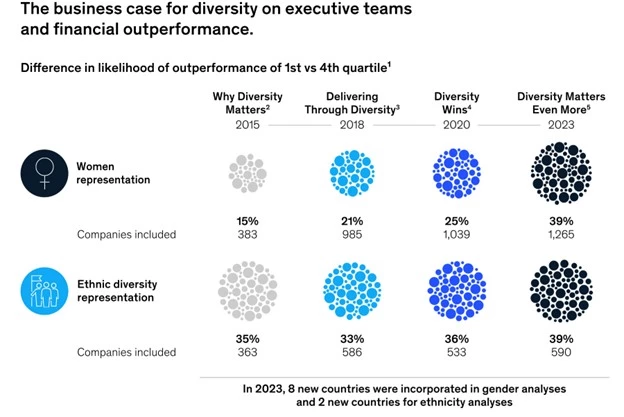
Gershon says this is because people from different cultural backgrounds and genders bring different perspectives to the table, which challenge the status quo and spur creativity.
“Homogeneous teams are more prone to blind spots, groupthink, and an echo chamber effect. These kinds of dynamics can be extremely harmful to any organization and ultimately make it less agile and less capable of adjusting to market changes and staying on top of its game.
In the U.S., we are lucky to live in a multiethnic, multicultural, and multi-gendered society. For the vast majority of organizations, that means that their customer base or the communities they serve represent this diversity.
It only makes sense that making your workforce better represent your customers will increase its ability to serve them in the best way possible,” he shares.
Embracing Diversity Starts with Confronting Bias
According to Gershon, people are hard-wired to be biased; and because artificial intelligence is learning from people, AI tools are also learning biases.
If left unchecked, using AI tools during the hiring process can make things worse. However, there are ways around this.
“My best advice is to look for tools with verifiable anti-bias protection (Cangrade owns a patent for removing biases from hiring algorithms) and use these tools to narrow down the number of candidates that get to the next stage in the hiring process.
At this stage, it’s incumbent on the recruiting team to invest in better understanding the abilities of each candidate. The process of getting to know somebody makes us focused on what actually matters for job success, rather than their identity or similarity to us,” ” Gershon says.
The good news is, this can be achieved. One of Cangrade’s clients, a fire department of one of the biggest U.S. metropolises, hoped to increase their workforce diversity without compromising hiring quality.
Following Cangrade’s system of unbiased selection, it experienced an 80% increase in BIPOC (black, Indigenous, and other people of color) hires and a 300% increase in women hires.
Gershon adds that many Diversity, Equity, and Inclusion (DE&I) initiatives have faced backlash due in part to organizations focusing on their performative aspects, such as DE&I training, requiring DE&I statements, and hiring DE&I executives, instead of practical ones.
“To summarize: recruiters need to be spending more time on fewer candidates, leaving the initial screening to valid, bias-free automation.
What Cangrade is bringing to the DE&I table is lowering the barrier to entry by focusing on soft skills as a predictor of future success.
We are in effect delivering the equality of potential, and while that may still fall short of the equality of outcome, it’s markedly better than the infamous equality of opportunity,” he explains.
Although the number of workers resigning gradually decreased to 30.5 million in 2023, businesses must realize it is time to approach the hiring process differently.
To hire and retain the right talent, companies should prioritize employee engagement, well-being, and a diverse workforce to adapt to changing market dynamics and drive innovation.
While this can be overwhelming, partnering with an agency can relieve businesses of these heavy responsibilities significantly.


-preview-webp.webp)