
England's 1966 World Cup victory remains one of the most celebrated moments in British sporting history.
Sixty years later, Alzheimer's Society is revisiting it to spotlight what dementia feels like through a collection of memorabilia.
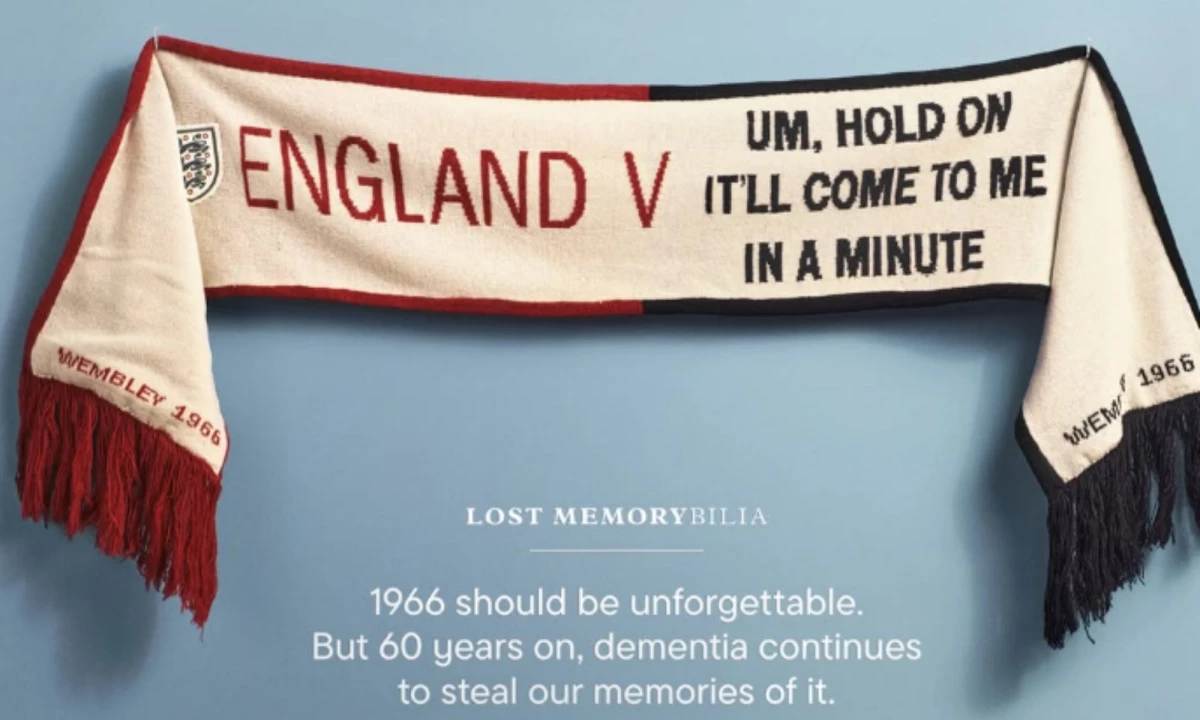
Creative agency New Commercial Arts developed "Lost Memorybilia," which features handcrafted keepsakes that misremember key details from the World Cup win.
The efforts connect one of the nation's most cherished sporting memories with the reality affecting nearly one million people living with dementia in the U.K.
The nostalgic campaign demonstrates how familiar symbols can communicate the effects of a disease more powerfully than listing statistics or symptoms.
Souvenirs From a Fading Memory
"Lost Memorybilia" gives memory loss a physical form by handcrafting keepsakes that get the details wrong, including:
- A handwoven scarf missing the name of England's opponent
- A commemorative rosette that misidentifies Wembley Stadium
- A collectible coin unable to fully recall either the final score or Sir Geoff Hurst
Model makers Ben Millar and Liz Putland handcrafted the pieces, while director Sam Nicklin photographed them.
Football's ability to connect generations through shared stories made the project especially meaningful for Nicklin, who said:
"It means a lot to be a part of this campaign, not only because I love the game, but also have a deep respect and personal connection to the work Alzheimer's Society does with my father having Frontotemporal Dementia."
The purpose-driven campaign earns its emotional weight because the people who made it understand what memory loss costs, and this comes through in every visual detail.
A Different Kind of Tribute 60 Years Later
The work connects the 60th anniversary of a national sporting milestone with a growing public health challenge.
According to Alzheimer's Society, over 70,800 people are living with young-onset dementia, and by 2040, about 1.4 million U.K. citizens will have dementia.
These numbers make the campaign's timing deliberate. A country looking back at 1966 is exactly the audience a dementia charity needs to reach.
"Lost Memorybilia" also coincides with Channel 4's colorized broadcast of the 1966 FIFA World Cup Final, airing in partnership with SunLife to raise funds for Alzheimer's Society.
The special program features Sir Geoff Hurst, who scored a hat-trick in England's 4-2 victory over West Germany.
He reflects on teammates affected by dementia, alongside appearances from comedian David Baddiel and current and former England players.
The work highlights how cultural memories often become part of personal identity, making their loss especially difficult for individuals and families.
This campaign offers a few lessons for nonprofits and brands tackling complex, emotionally sensitive subjects:
- Shared memories create emotional value. Brands and NPOs should connect messages to experiences people already recognize to strengthen engagement.
- Physical objects carry meaning. Organizations should use tangible symbols to make complex conditions easier to understand and remember.
- Familiar stories encourage participation. Teams should anchor fundraising efforts in recognizable events to increase awareness and support.
Remember that anchoring a message to a cultural event this widely watched means the story reaches audiences outside the charity's existing base.
Our Take: Can Football Fever Drive Donation Spikes?
Alzheimer's Society chose a week when millions of U.K. viewers were already primed to feel something about 1966.
And we think this emotional readiness lowers the barrier to giving.
The "Lost Memorybilia" objects make the ask feel more personal before the donation button appears.
The three-way structure between Channel 4, SunLife, and Alzheimer's Society is a strategic win.
SunLife's media spend and Channel 4's reach do the distribution work, and the charity ends up capturing the audience's goodwill.
Looking for an agency that can translate complex social issues into compelling creative work?
Explore these top nonprofit digital marketing agencies to find the right partner.