
Marketing teams have more dashboards than ever. Attribution platforms, BI tools, MMM outputs, platform reporting, and agency reports stacked on top of internal reports.
The expansion of platforms customers use today, such as search, social, video, streaming, retail media, and more, has driven a parallel expansion in the volume of reporting marketers are asked to make sense of.
You could assume that more reporting would equate to sharper decisions and more confidence in where every marketing dollar is going.
For most CMOs I talk to, it doesn’t. The problem is what those reports are built on.
How CMOs Can Measure Marketing Performance Beyond Last-Click Attribution
The majority of the marketing reporting CMOs see every week is some variation of click-based attribution, including first-click, last-click, and multi-touch.
Click-based models reward the channels that are easiest to track, and not the channels doing the most work, so they systematically misrepresent how revenue is generated.
CMOs end up buried in reports, with many of them built on a flawed foundation for making marketing decisions and are left to conclude that data was never built to answer the questions they're being asked.
Here are five questions every CMO should be able to walk into a board meeting and answer cleanly.
1. If we cut this channel tomorrow, what happens to revenue?
This is the only question that matters when a CFO is pressure-testing the marketing budget.
It's also the one most measurement systems can't answer.
Platform-reported ROAS tells you how many conversions touched a channel before closing, but it doesn't tell you what would have happened if that channel weren't running.
Google’s 2025 data found that only 40% of Demand Gen conversions and 50% of Performance Max conversions fall inside standard look-back windows, and that traditional last-click attribution can undervalue YouTube and Demand Gen returns by up to 14X.
What's changed in the last few years is the cost of getting a real answer.
Open-source frameworks like Meta's Robyn and Google's Meridian have collapsed the cost of Marketing Mix Modeling (MMM), making advanced measurement more attainable for more marketing teams.
Google describes Meridian as a free, open-source MMM framework, while Meta says Robyn was created to make MMM less resource-intensive and more accessible beyond large enterprises.
A competent in-house resource or agency partner can now design and execute these tests without a six-figure measurement contract attached.
The CMOs who've built these tools into the planning cycle can answer the “cut-the-channel” question confidently.
2. Which channels are creating demand vs. taking credit for it?
Click-based attribution rewards the channels that are easiest to track, not the channels doing the most work.
Branded search is the most common offender.
It shows the highest return in nearly every account because every conversion that touches a branded keyword gets credit for the sale.
Google Analytics itself notes that last-click attribution gives 100% of the credit to the final touchpoint before conversion, while a 2025 Dreamdata analysis found branded search campaigns delivering 1299% ROAS in B2B accounts because they capture demand already created elsewhere.
But the buyer searching for the brand name was already in the market, and the channel is taking credit for demand it didn't create.
Meanwhile, the channels that create that demand, such as upper-funnel video, paid social, sometimes offline, get under-credited or no credit at all.
We ran an incrementality test on Demand Gen for a retail client where the platform was signaling to turn the channel off entirely because it wasn't performing.
Demand Gen serves a significant share of its inventory on YouTube, and YouTube ads are rarely clicked even when they drive real action.
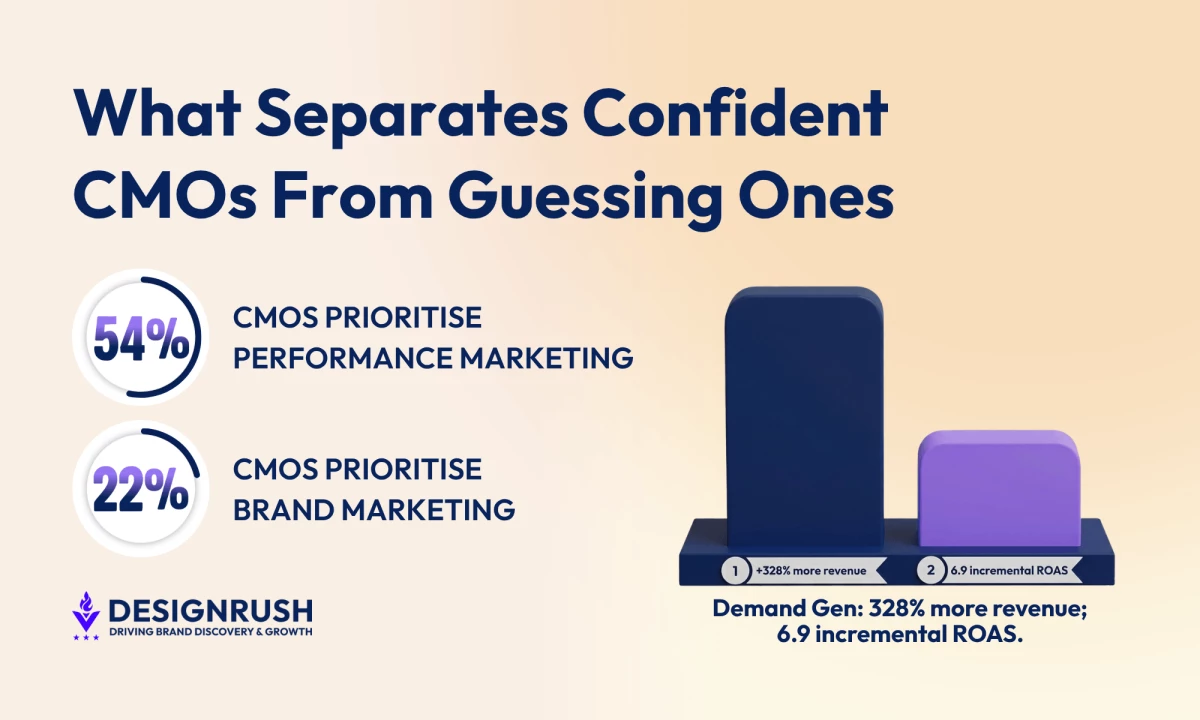
The test showed Demand Gen was driving 328% more revenue than the platform was reporting, with an incremental ROAS of 6.9.
A channel the platform recommended cutting turned out to be one of the strongest performers in the account.
Once you can separate the channels creating demand from the channels taking credit for it, the budget conversation changes.
You stop defending high-reported-ROAS channels that aren't pulling their weight and start protecting the channels that are growing the business.
3. Where can we invest more to drive growth and where are we past the point of diminishing returns?
Every channel has a saturation point.
Google’s Meridian and Meta’s Robyn both describe the same pattern where marginal returns decline as spend rises.
That means the next dollar buys less than the one before, while the cost per incremental sale increases as a channel becomes more saturated.
That requires testing into channels deliberately, watching for diminishing returns, and being willing to pull spend back on a "winning" channel and redeploy it somewhere with more room to grow.
It feels backwards in the moment, but the math is consistent.
4. What's our profitable CAC target?
This sounds like a simple question, but it rarely is.
A profitable customer acquisition cost should be defined jointly by marketing and finance, grounded in unit economics, like customer lifetime value, gross margin, payback period, and the growth rate the business is trying to fund.
But most marketing teams don't have that number agreed to.
They have a CPL target inherited from last year's plan or a CPA goal pulled from a platform recommendation, and neither of those are the same.
Without a defined profitable CAC, every other measurement question is harder to answer.
There's no benchmark to evaluate channel performance against, no shared definition of what "working" means, and no way to defend marketing spend when budget pressure shows up.
The CMOs who've done this work have one number the entire organization aligns to.
5. What are our awareness and brand campaigns actually contributing?
“Top of funnel” Brand and awareness campaigns get cut first when budgets tighten because they're the hardest to defend in a click-based reporting world.
Gartner’s 2025 CMO Spend Survey found that 54% of CMOs prioritize performance marketing, compared to 22% who prioritize brand marketing, largely because performance channels offer faster and more measurable revenue attribution.
Nobody clicks a TV ad before buying, and a connected TV impression doesn't show up in a last-click report.
So...the channels that drive long-term demand creation get pulled in favor of the channels that look better in the dashboard.
And a year or two later, the business wonders why net-new customer acquisition is harder than it used to be.
MMMs and incrementality tests consistently show that upper-funnel channels are driving meaningful lift, often by pushing demand into the lower-funnel channels that end up taking all the credit.
Google says traditional last-click attribution can undervalue YouTube and Demand Gen performance by up to 14 times, while lower-funnel channels receive disproportionate credit for conversions they did not create on their own.
The CMOs who can defend brand investment have a contribution-based measurement foundation in place to back it up.
How Better Measurement Helps CMOs Defend Marketing Spend
The CMOs who can answer these five questions have moved past click-based reporting as their primary source of truth and built contribution measurement into how they plan, budget, and defend spend.
The work isn't easy, but the tools to do it are more accessible than they've ever been.
The marketing leaders who do it earn more trust from their CFO, more room in the budget, and more durable growth out of the spend they're given.