
Uber x Coca-Cola Journey Takeover: Key Findings
- The app pairs branded maps with destination targeting, reaching riders traveling to locations where products are available.
- The format averages over 100 seconds of view time, outperforming mobile video benchmarks by 41% through captive in-ride attention.
- Coca-Cola's 12-market launch required seven regional creative variations, proving that premium in-app formats demand localized execution.
Uber Advertising launched Journey Takeovers on January 6, a premium format that turns the entire ride into a branded, destination-led experience.
The offering debuted with The Coca-Cola Company as its launch partner, rolling out across 12 markets including the U.S., Canada, the U.K., Spain, Australia, Mexico, and Brazil.
4/ Ad Surface Expansion $UBER Ads is a $1.5B beast (+60% YoY) (Q1’25).
— Manu Invests (@ManuInvests) January 3, 2026
Realistically, it is probably now closer to a ~$2B run rate.
SpotHero adds:
✅ High-intent search data (Retail Media)
✅ Digital screens in 5,000+ garages ✅ Closed-loop system for brands
Uber is now… pic.twitter.com/fX2eKPWwWH
Journey Takeovers combines three components:
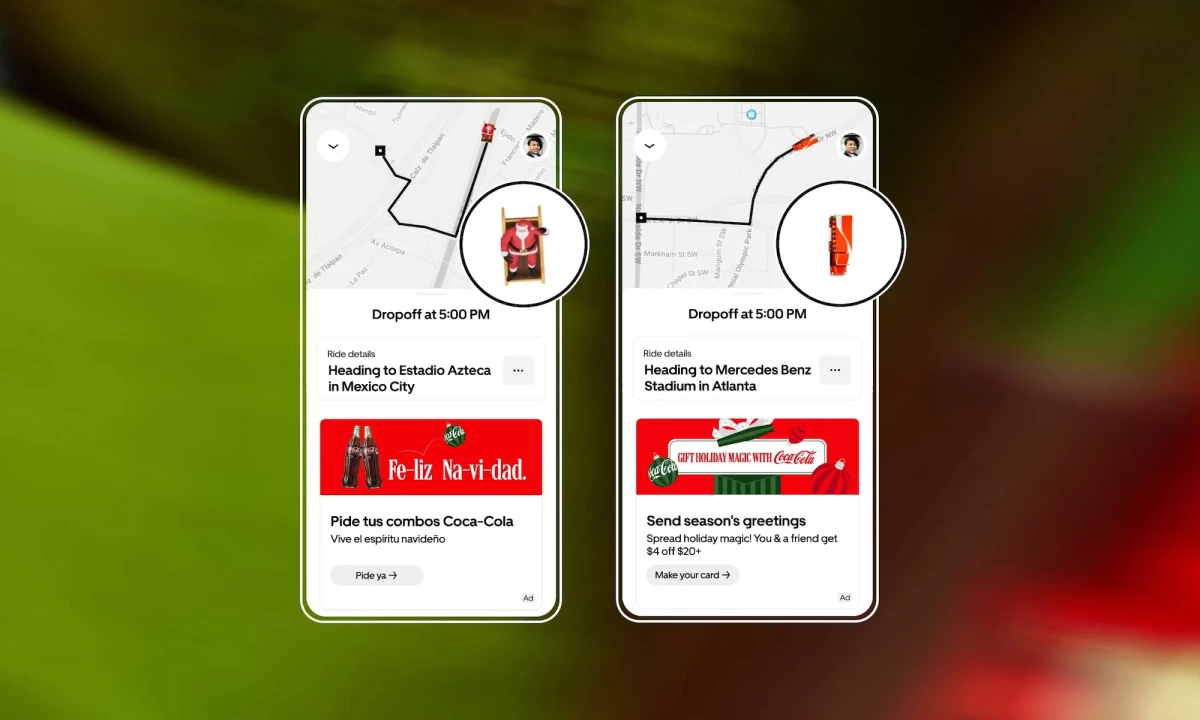
- Customized map interfaces displaying brand imagery across Uber's navigation
- Animated brand icons moving along route paths during transit
- Video units appearing at specific trip stages
The format targets riders based on destination rather than demographics.
The comparison below shows how destination-based targeting changes the duration and quality of attention compared to demographic-based mobile ads.
In practice, this allowed Coca-Cola's holiday campaign to reach riders traveling to restaurants, sporting events, and grocery stores where beverages are available for purchase.
Here, we can see how destination-based targeting creates higher purchase intent than demographic audiences.
When riders are already traveling toward their purchase locations, ads become pre-purchase nudges instead of awareness plays.
The Advantage of In-Moment Attention
Uber Global Head of Uber Advertising Kristi Argyilan explained the advantage of this format in the launch's official announcement:
"People open Uber when they're already headed somewhere that matters.
Journey Ads features an average global view time of over 100 seconds, and the moving icon on the map is one of the most attention-grabbing spaces in the app."
According to Uber, Journey Video Ads also achieved scores 41% higher than mobile video benchmarks in testing with Adelaide and Kantar in October 2025.
The performance differential reflects captive attention during rides compared to social media feeds or web browsing.
The map takeover transforms functional interactions into advertising exposures.
Riders checking progress, ETAs, and driver locations encounter brand imagery integrated directly into navigation interfaces without requiring separate content consumption.
Coca-Cola's execution also varied by market.
U.S. riders saw its Christmas Caravan imagery, and Spanish and Portuguese markets received holiday truck creative.
Australia and New Zealand displayed branded Kombi vans, while Mexican riders encountered Santa's sleigh navigating their routes.
This shows how premium in-app formats require localized creative at scale.
Coca-Cola's seven regional variations proved destination targeting alone doesn't work without cultural adaptationmatching local expectations.
Scarcity Sets the Premium Layer
Uber structures Journey Takeover as limited campaigns restricted by market and time period, differentiating it from standard Journey Ads inventory available through programmatic buying.
The format requires direct partnerships through Uber Advertising's Creative Studio rather than automated buying processes.
This positions Journey Takeovers as a premium tier above standard inventory, which has delivered average click-through rates exceeding 3% since launching in late 2022.
The Creative Studio model provides quality control over brand integration with Uber's core product experience while generating custom assets tailored to specific markets.
Journey Takeovers operates separately from Journey Ads, which opened to programmatic buying in June 2024 through Google's Display & Video 360, The Trade Desk, and Yahoo DSP.
Three patterns from Uber's Journey Takeovers reveal how destination targeting reshapes in-app advertising:
- Context sharpens intent. Combine location signals with time-based cues to reach audiences when purpose and readiness align.
- Premium formats favor dense usage environments. Launch high-touch executions where audience concentration supports deeper integration.
- Localization requires its own planning track. Treat cultural adaptation as a distinct investment with separate timelines and resources.
When ads are rare and premium, they grab attention in ways that always-on campaigns simply can't.
Our Take: Can Destination Ads Scale Beyond CPG Brands?
I think Journey Takeovers is a good match for Coca-Cola, because beverage availability at restaurants, stadiums, and grocery stores creates obvious destination alignment.
With that being said, the format might be harder to justify for categories without physical purchase locations matching Uber's rider destinations.
For instance, B2B software or financial services may face challenges when connecting destination data to purchase intent.
The limited availability model also favors major brands with substantial budgets over performance marketers seeking scaled reach through self-service platforms.
If Uber expands Journey Takeovers and clarifies measurement beyond view time, the format could reset how brands value context over demographics.
In other news, McDonald's UK captured hangover relief in real doorways for a last-minute New Year's Day campaign.
Brands exploring destination-based advertising need agencies that understand location intelligence and contextual targeting strategies.
Take a look at the top programmatic advertising agencies in our directory.