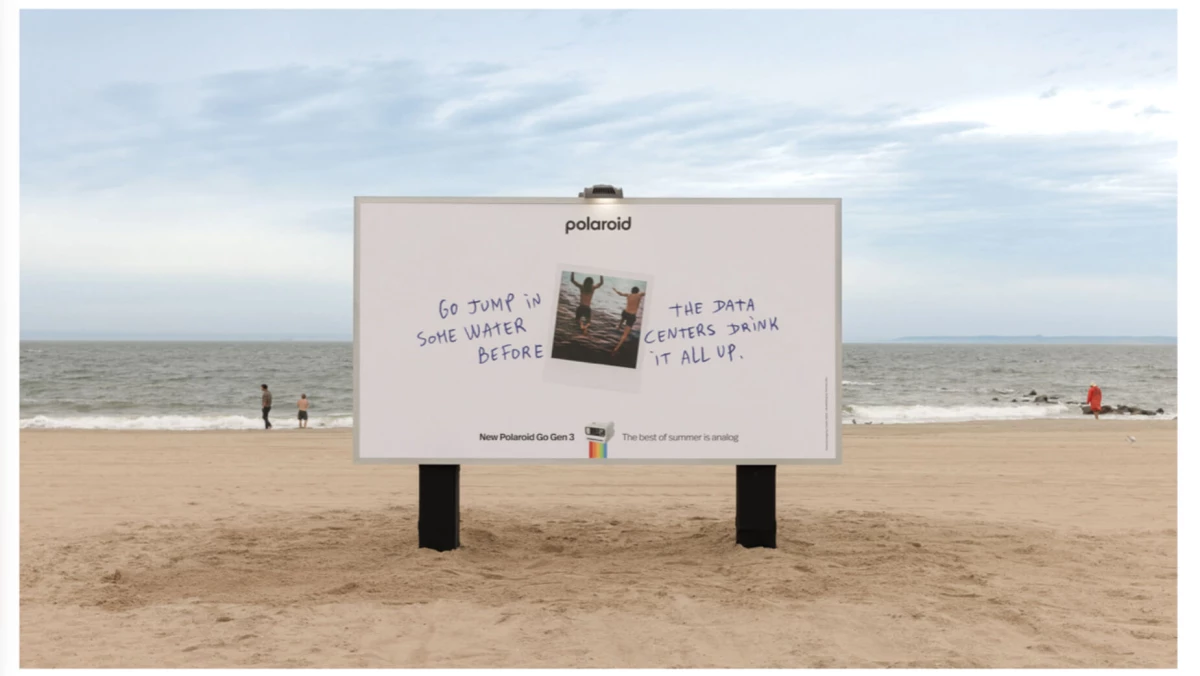

Polaroid is picking a fight with screen culture.
A new global campaign for its Go Generation 3 camera runs billboards that needle our AI habits.
It uses sharp brand messaging aimed at screen dependence and the environmental demands of modern tech.
The campaign debuted with a giant billboard on New York's Coney Island beach carrying the line:
"Go jump in some water before the data centres drink it all up."
View this post on Instagram
The work is part of a wider outdoor rollout that takes over high-profile spots across New York, South Korea, and London.
Other executions include messages such as "What a glorious day to stare into various screens for hours on end" and "Less getting tracked, more getting lost."
Polaroid treats the launch as a larger question of relevance in a society that continues to be influenced by AI tools and connected devices.
Polaroid Creative Director Patricia Varella explains the thought process behind the work:
"When we stopped asking, 'How do you make instant cameras appealing to Gen Z?', and started asking, 'Why should Polaroid exist at all in an AI era?', we knew we were on to something."
View this post on Instagram
Committing to these OOH efforts also allowed Polaroid to build brand awareness and have its product category spark important social conversations.
"For Polaroid, the simple act of existing is already an act of rebellion," Varella added.
While most of the brand's campaigns challenge its relationship with technology, the creative director emphasizes that Polaroid is not "anti-digital."
The brand knows it's something people must live alongside, which is why it needs to continue its "deeply human" position.
Creator Partnerships Keep the Campaign Moving
Apart from outdoor ads, Polaroid partnered with 12 creators around the world, asking them to temporarily disconnect and document their experiences.
They were tasked with doing so through handwritten notes instead of digital content streams.
View this post on Instagram
The brand also distributed sensory seeding kits that unfold into miniature summer gardens complete with birdsong, scent, and wildflowers.
The activation is made to give participants a physical experience that contrasts with screen-based consumption, aligning closely with the launch of the Go Generation 3.
The campaign establishes the camera as a tool for capturing memories without the distractions associated with smartphones and social media.
And instead of attacking technology outright, the brand just wants to prove that analog can give you something of value and is equally worth your time.
A Purpose-Led Positioning
As AI becomes a bigger part of daily life, brands face growing pressure to explain why their products matter outside of how they function.
Polaroid addresses this challenge by linking its camera category to concerns about digital fatigue, privacy, and environmental impact.
Analog experiences become more valuable when consumers feel overwhelmed by constant connectivity.
We can learn three lessons from Polaroid's OOH push:
- Own a larger conversation: Products become more memorable when linked to ongoing societal discussions that audiences deeply care about.
- Give audiences something to feel: Polaroid's sensory garden kits made a campaign message a hands-on experience that people could physically interact with.
- Don't stop with one idea: The brand went above and beyond OOH ads and had handwritten creator notes push the campaign's offline message.
"Why should Polaroid exist at all in an AI era?" may have started as an internal question, but it ultimately became the foundation of the campaign's marketing strategy.
Our Take: Is Going Offline Becoming a Premium Experience?
Polaroid is smart to avoid turning this into an anti-technology campaign, because this would have probably alienated many consumers.
Instead, the brand wants consumers to treat analog photography as a complement to digital life and not a replacement for it.
View this post on Instagram
We think the real strength lies in how the campaign reconnects the product to a human benefit people are growing to value: being present.
AI-generated content is on a bit of a boom, which is why brands building around physical experiences may find new opportunities to stand apart.
Polaroid is staying on top of this challenge by delivering a campaign that encourages you to live outside your screens.
On the other side of the spectrum, EE recently launched a campaign showing how faster connectivity can help consumers gain small advantages every day.
Want to spark joy among your audience?
Check out the top experiential marketing agencies that design campaigns to do just this.