
Times Square's giant hot dog was missing something, and Heinz noticed before most people even realized.
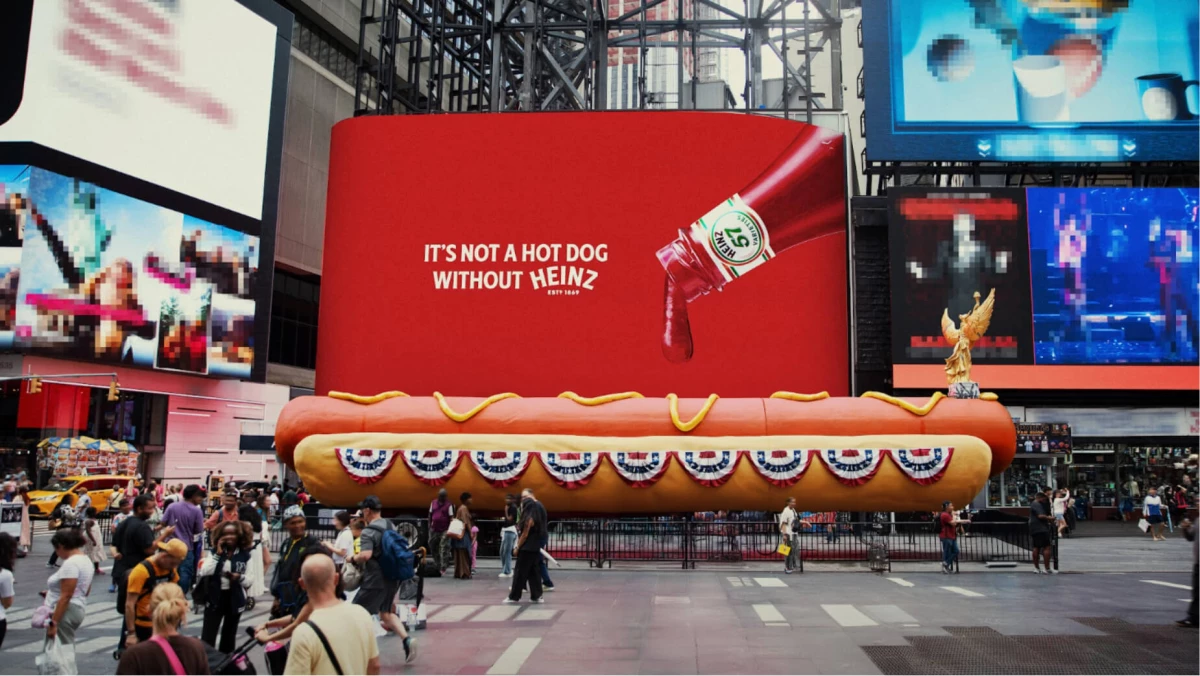
"Hot Dog: The Second Serving," the 65-foot sculpture by artists Jen Catron and Paul Outlaw, returned to Duffy Square this summer with mustard running down its sides.
The artists reworked the piece for the country's 250th birthday, adding red, white, and blue bunting and a gold Lady Liberty figure duct-taped to the end that lifts.
However, ketchup was nowhere in sight.
Ketchup on a hot dog is the kind of thing people argue about in public, so the gap was hard to miss once someone pointed it out.
And Heinz made sure someone did.
Working with agency Rethink and the artists themselves, the brand placed an ad just above the sculpture to look like a stream of ketchup pouring down onto the frank below.
The optical trick required no changes to the artwork itself, just a well-aimed sign timed to the sculpture's run through the heart of Manhattan.
"We've spent years championing HEINZ as food's best friend, especially alongside America's favourite hot dog," said Jamie Mack, associate director, brand communications for Heinz.
"Every iconic hot dog deserves an equally iconic topping, so we're giving it a finishing touch in true HEINZ fashion."
View this post on Instagram
In short, it's a "public service for hot dog lovers everywhere."
The framing does a lot of work. Heinz gets to say it fixed the artwork, and the ad reads as a favor.
Heinz's Obvious Pairing Strategy
The move follows a pattern Heinz has been accustomed to for years.
The brand has staked its claim to hot dogs through the "Hot Dog Pact," an agreement pushing hot dog and bun counts to match.
More recently, it created a new Dipper format: a compartment within the fries box especially made for dunking into ketchup.
While conceptually different, each effort works the same angle.
Hot dogs and fries need Heinz Ketchup, and the brand will keep saying so wherever they show up.
Even if that means creating a billboard in the middle of Manhattan.
The sculpture's return this year came with its own news hook, arriving as part of New York's programming around America's 250th anniversary.
And of course, it comes with daily confetti blasts pulling crowds back to Duffy Square through August 8.
A celebration was already running, so Heinz just needed a sign in the right spot and let the crowd do the rest.
Heinz's Uninvited Guest Approach
Heinz saw a gap in someone else's art installation and filled it with a paid placement that reads as commentary.
This confidence comes from category dominance.
Kraft Heinz holds an estimated 24% of the global market share of the tomato ketchup market.
Given its scale, the brand has the freedom to be playful with its creative and explore content marketing formats that other brands would have to second-guess.
This time, it set its sights on a public art piece and treated it as unfinished business.
View this post on Instagram
It's also worth knowing what Heinz actually bought space above.
Catron and Outlaw built this version as a comment on American excess and political power.
The gold Liberty figure on it matches the one on renderings of President Donald Trump's planned triumphal arch in Washington.
Heinz answered all of it with a condiment joke, and the sculpture never flinched.
Three things gave the placement its punch:
- Pick a target people gather around: The sculpture had two years of press and a fresh news hook in the anniversary programming, so Heinz's placement rode attention that was already there.
- Always point to something true: The missing ketchup was a visible gap in the artwork, which gave the punchline a factual foundation.
- On some occasions, placement matters more than production: A single sign did the job a full campaign shoot usually does. This keeps the cost of entry low compared to a produced spot.
Heinz treated someone else's crowd as free real estate, and it worked because the brand had something true to say about it.
Our Take: What Happens When A Condiment Brand Reviews Public Art?
Heinz bought ad space above a sculpture that was already making fun of American excess.
And the sculpture absorbed it without breaking stride.
Heinz gets the photo, the artists get the foot traffic, and nobody has to agree on what any of it meant.
View this post on Instagram
We think that the placement worked because Catron and Outlaw left the door open.
Their version piles on bunting and a gold Liberty figure and invites people to read whatever they want into it.
And Heinz showed up with a budget and a red bottle.
Brands keep parking themselves next to cultural objects they had no hand in making, and the ones that get away with it have a real claim to the joke.
Heinz owns hot dogs, so it does. The next brand trying this without the same standing is going to find out how thin the ice is.
Want to spark a creative revolution with your ideas?
Discover the top creative agencies making a change in our agency directory.