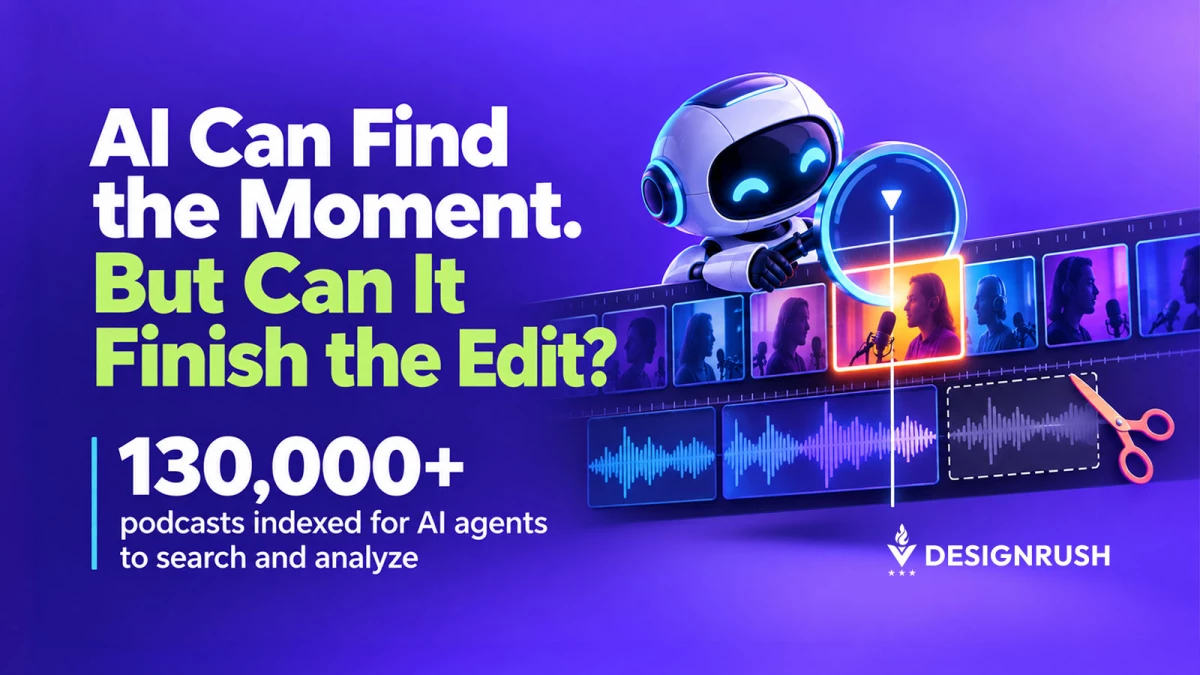

Radar, a podcast search engine, has indexed more than 130,000 podcasts and is adding about 20,000 episodes a day, giving AI agents a growing body of spoken content they can search and analyze, according to reports by TechCrunch.
AI newsreader startup, Particle, launched Radar on Aug. 26 with an API and Model Context Protocol, or MCP, connection that gives businesses and AI agents access to its podcast data.
Hedge funds are its highest-volume API customers, while AI search platforms and data resellers are among its other top-paying customers.
What they are buying is access to podcast data that an AI agent can search through for specific conversations, people, companies, quotes, or moments without listening through the entire episode.
Descript, however, works further down that process, where understanding the recording has to become an actual edit.
Its MCP connection lets people work with Descript through Claude and ChatGPT, giving the agent a way to act on the media rather than only read it.
Daisy Zhang, head of growth marketing at Descript, says the harder part starts once the agent has to change the media itself.
"Understanding content and changing content are fundamentally different tasks," Zhang says.
"While an agent can read a transcript and identify a topic or moment relatively easily, editing, on the other hand, means turning that understanding into decisions about the actual media.
"This includes what to remove, what to preserve, where a clip should begin and end, and when a creative decision should stay with the person."
Why Podcast Search Is Ahead of AI Editing
Radar transcribes podcasts with speaker labels and metadata around people, companies, products, brands, and topics. It can track mentions over time, send alerts, and pull clips with timestamps.
"The interesting part of MCP is moving from understanding the content to actually helping transform it," Zhang adds.
"Once the agent starts making changes, it has to work with the structure of the recording and with choices that affect the finished piece."
For teams repurposing long-form audio, those two parts of the workflow are developing at different speeds.
Finding a useful moment is increasingly automatable, while turning it into something ready to publish still involves more decisions.
How Descript Connects Claude and ChatGPT to Editing
Descript’s MCP server can connect with Claude, ChatGPT, and other MCP clients, so a user can describe an edit in natural language and have the assistant work with an existing Descript project.
Those tools are already familiar to content teams, with Ahrefs finding that 83.2% of marketers use Claude for content creation, 75.7% use ChatGPT, and 57.9% use Gemini.

"Someone can be in Claude or ChatGPT and simply ask it to edit a video in Descript," Zhang explains.
"They don’t necessarily have to start by opening an editing interface and performing every action themselves."
That means that the conversation itself can increasingly become the interface.
Through the connector, an agent can find projects, import media, trim transcript sections, remove filler words, create highlight reels, add captions, apply Studio Sound, and publish a shareable link.
More machine-readable audio also gives those editing workflows more material to work with.
"A long conversation can become input for clips, summaries, social content, edited videos, and other outputs," Zhang says.
"That is particularly useful for podcasts because one recording often needs to become several different pieces of content."
What Content Teams Should Automate First
Some editing decisions are still difficult to hand over.
Zhang points to storytelling, tone, comedic timing, sensitive edits, and decisions about what a creator or brand actually wants to say.
Here, agents can help carry out parts of the work, but those choices still depend heavily on human judgment.
For teams starting with agent-driven repurposing, she recommends choosing one repetitive job where the result is easy to judge.
"Pick something where you know what a good result looks like, then measure how much time it actually saves once review and correction are included," Zhang says.
"If that workflow holds up, expand from there."
As more of the discovery work becomes easier to automate, the harder part is deciding where human judgment still needs to stay in the process.
For those working in the industry, it may be time to ask how much of the process can be handed over before the creative decisions become the part that matters most.